You know how if you ever let anyone see how you do sit-ups or push-ups or planks or whatever, the first thing they say, invariably, is "you're doing that all wrong!"? And then you change your technique but still the next person says "no, that's not how you do it." So you should never let anyone other than your coach, if you have one, see you exercise.
Similarly, it is probably a bad idea to let anyone other than your teacher see how you practice guitar. And now I'm going to demonstrate why. Here is a clip of Alexandra Whittingham practicing:
And I'm going to say "Alexandra, you're doing it all wrong!" Now Ms Whittingham is undoubtedly a more accomplished guitarist than I am--after all I retired from the concert stage a long time ago, and she is a fine musician and technician who has won major international competitions. But still, this is a very bad way to approach a new piece. As Itzhak Perlman said in a video once, if you practice the wrong way, it takes twice as many hours to undo it. This is true. Exactly how you approach a new piece is really important. Hacking away at it like this is obviously not a good approach. There is no point in doing this arpeggio before you even learn the notes of the chords.
I am reminded of that axiom from Biology 11: "ontogeny recapitulates phylogeny." In this context, it is the idea that in some ways for some pieces, they are built up a bit like how music developed historically. Without wandering off into the weeds, what I mean is that for a lot of pieces, like this one, instead of just hacking away at it, trying to sight-read it as it lies on the paper, a better approach is to reduce the texture to just the harmonies--play it as simple chords. Then you can more easily play just the right notes and connect them to what comes before and after. I learned this from Oscar Ghiglia.
Once you have all the harmonies clear, you can add in rhythm and then melody. She feels like she doesn't have time to do this, but honestly, you don't have the time to screw it up! What she is learning here is all the wrong stuff: how to misread the notes, go back and forth, and constantly interrupt the flow.
I don't mean to pick on Ms Whittingham, as I said she is an excellent guitarist and we have all been in situations where we are pressed for time and hack away at a new piece. But still... If I were a pianist I would probably have picked one of the clips of Tiffany Poon:
(But she is better at it. Guitarists are notoriously bad sight-readers.)
For different pieces there are different approaches. For a fugue or anything contrapuntal, obviously you want to read the voices individually. For many pieces you want to learn the melody first. Learn what to leave out: ornaments, fioratura, tricky rhythms. Learn the bones first, then put on the flesh and last of all the clothes and makeup.
Tiffany Poon, by the way, is no great shakes as a sight-reader. Experienced pianists (and violinists, etc.) can play pretty much anything at sight. First time. That is how all movie soundtracks are recorded. They are done in one two and half hour session. What you hear was most likely played once! That's what those guys get paid for. And yes that includes guitarists who do studio work. I once worked with a very gifted singer who could sight-read early music from the original notation. I kid you not.
I've spent a lot of time both practicing technique on the guitar and thinking about it. The reason for this is that I have had to wrestle with technique my whole life as a guitarist. This started when I was sixteen and my mother came home with a rented bass guitar from the music store. I actually wanted to learn drums, but as my mother explained, drums cost $12 a month to rent, but a bass guitar was only $8 and we simply couldn't afford the extra cost. This was 1966 and money was scarce. As my mother explained "they're both in the rhythm section!"
There was some real benefit in starting on bass guitar: that is pretty much going to guarantee a strong left hand. But the real problem was that I was fifteen years old and, in terms of mastering the classical guitar, I was about eight years too late. Yep, if you don't start young it is an uphill battle. But at this point, I just wanted to play in a band and that was pretty easy. In a few weeks I was rehearsing with my first band and we played our first gig a few months later. I don't recall what songs we played, but I do remember that we cleared a modest $6.70 (Canadian) each.
I didn't actually start to transition to a classical guitarist for a few years. I wasn't even aware of classical music until my late teens and never heard a classical guitar until I was nineteen or so. Then, of course, there was a distinct lack of teachers. I have told the story a few times of going to Spain in 1974 to study with José Tomás, one of the great maestros of the instrument. I went from being a hack guitarist to being quite good in the course of one year as I discovered when I auditioned to enter the McGill School of Music a few months after returning from Spain. Tomás was a great teacher, but like many great guitarists (musicians in general), not very articulate. I don't remember too many things he said about technique, but I do remember him demonstrating many things on his guitar.
He was a calm and relaxed player, but I didn't fully appreciate the benefits of this until years later. As I struggled to become a better guitarist I strained and wrestled with myself, sometimes losing my temper in frustration at not being able to do what I wanted to. Well into my career I saw a really relaxed player, Alvaro Pierri, student of Abel Carlevaro, the great Uruguayan pedagogue. The first time I heard him play I wasn't impressed. What he did seemed too low calorie, not very heroic. He played without much effort. Later I realized that this was his great strength: he played with little effort!
How many players are like this? Not many, to be honest. Abel Carlevaro himself, of course, whom I saw in concert in Toronto many years ago. It was really technically perfect and without struggle and strain. We might contrast this with Julian Bream, a very great guitarist and great musician who nonetheless, plays with great strain--his concerts were like an heroic struggle with the guitar. For even more extreme examples we could look at Eliot Fisk, who plays the guitar as if he hates it and wants to beat it to death. Sharon Isbin is almost as bad.
There is another category of guitarist: those who achieve technical perfection but at perhaps too great a cost. Both John Williams and Manuel Barrueco tend, in my view, to be robotic. Clean, even, precise playing but with perhaps a bit less warmth and charm than the music deserves. I'm sure I will get a great deal of pushback on that!
Now let me get to my title: I have mentioned before the benefit of practicing with "soft" hands. Shaping everything for a perfect result, but without straining and struggling. I employ this more and more in my practice. Another element is to practice slowly. You don't have to go to extremes: one hears of famous guitarists practicing the Aranjuez before a performance at one-quarter tempo with a metronome. But you do have to practice at a super comfortable speed so that everything is easy and pleasant and comfortable.
These are things that are so obvious to great musicians that they never even mention them. I recall a clip of Isaac Stern talking about practicing: he said that it can take two hours of good practice, to make up for an hour of bad practice. What is bad practice? More and more it is obvious to me that it is practicing with strain, tension, awkwardness. Instead you have to practice with ease and grace. I sometimes find myself still trying to remove an awkwardness in a passage months later because I failed to make it smooth and comfortable when I first learned it.
The Italian concept of sprezzatura comes in here: this is the art of making something look easy. Well, it is not just that. You make something look easy by actually making it easy. Everything can be easy if approached in the right way--mind you, it might take a long time!
I'm tagging this "guitar technique" because I don't have a "music and health" tag. Yesterday I was diagnosed with tendonitis. I have played guitar for over fifty years and never had a problem, but now I do. The irony is that for quite a few years now I have been the guy professional guitarists come to when they have a problem with tension, technique or tendonitis. I have been fairly successful in helping with these kinds of problems. I even wrote a book on guitar technique. So how did I come down with tendonitis at my advanced age, especially since I retired from my performing career a long time ago? I only ever had one student with a tendonitis problem in many years of teaching.
Here is the context: last fall, for the first time in several years, I gave a mini-concert for a private audience. I played a short program of music from Milan to Rodrigo. Preparing for the program I dropped a piece by Moreno Torroba because I found that my bar chord technique was not up to it. I do daily technique just to keep a minimal amount of technique, but my index finger was not strong enough for some bar chords. So I did three things: I replaced the Torroba with a piece by Rodrigo that did not have awkward bar chords, I switched from hard tension to medium tension strings and I instituted a set of bar chord exercises that I practiced every morning. After a few months I had restored my bar chord technique. But I noticed that I had developed some tenderness in my elbow, so I stopped those exercises hoping the tenderness would go away. A couple of weeks later I was making a pan sauce in a heavy cast-iron pan and holding the pan at a steep angle to pour out the sauce when suddenly I got a very sharp pain in my elbow--it almost felt as if something had given way. Agh! Now I have a serious case of tendonitis which is an inflammation of a tendon.
I emailed my doctor and she sent an ultrasound technician to my house to take pictures of my elbow. A couple of days later I visited her in her office where she prescribed an anti-inflammatory, a cream, and a muscle relaxant. While in her office she had an orthopedic surgeon pop in just to have a look at my elbow and confirm the diagnosis. Also, Monday, a physiotherapist is going to come by my house and show me an exercise for my arm. No permanent damage and I should be back to normal in a few weeks.
If this range of services sounds weird or implausible, especially the home visits, I should tell you that this is private medicine in Mexico which is actually very reasonable. My doctor heads up a team that offers emergency and radiological services, home services, x-rays, ultrasound, nursing care, laboratory studies and so on. They even have their own ambulance. The orthopedic surgeon who dropped by is a member of the team.
Anyway, I will keep you posted on my recovery! Here is the piece by Rodrigo I swapped in:
I had the opportunity to participate in two master-classes with Pepe Romero in my younger years. One was a brief one in Canada and the other a month-long session in Salzburg at the Mozarteum. What set Pepe's approach apart from other classes was the focus on technique. Each class began by playing some basic technical exercises together and the result was that by the end of the class everyone had acquired more technical confidence. This was valuable because most guitarists are still a bit weak, technically, compared to violinists and pianists.
I picked up these two exercises from the master-class and I still use them as a warm-up to this day. The first one is a scale exercise. Most guitarists use the Segovia scales which are certainly useful, but this approach is a bit different. Instead of diatonic major or minor scales, the exercise uses chromatic scales. Very simply it goes from the lowest to the highest note so it also keeps your extension to the highest frets in shape. I'm not going to write out the whole gamut as it is obvious how it is to be fingered. Once you get to the first string, just keep the pattern, shifting up. Once your first finger shifts to the fingerboard past the body, the problem is where do you put your thumb. You have to practice very slowly sliding your thumb from behind the neck to resting along the edge of the fingerboard. With practice this will become quite easy. The right hand fingering is simply to work all the possibilities. These days I am using pm, im, ia and ma.
Click to enlarge
The other exercise is for the right hand. This is a rasgueado exercise which classical guitarists normally don't do but it is perfect for both warming up and strengthening the weak side of the hand. On the open strings use this pattern: c ("chico" standing for the little finger), a, m, i (all downstrokes) and i coming back as an upstroke. The trick is to stack the fingers so, for example, the c is stacked behind the a, the a behind the m, the m behind the i and the i held with the thumb. This is so you can put pressure on each finger in turn, releasing it with a sudden burst of energy. As the greatest accent is on the c, this allows you to strengthen the weak side of the hand. You can rest the thumb on the sixth string for stability. Try to make the five-stroke pattern as even as possible.
And for listening, a little piece by Turina, the Fantasia Sevillana which uses a lot of rasgueado:
I realize that my post the other day was too short to really address this. The basic principle relates to the idea of balancing two different elements, in this case energy and control. A lot of the technical problems guitarists have stem from inadequate control of what the fingers are doing. If you don't have good control, then you can't build a solid technical foundation. One of the things that always impressed me about John Williams was that once he learned a piece, he was pretty much rock-solid every time he played it. This shows how great his control was.
So how do you get this kind of controlled technique? Well, you do have to start young, past a certain age it is doubtful that you can achieve a really great technique. But the daily issue is that you have to balance your energy and your ability to control this energy. The problem students typically have is that they have enthusiasm and energy, but lack control so when they practice they are, essentially, practicing sloppiness.
The solution is to reduce the energy to an amount that you can control. Then, as your control develops, you can increase the amount of energy, being careful not to put in more than you can easily control. This is pretty much the secret of good practicing. Well-controlled movements repeated until they become automatic. Every time you allow an uncontrolled movement, it sets you back and you will have to practice to remove that muscle memory.
A violinist once told me that he couldn't teach a concerto he was about to perform because he might recall the mistake a student made!
So this was why I talked about "soft" practicing: the idea is to soften the movements and energy in your hands down to levels that you can easily control. Most guitarists probably know this instinctively, but it doesn't hurt to be consciously aware of the principle.
I'm not sure where I got this idea from--I have the vague recollection that Oscar Ghiglia might have said something similar in a master class--but it is a very useful concept. When you are learning new music or re-learning old music you should make use of "soft" practicing. I mean by this a particular approach to how you use your hands, especially the left hand. You should practice slowly, of course, but you should also practice with soft hands. That is, without any tension in the hand to speak of. Approach the notes not only very deliberately, but also very softly, focussing on touch and feeling. Don't slap your fingers down quickly and inaccurately, do the opposite, place them gently and carefully. If you do this many times, then you will have the passage programmed accurately into your muscle memory. The more speed, inaccuracy and tension, the harder this is to do. Don't play loud! Play quietly as well.
Perhaps the greatest failing of guitar students is that they practice too quickly and are very sloppy. The more you do this, the more you inculcate bad habits that will be hard to eradicate later on. I think it was in an interview that Isaac Stern said it is all in how you practice: it might take two hours of careful practice to make up for one hour of bad practice. This kind of practicing does take a lot of focus and concentration and when you feel your concentration going, you should take a break. But I am quite sure that soft practicing will improve your playing!
I played a concert at The Banff Centre once and Oscar Ghiglia, who was holding a master class there that summer that I attended, was in the audience. I had already played for him a few times, but I guess something about my approach puzzled him. He came up to me afterwards and said, "you used to play folk guitar, didn't you?" I had to confess that I had started on bass guitar and steel string, both acoustic and electric. I don't know what he heard that tipped him off, but I didn't play much folk, mostly blues and rock.
In any case, I am learning a pair of gavottes by Bach that I haven't played before and I notice something about the fingering that might be interesting. The editor, much of whose fingering I changed right off the bat, must have been a rhythm guitarist at one point. This might seem an odd claim to make about a classical guitarist, but in North America especially, most of us who end up as classical guitarists actually started out as some variety of pop guitarist playing steel string and electric guitars. Among pop guitarists (meaning just "non-classical") there are two basic kinds of guitarists. Let's call them JL guitarists (after John Lennon) and EC guitarists (after Eric Clapton). John Lennon was a solid, even outstanding, rhythm guitarist; Eric Clapton a really great lead guitarist. In most bands from the "guitar era" there was one of each in each group. Keith Richards, rhythm, Brian Jones, lead; John Lennon, rhythm, George Harrison, lead and so on. In Cream, of course, all three of the players were so busy there was hardly room for a rhythm guitarist--Jack Bruce did some rhythm guitar on the bass when he wasn't doing "lead" bass!
In the classical world, of course, all concert artists are pretty much "lead" guitarists but sometimes a guitar editor might reveal his roots. And so it was with my edition of the Bach. Let me show you what I mean. Here is the first phrase of the gavotte in his fingering:
Click to enlarge
The first half of the phrase is all bar chords with no open strings. Here is my fingering:
Click to enlarge
That inner voice C is on the third string. I have two things I am aiming for: first of all, to try and connect voices by putting consecutive notes on the same string when possible and connecting by moving a finger along a string. The first two notes of the melody, for example, are on the first string, the next two on the second string, there is one note on the first string open, and then it returns to the second string. The falling fourths are usually going to be on two adjacent strings. The other thing I do is avoid bar chords whenever possible. This is for two reasons: first, they immobilize the left hand and, especially when prolonged, create fatigue. Second, they tend to turn melodies into arpeggiated harmonies. Take the first few beats, for example. I want the E A F G E F to sound melodic, not harmonic. I also want to do the rests as they let air into the line.
If you sit down and play through the two fingerings this will all be clear!
The two kinds of guitarists, rhythm guitarists and lead guitarists, we can see as guitarists who focus on the harmony and ones who focus on the melody. Of course a good classical guitarist is focussing on both, plus rhythm, phrasing, counterpoint and so on.
There are a lot of editions out there by "rhythm" guitarists. One thing I notice is that they are rarely concert artists. As soon as I saw this edition I went to my shelves to find the edition by Oscar Ghiglia, but sadly, that was one score I lost years ago. Ghiglia has an excellent fingering, of course. This gavotte is from the 3rd lute suite published by Suvini Zerboni. Other editors with good fingerings are Leo Brouwer, Andrés Segovia and José Tomas--all also concert artists.
Let's have some music! I had to go through five or six guitarists before I found one who does, pretty much, my fingering. This is Jason Vieaux with both gavottes:
And just for fun, this is the only clip that I know of where we can see John Lennon and Eric Clapton playing together. Bonus: Keith Richards is playing bass. The song starts around the 1:05 mark:
Wikipedia gives a pretty decent introduction to the musical technique of vibrato:
Vibrato (Italian, from past participle of "vibrare", to vibrate) is a musical effect consisting of a regular, pulsating change of pitch. It is used to add expression to vocal and instrumental music. Vibrato is typically characterised in terms of two factors: the amount of pitch variation ("extent of vibrato") and the speed with which the pitch is varied ("rate of vibrato").
In singing it can occur spontaneously through variations in the larynx. The vibrato of a string instrument and wind instrument is an imitation of that vocal function.
I could quibble with some of that, of course. Vibrato does not have to be and often isn't all that "regular." One frequently changes the pace of vibrato for musical effect. Vibrato is used more in some genres than others. My mother, for example, an old-time Canadian fiddler, never used vibrato and in fact, did not know how to do vibrato, or at least claimed not to. Classical violinists typically use vibrato in varying amounts depending on the era and style of the piece in question, less in Baroque music, more in Romantic music--but there are lots of ongoing controversies about it.
I want to talk about vibrato on the guitar as that is the instrument I am most familiar with. Correct me if I am wrong, bowed instrument players, but I believe that vibrato on the violin and similar instruments is produced by rolling back and forth on the ball of the finger stopping the note on the fingerboard? As there are no frets, this produces a fluctuation in the pitch, both above and below the "correct" pitch. What do gamba players do, I wonder, or do they just avoid vibrato?
In any case, rolling around on the ball of your fingertip does not do much on fretted instruments as the location of the fret fixes the pitch of the note. So what do guitarists do? It varies according to the type of guitar and genre. Here, for example, is an excellent discussion of how blues guitarists create vibrato:
You get the essence of it in the first minute from the great authority, B. B. King! I played electric blues guitar for several years when I was young, but for the life of me I can't actually recall how I did vibrato. Bending notes, sure, but vibrato? As B. B. hints at in the clip, his method only really produces a vibrato between the pitch and slightly above the pitch. It is a kind of heightened expression that, "shimmers." Another famous practitioner is Eric Clapton and he talks about it in an interview somewhere.
Bending notes is quite different on the classical guitar as opposed to the steel string one. You have to work a lot harder bending notes on nylon strings and it is never as effective. As the blues vibrato is basically a kind of note-bending, pushing the string to one side, it is not a good technique on classical guitar. So what do we do instead? On steel string guitars, you bend notes and do vibrato by increasing the string tension by pushing the string to one side. You are basically raising the pitch by increasing the tension. On classical guitar, you do it slightly differently. You also increase the tension but by pulling on the string laterally instead of pushing it to one side. Imagine you are stopping a note on, say, the fifth or seventh fret. If you move your arm away from your body while keeping the pressure on the string you will raise the tension and hence the pitch. If you move your arm toward your body you will be lowering the tension of the vibrating part of the string and therefore lowering the pitch. It is a kind of a see-saw: as you push or pull the string, the tension raises on one side and lowers on the other. This gives you a vibrato on both sides of the "correct" pitch, as with the violin.
The hitch is that this only works if you have sufficient string length on either side. Once you get down to the end of the fingerboard close to the tuners, it won't work because you have almost no string length on the non-vibrating part of the string. So what do you do there? Essentially a variant of what B. B. is showing in the clip: you let your thumb loose and pull the string to one side with a wiggling motion of the finger. It works well enough, but not as satisfactory as the vibrato higher on the fingerboard. For that kind, the closer you are to the middle of the string, the easier it is.
When I was a young student in Spain, studying with José Tomás, I remember hearing another student say that Tomás taught that there were five kinds of vibrato. We never got into that in any of my lessons and it never came up in the master class so I don't know what the "five kinds" actually were. I could speculate a bit...
In a lute treatise somewhere the author mentions an odd and very subtle kind of vibrato that is actually not a vibrato at all, but a kind of tremolo (a quickly repeated note). While holding a note with the index finger of the left hand, you could, very gently, tap several times on the vibrating string close to the end being stopped. If done lightly and carefully enough it will result in a kind of fluttering note. This is used for expressive effect in 17th century lute music.
Ok, that, with the two before, gives us three kinds of vibrato. What do you do if you have an open string and want to do vibrato? I suppose that an electric guitarist might use the whammy bar, push on the neck, or just fiddle with the string after the nut, but those are not going to work on a classical guitar. What you can do is shake the whole guitar. While not hugely effective, it will do something.
Last but not least, if all else fails, you just shake your head!
Q. E. D. Five kinds of vibrato.
The Prelude No. 1 by Villa-Lobos is particularly well suited to the use of vibrato because of the way the melody is distributed over the strings. Here is a performance by John Williams (sorry about the sound quality, but the vibrato is pretty evident):
Here is Andrés Segovia with a more variable vibrato:
I have long advocated slow practicing to my students (and nowadays, to myself!) but what that means exactly needs to be spelled out in some detail, I suspect.
The virtues of slow practicing are widely known and widely practiced. I have been told by people who were there that guitarists like John Williams can be heard before a concert playing through certain repertoire at very slow speeds, perhaps half of the actual tempo. I have been told by orchestral players that they have heard Pepe Romero practicing the Concierto de Aranjuez at one-quarter tempo before a concert. If you have never done this you will be astonished at how much sheer concentration it takes and how much energy.
But just playing the piece at a fraction of the normal tempo is only part of the story. You need to ask yourself why this is a useful technique. The reason you are practicing very slowly is to observe exactly what is going on in both hands. Is there some fixed tension somewhere that you might need to release? Can you improve the right hand attack so as to remove any harsh sounds due to rushing? Are your fingers moving in the most efficient way possible? Do you feel any strain anywhere and can you reduce or remove it? In other words, it is all in how you practice. Frankly, if you practice slowly in a sloppy inattentive manner, you will actually make things worse instead of better! I think that one of the most important factors in good playing is your alertness to what is physically comfortable. You also need to be sensitive to good tone, rhythmic precision and musical phrasing. In the absence of these abilities, I suspect it doesn't matter how slow you practice.
Here is a piece I recorded years ago and I assure you, there was lots of slow, careful practicing beforehand. This is Las Abejas by Barrios:
I haven't done too many posts on the practical aspects of guitar-playing lately; this might fill the gap. I studied in Spain in the mid-70s just when Leo Brouwer was starting to become known as an outstanding composer for guitar in a modern idiom. Not a lot of players were learning his music yet and his important compositions, like Elogio de la Danza, were just beginning to be published. That piece was written in 1964 and was published by Schott in 1972. I purchased a copy from Union Musical Española in Madrid in 1974 and I still have that copy.
I first learned the piece in 1976 when I was a student at McGill University. I didn't study it when I was a student of José Tomás in Spain because it seemed too avant-garde at the time. All the students in the international group gathered in Alicante under his tutelage were studying the more conventional repertoire, especially pieces that he had either edited, like the Lute Suite No. 1 by Bach, or ones he or Segovia had edited and fingered by composers such as Moreno Torroba, Joaquin Rodrigo, Castelnuovo-Tedesco, Tansman and so on. The most modernist music I recall playing for Tomás was a couple of studies by Stephen Dodgson. So I didn't take up the Elogio until I was an undergraduate at McGill. In fact, I recorded it and the first three movements of the Lute Suite No. 4 by Bach for Radio Canada (CBC) in 1977. Sadly, I don't have a copy of that recording as I would love to hear how I was approaching the piece back then. I had the opportunity on a couple of occasions, once in Montreal and once in Toronto, to play for Brouwer in a master class and I think I played this piece for him in one of them, probably in Montreal.
So that's the background, on to the music. The piece, while largely conventional from a technical point of view, has some interesting musical challenges. What I love about the piece, apart from its cellular sort of structure, is the unique timbres he wrests from the guitar and that starts with the very first harmony:
I have a couple of suggestions before we start. As the printed edition lacks measure numbers I suggest you mark them for reference. Put the measure number at the beginning of each line, counting carefully. All marks on the score, measure numbers, fingerings, etc. should be in pencil only, never pen. You will inevitably want to change them at some point!
For guitarists in the 70s this was a unique and remarkable new kind of sound--remember we had mostly developed our technique with endless scales, slurs and arpeggios and a lot of studies by Sor, Giuliani and Aguado. Our repertoire extended from Bach to Moreno Torroba with just a touch of Rodrigo. This was a whole other world of sound. This is actually pretty tricky to execute. That little grace-note arpeggio has to be handled just right or the notes won't balance. You have to get all four notes to come out evenly with the stress on the high C#. The shape of the chord is unusual so you have to be careful that each string vibrates freely. I use a little different fingering than the one given: piaia instead of pimpa, but you should use whatever gives you the best balance in the chord. You will notice that I have penciled in a different, slower, metronome marking. This comes from the Cuban edition of the music which I had access to at one point. This opening motif is repeated with rhythmic variation and then a new motif is introduced:
This is a written-out accelerando, so the poco accel. is really not necessary. Perhaps he added that to make sure you got the point. I always found the added indication distracting. It makes you tend to lose control in the third little group of notes! So I choose to understand this as meaning that you should not over-emphasize the different subdivisions, but execute the whole gesture smoothly. When you are learning the passage, it is good to be quite strict with the rhythm at first, feel each subdivision. You will notice "f g g flat" penciled in. This is because I think that there is a misprint here. The motif, which appears later on, is always tone, semitone, moving from the first through the second and third strings. F A flat, G is minor third, semitone and does not fit. The whole piece uses symmetrical patterns moving across strings, so I am pretty sure this is a misprint. Play F G G flat instead. One other thing, don't let the low B flat ring, but cut it off as soon as you play the A.
The next new idea, along with a tempo change not indicated in the Schott edition comes in mm 7:
Click to enlarge
The previous section ends with those open Bs, first as harmonics and then the open string. This echoes the open low Es of the beginning and transitions us into the next section. There is no tempo change in the Schott edition, but the Cuban edition says piu mosso with the dotted quarter at 84. This is correct, of course. For Brouwer things like dynamics and timbre are structural so you need to make sudden, crisp contrasts between the f sub and the p stacc. That means "suddenly forte," that is, without any foreshadowing, and he also asks for metálico, meaning with a very bright sound achieved by plucking near the bridge, and then suddenly piano and staccato. The kind of staccato used here is what I call "thumb staccato" which you execute by using the flesh of your thumb to damp the sound as soon as you pluck. This is contrasted with the accented notes played forte which are played just with the nail, quite forcefully.
The sextuplet is a bit tricky so it and all the fast passages need to be practiced many times very slowly and very evenly. If you click on the example you should be able to read my penciled in fingerings. The second time you play the sextuplet, the printed fingering asks you to suddenly shift to third position for the last C in the group. Don't do it! It is needlessly difficult. Instead shift to third position after the F# on the next line. That gives you lots of time to make the shift instead of while you are playing that tricky sextuplet. Next the rubato sextuplet from before is played twice, the second time sul tasto, which means you pluck over the fingerboard to get a very dark sound. Remember, these timbral contrasts are structural, so make them very stark.
The next motif recalls the rhythm of measure 4 with a syncopated figure followed by a triplet. This time, however, it is with a tone cluster:
The notation is just a tad deceptive. This kind of motif Brouwer always wants to ring: laissez vibrar. That little breath mark ordinarily means you would cut the sound, but not in his music. He generally likes chords to ring as long as possible. This motif is then repeated with the stopped notes a semitone higher, heightening the tension and preparing for the next section, the Allegro moderato. Let's stop here and continue with that section in a future post.
For an envoi, let's listen to a performance of the piece. This is Mabel Millán playing in a competition in Bilbao:
There are a few problems with the performance. She simply plays the notes of the grace-note arpeggio across the strings instead of the order as written. She plays the accelerating motif with the printed notes, which I am pretty sure are a misprint. She ignores the staccato and tenuto marks on the repeated G notes in mm 7. Her sextuplet is a bit sloppy, but she uses the fingering I suggest for the shift to third position. Anyway, enough nit-picking!
I used to have a fairly thick book that contained all the most difficult technical challenges in the guitar repertoire: all the hardest stuff from concertos and solo pieces. I had a lot of that in my repertoire: the Etudes 1, 2, 7 and 10 by Villa-Lobos, passages from his Concerto, passages from concertos by Rodrigo and Castelnuovo-Tedesco, the really hard bits from Bach lute suites, etc.
Now I am finding my Prelude 1006a, the E major Lute Suite, is just not happening! Mostly I do maintenance technique, which is enough to play the usual Spanish pieces and moderate Bach. But this prelude is nearly seven pages of unrelenting sixteenth notes. When it moves into the keys of F# minor and C# minor, the fingering gets really nasty. For those of you counting at home, there are over 1600 notes! I've been playing it so long that I don't have memory issues, but to play it well takes a level of precision and control that I don't seem to have in my fingers right now. So, I have to dig deep and move to a higher level of work.
In a way, it's like restoring a classic car. I had a friend in Vancouver who had a classic E-type Jaguar he bought new in 1966:
He was a bit of a car collector. He also had a 1960 BMW 3.0 and a Morgan. All white. He thought cars had to be white. In any case, when I knew him, he had had the Jaguar for quite a while and it really needed restoration. So he took it to this specialist in restoring classic cars. It took about two years! They take the car completely apart, down to the last nut and bolt, and restore each part to its original perfection. Then they reassemble the car. It is better than when it came off the factory floor. It took about two years and cost several times what the car itself originally cost! I would say it was worth it, though. Lovely cars, those.
I had to do the same with my guitar. After 20 years of hard concertizing, everything needed restoring. The fellow I took it to did a great job. Five cracks in the back, repaired; all the frets replaced; the tuning pegs replaced, all the varnish stripped and redone. It came back like a new guitar.
But now I have to do something similar with my Bach prelude. I started this morning where you should start: at the end. The last page is one of the hardest so that is a good place to start. You take each measure by itself and play it very, very, very slowly, making fine adjustments and keep playing it until the difficulties evaporate. That's really all there is to it. But it is amazing how few people practice like this. It is pretty hard mental work, but that is what leads to a smooth and elegant performance.
I recorded the prelude and two other movements from the Lute Suite No. 4 many years ago for CBC Montreal, but that tape long ago disappeared. So we will have to hear someone else's recording. This is the Swedish guitarist Göran Söllscher playing the Prelude and the Loure on an 11-string guitar. I like the tempo, but not the sound very much.
I never google myself as it seems, well, narcissistic. But I just switched my default search engine from Google to DuckDuckGo (for reasons you might well guess!) and tried it out by searching my name. Apparently I have namesakes who are state senators, dermatologists and arrested for something or other. But if you narrow it down by searching for Bryan Townsend, guitar, you get me, basically. So I discovered that a technique book I wrote a number of years ago is still available through Amazon and it has a rather nice review:
The book is thorough, informative, and civilized. It is a somewhat toned-down and non-shrill alternative to Tennant's "Pumping Nylon" which appeals to the same market with its gimmicky title and locker room odor. One cannot dismiss Tennant's book, which successfully covers much of the same material, but it's not the only game in town, and I always found the concept of "pumping nylon" to be marginally offensive although obviously a successful sale tactic. I really prefer Townsend's book and recommend it.
So, if you need a book on guitar technique, I guess you need not hesitate!
Here is my recording of Recuerdos de la Alhambra that you can listen to while you shop:
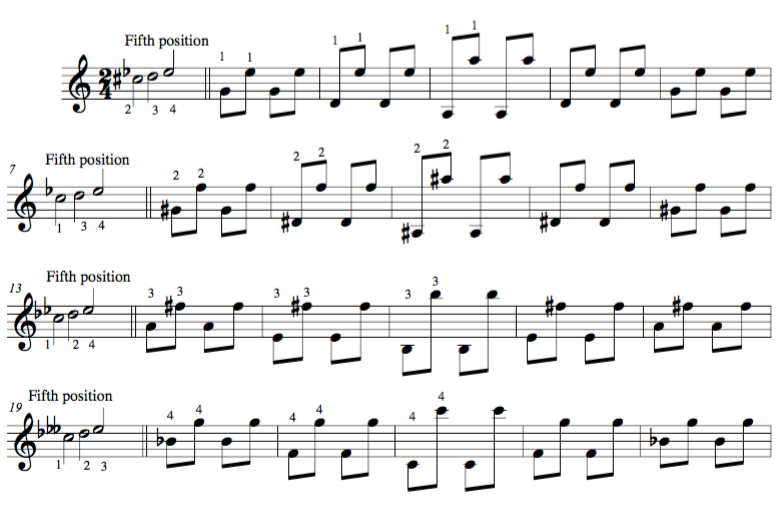
Now I know that you all rushed to try out my exercises yesterday, right? I hope you didn't sprain anything! After I posted the exercises I realized that I left out an important preliminary one. Before the exercise with two fingers swapping strings (originally from Abel Carlevaro), you need to warm up with a similar exercise with three fixed fingers and one finger moving. That gets you ready for the harder ones. Here is how it looks:
Click to enlarge
The first measure shows which fingers you fix. I have shown it in fifth position, but you can do it anywhere. Fix three fingers on the third string without playing them and leave them while you move the remaining finger, playing the eighth notes. Starting with the first finger, you jump from the fourth string to the second, the fifth to the second and the sixth to the first, then return. Play slowly and cleanly. Do this with each finger in turn, as shown. This is the necessary preparation for the exercises with two fixed and two moving fingers.
As an envoi, let's have another Villa-Lobos study. This is the Etude No. 5, which has some interesting left hand challenges. This is Andrea Dieci again with a very fine performance:
I haven't done any posts on guitar technique for a long time. There are a couple of good exercises for the left hand that classical guitarists might find useful.
Every time I watch a pianist play, after I am impressed and astonished at their virtuosity, I secretly think to myself how much easier their job is. On keyboard instruments a lot of what is needed to produce each note is automated. Every time you strike a key, an internal mechanism goes to work with a hammer (in the case of the piano) striking a string at just the right angle and, as soon as the key is released, a damping mechanism stops the sound. How very cool!
Things are more complicated for guitarists. Instead of each hand being able to produce notes independently, both hands are needed for most notes. The left hand most commonly is needed to stop each note on a fret while the right hand plucks the string. What this means is that usually we are limited to four notes at a time as there are four available fingers on the left hand (the thumb is behind the neck for stability) and four on the right hand (the little finger is rarely used to pluck). But, you will say with surprise, we often hear a lot more notes on the guitar? Yes, there are a couple of techniques that enable all six strings to be played at once: they may be strummed, passing quickly across all six, and the left hand index finger can be laid across all six strings at once. This, along with the other fingers, enables the use of six-note chords.
But the bottom line is, in order to reproduce some of the complex textures we find on the piano, each hand has to do the job on guitar, whereas on the keyboard, the task can be split up between the two hands. This being so, there are all kinds of textures that the piano can create that the guitar cannot. Still, three, four, even rarely five, independent voices can be played on the guitar--with a lot of restrictions, of course. For one of my graduating recitals I played a piece by Valentin Bakfark, a Hungarian lutenist notorious for articulating four, five and once even a six-voice structure. I couldn't find the one I was looking for, but here is a clip of three of Bakfark's transcriptions of polyphony for multiple voices:
So, just to clarify, whereas on the piano you can play a four-voice texture by dividing it between the two hands so each hand is responsible for two voices, but on the guitar, each hand has to play all four voices.
This being the case, guitarists have to develop a lot of independence in each hand.
The first exercise is from the "Cuadernos" of Abel Carlevaro, perhaps the most gifted modern guitar pedagogue. I attended a guitar festival in Toronto many years ago where he gave master classes and a concert. The concert, which included the Sonata by Castelnuovo-Tedesco, was an excellent demonstration of real technical command. In the master classes, after the student played, he would begin each commentary by saying: "hay dos problemas: el mano derecho y el mano izquierda!" ("There are two problems: the right hand and the left hand.")
This exercise involves "fixing" one or more fingers while moving the others. This method is one of the very best for developing finger independence. I show it on the fifth fret, but it can be done anywhere on the fingerboard. You will notice a half note at the beginning. This note is stopped by the first finger on the fifth fret of the third string. You can sound it or not, but if you don't sound it, make sure that the note is cleanly held. Then the other fingers simply play the pattern 4342 across the whole fingerboard. I only show it going up to the first string, but you should go up and back:
Click to enlarge
Then you simply go on to fix each of the fingers in succession, while playing the same pattern with the remaining fingers. With the other three fingers, you have to skip the third string. This shows the pattern with the second finger fixed:
Click to enlarge
UPDATE: oops, I indicated the wrong fingering above. With the second finger fixed, the fingering for the eighth notes is 4341!
Then you just go on and fix three and then four while playing the pattern with the remaining fingers.
Carlevaro adds a couple more difficult versions. Next you fix two fingers and play a different pattern with the other two. Here it is with one and two fixed while playing three and four:
Click to enlarge
I have put the fixed fingers in a separate measure for clarity. So you start by fixing your first and second fingers on the third string (in fifth position, as before, though you can do this any where). Then you play the fourth finger on the second string and the third finger on the fourth string simultaneously. Then the third and fourth fingers leap, trading strings and the next pair of notes have the fourth finger on the fourth string and the third finger on the second string. This repeats then you simply expand the pattern to the second and fifth strings and then the first and sixth strings--that one is quite difficult. It is very important to do this very slowly and carefully so that the fingers can find the right strings cleanly.
I'm not going to write the rest out, but you follow this by fixing the second and third fingers, while playing with the first and fourth, then fixing the third and fourth while playing the first and second. Then you fix the non-adjacent fingers: fix one and four while playing two and three, fix one and three while playing two and four and fix two and four while playing one and three. Did I miss any?
I haven't actually looked at Carlevaro's book for about twenty years (I lost a lot of my library because of an Evil Moving Company) so he may notate it differently.
Now for my left hand exercise. When I was playing a lot of Baroque music I felt the need to improve my trill technique so I invented this exercise: trills with each pair of fingers while holding a bass note. As the exercise is for cadential trills, they all start on the upper note:
Click to enlarge
You start by fixing the first finger on the sixth string, again in fifth position. Then you do slow, measured slurs with your fourth and second fingers on the fifth string. Do a full measure in 4/4 of sixteenth notes. Then just move this pattern across the strings as indicated, going up to the first string and returning to the fifth. Then do the same pattern but this time with the third finger slurring to the second, each on their fret. Finally, repeat the pattern using the fourth and third fingers. Then do it all over again, but with the second finger fixed on the sixth string and doing the slurs with the first, third and fourth fingers. These two groups of patterns cover most of the typical situations, but if you really want a workout, do the same fixing the third and fourth fingers! Very difficult.
Those two exercises should give you a lot of independence in the left hand. There is a very appropriate study by Villa-Lobos that you might also try: the Etude No. 10. Here is a performance by Andrea Dieci:
No, you haven't stumbled onto Deepak Chopra's blog by mistake! This is still the Music Salon, home of the acerbic quip and sardonic metaphor. But as I was doing my technique the other day I found my mind wandering as it sometimes does (bad mind, bad!) and I had a thought that might be helpful to guitarists and maybe even other musicians.
Good playing isn't that difficult really, but it sure seems so when you are learning! Guitar students are so often plagued by misunderstanding, physical difficulties and neurosis that sometimes the best thing you can do as a teacher is just be positive and affirmative. I think that the best guitar teacher I worked with did just that with a minimum of commentary.
So what do I mean by "a calm mind and a quiet hand?" I guess I should define both of those things so you know what I am talking about. Let's start with the easy one: a quiet hand. If you watch some great guitar players to see what you can learn, it is amazing how little you see--with classical players at least. They tend not to do wild, arm-swinging power chords while leaping in the air like Pete Townshend of The Who:
Quite the opposite:
The ideal is minimum movement. The right hand is particularly difficult to see what is going on, because if your technique is really good, nearly all the movement of the fingers is concealed by the hand. Here is a good example:
And that's Manuel Barrueco ripping through some particularly virtuoso passage!
The problem students have is that they are impatient and obsessive (often), which means that they are always trying too hard, working too hard, playing too hard and struggling. If you are struggling then you have to stop and start again. The way to approach everything is very, very, very slowly and gently until you have the physical movements under control. From there on it is just a question of gaining surety and speeding things up. But always under control! A quiet hand gets the job done quietly.
Roughly the same principles apply to "a calm mind." If you are mentally agitated, nervous, neurotic and terrified about making a mistake, then you will not be able to play at your best. Obviously! Unfortunately, all too many music students exhibit all these mental qualities! What brings this about are some of the same things that cause technical problems: impatience and trying too hard.
This is understandable because the discipline of classical music is pretty stringent. You read things like professional guitarists saying you need to be able to play all your repertoire through perfectly ten times in a row before venturing it in public. And you are sitting there thinking, "I don't think I have ever played anything perfectly in my life! Not even once!" Dude, I hear ya! Making this demand on yourself in these stark terms is what makes you neurotic. You are basically creating a situation too difficult to cope with. So don't do it.
Here is what you should think: make everything easy. Relax, not just your body, but your mind. You do that by not making impossible demands, but easy ones. Learn a very easy piece and practice it very slowly. Suddenly accuracy is possible. The word "perfection" is so dangerous to music students because they associate it with everything they don't feel capable of doing. But the word "accuracy" may not have the same psychological traps. Be accurate, don't even try to be perfect and pretty soon, you will be just where you want to be.
Recording is one of those things that can lead to neurosis because, at least until you get used to it, it seems to exaggerate every tiny flaw in your playing. I used to avoid recording myself until I had to for this very reason. But then I came to terms with it, got used to it, and it has become a very useful tool.
In general beware of all advice that seems to be too "psychological" because worrying about being neurotic is what makes you neurotic--for example. Just have a calm mind and don't do anything or allow anything to happen that will disturb your calm. If you have to practice slowly to remain calm, then do it.
I'm pretty sure that if you asked two of those gentlemen whose photos are above, not Pete Townshend, but the other guys, John Williams and Manuel Barrueco, they would say the same thing.
UPDATE: I just recalled one of those misunderstandings that students tend to have. It relates to causality. When you are starting out, you see one of these great masters play and you think, "wow, he's so calm--it must be because he is such a master" i.e. he is calm because he plays perfectly. But the causality is quite the opposite: he plays so well because he is calm, not the other way around!
I haven't posted on guitar technique for a while. I hope you non-guitarists will forgive me but, who knows, I might say something useful even to non-guitarists.
A while ago I put up my performance of the Etude No. 1 by Heitor Villa-Lobos. Here it is again:
This is possibly the most popular etude of the twelve, not just with guitarists, but also with audiences. It poses some unique technical challenges. There is a new critical edition of the Etudes by Frédéric Zigante that takes into account some manuscript versions of the pieces and corrects some misprints. It is an excellent edition with complete scholarly apparatus about editions and sources. But, there are still some problems. I think the major problem with this etude is the right hand fingering which is found in a ms. of Villa-Lobos. He was a fine composer, but one suspects his guitar technique was less than polished. The problem with the RH fingering indicated is that you will probably never be able to achieve a truly even effect. There is a better fingering that aligns the RH with the meter more effectively. I have been using it so long myself that I honestly don't remember if I discovered it independently or if someone showed it to me. In any case, here is the first measure as a sample with Villa-Lobos' fingering and mine underneath:
Click to enlarge
The problem this solves is the one created by following what Villa-Lobos considered to be a logical right hand fingering in terms of assigning strings to fingers. Unfortunately, this creates a problem in the third beat where a very weak finger combination, m a, falls on a strong beat metrically. What happens is that the rhythm at this point tends to limp. I'm sure there are very gifted technicians that can make the arpeggio even despite this, but I'm not one of them, nor are any of the students I have taught over thirty years. So there is a simple solution: simply adapt the fingering to the meter, which is what the lower fingering, numbered "2" does. The thumb plays on the beginning of each beat, making this fingering feel much more natural. The string-crossing requires a bit of practice, but it is easily achievable.
There are a couple of other issues with this piece. First of all, the tempo. The etude is often played at MM 120 to the quarter or even faster, at perhaps 132 or more. This may be achievable technically, but notice what Villa-Lobos writes: "Allegro non troppo". NOT too fast. Allegro is estimated at being between 109 and 132, so a not too fast allegro could easily be around 100. I think my recording, which dates back a number of years, is actually too fast! Even and controlled is better than speedy with this etude.
Now, how to practice it. Over the years I came up with an excellent practice method that will just about guarantee success. Practice the arpeggio by itself on open strings and also damp the strings with your left hand around the tenth to twelfth frets. You will get just a thumping kind of sound, which is very good for you to listen to for an even touch and rhythm. Practice this arpeggio VERY SLOWLY until it is memorized and very even. The next step is to practice it with different rhythms as below:
Click to enlarge
Once you can play all these rhythms with complete control and evenness, then incrementally speed them up until you reach 100 on the metronome. As far as the argpeggio goes, that's it. It might take a while, but it is an extremely good discipline for the right hand. Once you have the arpeggio going well, you can try it with the actual chords. Having real pitches instead of just thumps is a real thrill, which adds to the fun of playing this etude.
UPDATE: I should probably mention that the way to practice those rhythmic patterns is to do each one by itself many times in a row before going on to the next one.
The only remaining problems with the etude are measures 23 and 24 and 31 and 32 where you have to skip around, first with slurs and then with harmonics. But just practice each passage very slowly until you have it mastered. No real tricks here.
Don't rush it and you will have an excellent addition to your repertoire.
Just so we don't get too abstract for too long here at the Music Salon, I like to mix in some practical stuff. One of the things that used to give beginning guitarists a headache was tuning. How the heck do you get the guitar in tune? Technology has leaped to the rescue with electronic guitar tuners that do everything except turn the pegs for you. Speaking of pegs, let's have a look at the parts of the guitar:
Yes, I know I called the "tuning machine" a "peg", but I just don't know anyone who actually calls them "tuning machines". I think we call them "tuning pegs" from the history. That's what they are on the violin and cello and what they were on the lute and older guitars: just simple ebony pegs that held the tension by friction alone.
Back to those electronic tuners, here is what one looks like:
And you can pick one up here. Funny thing, though. I notice that every student I have had who uses one of these is tuned just a bit sharp. The only thing I can figure is that there is a little bit of lag in the response. By the time the indicator says you are at the pitch, you are actually just a bit above. Anyway, I still use one of the old-fashioned tuning forks:
No batteries! There are a few odd things about guitar tuning that plague beginners, which is the main reason for this post. Have you ever watched a guitarist spend minute after minute trying to get the guitar in tune? Going back again and again to the same strings, but never quite getting it right? This is very probably because he doesn't realize the difference between Equal Temperament and Pythagorean tuning. Here is a pretty good article that explains this in considerable detail. I think I can demonstrate it in fewer words. The problem is that equal temperament, which has been used in Western music since the 18th century, is different from Pythagorean tuning. Pythagorean tuning is based on the overtones and gives you nice pure intervals in some keys, but makes other keys hopelessly out of tune. Equal temperament solves this problem making all keys equally useful at the cost of making all intervals slightly out of tune.
Our hapless guitarist is caught in this contradiction because he is using harmonics (probably) to tune and then cannot reconcile the results with chords he plays to test. If he gets his E major chord perfectly in tune, the C major chord will be badly out of tune. I recommend something very close to the method used in the article on Equal Temperament tuning. That is, use your tuning fork to get one string exactly in tune. Paraglider suggests the fifth string, but I use the fourth string instead. Tune every string to the fourth (or fifth) string and you will not go far wrong. You may have to make some tiny adjustments, splitting the difference with a couple of strings. One big suggestion: never check your tuning with an E major chord! The third string is always going to sound a bit sharp. But if you fix it, then other chords will be out of tune. The reason is this: the sixth string has a very audible overtone that is the harmonic on the fourth fret. This is a Pythagorean G#, which is flat from an equal-tempered G#. If you tune the third string down to fix it, then it will be flat. The solution is to always check your tuning with an E minor chord!
I was going to be very clever and end this with a duet by Manuel Barrueco and David Russell introduced by saying "here are two guitarists who managed to get both guitars in tune!" But, alas, they did not quite manage it! So here are two other guitarists who are pretty much in tune. Julian Bream and John Williams with a transcription of "Clair de Lune" by Debussy:
I'm not sure how long interval training has been around, but I recently read an article reporting on research that indicates it is an extremely good program for fitness. I can't even find the link now, but the researchers have come up with an intense daily workout that is supposed to be the best. You do brief, 30 second, exercises interspersed with ten second rest periods. Here are the exercises:
Click to enlarge
I've just started doing these every morning replacing my old routine which was based on a martial arts warmup routine. Very demanding! So far I can only get through two-thirds of the exercises.
The reason I bring this up is that I realized after doing this for a couple of days that long ago I developed something similar to maintain and improve my guitar technique. I have limited time to practice so I needed a very concentrated technical routine that would keep me in shape.
Here is what I do:
Left hand finger crossing exercise. This is one that I learned from Pepe Romero. It consists in starting on the 6th string first fret with the first LH finger, then the 2nd LH finger directly below on the first fret 5th string, then the first LH finger on the 4th string first fret, second LH finger on the 3rd string first fret and so on to the first string and returning to the 6th. Then the 2nd and 3rd fingers walk across the fretboard on the second fret and finally the 3rd and 4th fingers on the third fret. Here is what it looks like:
Click to enlarge
Then I do some kind of LH independence exercise. Here are some of the possibilities:
Click to enlarge
This example is from my technique book.
Next I do some form of scale exercise, either an ordinary three octave scale in different rhythms (slow quarter notes, triplets, dotted, two sixteenths and an eighth, four sixteenths and so on) or a chromatic scale. The version I usually do is triplets (or sextuplets) going back and forth. You can do it on a single string, here is what it looks like on the third string:
Click to enlarge
or on all the strings. I usually start on the sixth string and keep going up on each string. On the first, I go all the way to the 19th fret, then return.
Next I do a couple of slur exercises where I hold some notes down while slurring other notes. Here are some examples:
Click to enlarge
Then I do a right hand rasgueado exercise which is very good for loosening and strengthening the RH. Here are several and I usually just pick one and do it for a minute or two:
Click to enlarge
Next is another LH exercise. I do this one all the way up to the twelfth fret and back. This is another exercise I learned from Pepe Romero:
Click to enlarge
Finally I do a right hand exercise for tremolo starting with the reverse, PIMA:
Click to enlarge
This is another excerpt from my technique book. What I mean by "G major in 3rds" is to ascend to the 12th fret with a G major scale in thirds. I usually do this with PIMA, then the flamenco version of tremolo, PIAMI and ending with the conventional tremolo, PAMI.
That's it! It takes me fifteen to twenty minutes to do and keeps my hands in pretty good shape.
Now if all you oboists, pianists, violinists could comment on what you do?