I don't find a lot of what Ted Gioia writes to be very interesting, but he came up with a good one today: Google Thinks Beethoven Looks Like Mr. Bean. Well, no, that is another exaggeration, but from the evidence Mr. Gioia assembles it is certainly the case that Google is massively falsifying historic images of composers. This certainly doesn't look like Mr. Bean--but it looks even less like Beethoven:
This is what Beethoven actually looked like, from a contemporary portrait:
Follow the link for some more ridiculous images. What really and truly shocks me is people are still using Google? I switched to DuckDuckGo at least ten years ago. They aren't perfect, but at least they aren't insane.
Here is the "Tempest" Sonata for Piano with Maria João Pires:
I put up a symphony by Walter Piston as an envoi to my post yesterday on varied topics. After listening to it I realized that Piston is very likely a seriously underrated composer. One suspects that in the welter of programs featuring women composers like Fanny Mendelssohn, black composers like William Grant Still and black women composers like Florence Price, music by mere dead white men like Walter Piston is likely to be over-looked. And so it is.
You need to start by reading the Wikipedia article on Walter Piston. He died about the time when I was still a young musician so my only awareness of him was the name on the cover of various textbooks:
I think I came along just a bit too late for those texts. For harmony, for example, we used Aldwell and Schachter and in my Fugue course we just used Bach. But my musical DNA does connect back to Piston, indirectly. One of my composition and theory teachers was Robert F. Jones who studied with Arthur Berger who was a student of Walter Piston. Piston himself was a student of the ubiquitous Nadia Boulanger:
On graduating summa cum laude from Harvard, Piston was awarded a John Knowles Paine Traveling Fellowship.[7] He chose to go to Paris, living there from 1924 to 1926.[9] At the Ecole Nationale de Musique in Paris, he studied composition and counterpoint with Nadia Boulanger, composition with Paul Dukas and violin with George Enescu.
Piston taught at Harvard from 1926 until he retired in 1960 and the list of his students is mind-boggling:
See the Wikipedia article for the long list of works that include pieces for every conceivable combination of instruments except for solo voice, opera and guitar. Let's listen to two symphonies and a string quartet to get an idea of his work. First, the Symphony No. 3 with the Boston Symphony Orchestra conducted by Serge Koussevitzky. This is the premiere recording from 1948.
The Symphony No. 7 with the Louisville Orchestra conducted by Jorge Mester. The premiere was in 1961.
Finally, the String Quartet No. 5 with the Harlem Quartet:
Every few years I make a, for me at least, musical discovery and share it here under the title "Discovering Musicians." There aren't very many of them, but in each case I think it is someone you ought to get to know if you don't already. Today it is Samuel Andreyev who I stumbled across in rather an odd way. Doing research for a post on Bartók's String Quartet No. 4, I ran across a clip by Mr. Andreyev analyzing the work--and a darn good one. Then I discovered a number of other clips talking about other pieces. Always interesting clips about interesting pieces, by the way. Here is a discussion of an early Bach cantata, for example:
Then I ran across a clip of an interview with him and Jordan Peterson and from that I learned that Mr. Andreyev is Canadian, though he has lived much of his life in France, which is why I hadn't heard of him. Here is that interview:
Dr. Peterson, by the way, uses Mr. Andreyev to walk us through the whole history of Western music, explaining as he goes. Turning it around, here is Mr. Andreyev interviewing composer Brian Ferneyhough.
And now, let's listen to a composition by Samuel Andreyev. This is his Piano Piece No. 4 which I think is quite recent as he posted it on YouTube in April of this year.
I can't resist trying to give a very brief description of the music: it sounds to me a bit like Stockhausen if he were Japanese! That means, I quite like it. Here is a concerto for violin and chamber orchestra that was posted in 2019 titled "Trois pierres à ne pas jeter," which means "Three stones not to be thrown."
And that reminds me, just a bit, of Henri Dutilleux. Samuel Andreyev is a very interesting composer and one who is able to talk about music very articulately.
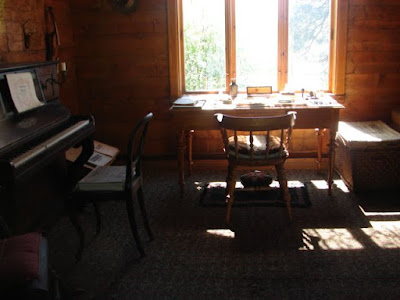
Troldhaugen is the name of the former residence of Norwegian composer Edvard Grieg and it has, apart from living quarters, Grieg's "composing hut" overlooking Nordås Lake. Here is a photo of the hut:
The interior of the hut
As you can see, a "hut" is exactly what it is, just big enough for a piano, a chair and a little desk
. Stravinsky composed the Rite of Spring in a similar environment:
In October he left Ustilug for Clarens in Switzerland, where in a tiny and sparsely-furnished room—an 8-by-8-foot (2.4 by 2.4 m) closet, with only a muted upright piano, a table and two chairs—he worked throughout the 1911–12 winter on the score. [Wikipedia]
Indeed, it is not unusual for composers to retreat to a tiny, isolated environment to compose. Mahler composed in a similar tiny hut overlooking Lake Attersee in Upper Austria. The hut even has its own Wikipedia page:
And here is the interior:
Mahler had a second composing hut near Maiernigg:
While I suspect that lots of other composers had similar huts, I can't find photos of them online. When I attended The Banff Centre many years ago, the extensive grounds were dotted with isolated little practice huts for musicians, writers and composers to work in. Here is a photo of the simplest ones:
But there are also much more elaborate ones:
This is the dream of many composers, writers and musicians, of course. The key elements are complete separation from other people and their noises (and the noises of their pets). You cannot imagine the sheer frustration when you are just working out some sound-combination in your mind or on the piano when next door Fido unleashes a furious round of barking or your neighbor decides he really needs to hear some Grateful Dead at high volume. The delicate, only half-comprehended idea vanishes like mist in the morning.
What do composers need even more than commissions and premieres? Solitude.
Here is the Peer Gynt Suite No. 1 by Edvard Grieg:
UPDATE: A commentator reminds me of composer Peter Maxwell Davies' croft in the Orkney Islands:
Have you ever notice that composers look just a bit odd in photos? As if they are not quite part of this universe, but just visiting? Here are some examples:
Debussy certainly looks as if he just teleported in from another place, doesn't he?
This is George Crumb, and doesn't he look as if he is just about to dematerialize back into that piano?
And Stravinsky looks like he is just taking a coffee break from dwelling somewhere else.
Harry Partch looks as if he never left that other dimension.
Bruckner? Well it doesn't look like he visits Earth very often!
And Stockhausen can hardly wait to get back to his part of the sky.
Being here in our reality makes Schoenberg rather troubled.
Even Nico Muhly looks a bit glazed.
Prokofiev just whiles away a few idle minutes before he takes that wormhole back to his dimension.
And Puccini is wondering why he dropped by at all!
Shostakovich finds being here on Earth very anxiety-producing.
Even when he is with his friends Prokofiev and Khachaturian.
Even I look at bit puzzled to be here in this quantum reality.
But if we go back a bit, we find composers were a bit more at home in the late 19th century, as we can see in this photo of Mahler. With the exception of Bruckner, of course...
So why is this? Why do most composers look out of place in photos? I think it is because their home environment is sound, not sight. It's a bit like audio recordings of painters, isn't it?
One of my frequent commentators has posed a challenge, or at least so it appears to me. He says, "I have yet to hear of a good living female composer." Actually, I think I have already talked about several good living female composers, but without singling them out as women. This was in my series of posts on Hilary Hahn's recording of newly-commissioned encores, of which about half were written by women. While at Curtis, Hilary met and studied with the composer Jennifer Higdon, whose violin concerto she also recorded.
Pay no attention to the video as it has nothing to do with the audio track, which is of Higdon's Violin Concerto. Higdon was awarded the 2010 Pulitzer Prize in music for that piece. Incidentally, when I put up my final post on the album I posed a few questions about the commissioning process and Jennifer Higdon herself left a comment answering them. Nice gesture! She even complimented this blog. Higdon has also won a Grammy for best contemporary classical composition in 2009 for her percussion concerto. So I think that the task of finding a good living female composer has been achieved very easily: Jennifer Higdon, currently professor of composition at the Curtis Institute. The Wikipedia article assembles a nice paragraph of praise for her work:
Higdon's music is popular with orchestras and audiences and the League of American Orchestras recently reported Higdon as one of the most performed living American composers.[6] "Higdon's music is lithe and expert," wrote Robert Battey of the Washington Post. "Jennifer Higdon's vivid, attractive works have made her a hot commodity lately," wrote Steve Smith of the New York Times. "Jennifer Higdon is in my assessment one of the greatest of the newer composers," wrote Steven Ritter of Audiophile Audition.[7] Of her Concerto for Orchestra, Richard Morrison in The Times(London) stated that "it is rare to witness a big new orchestral piece being acclaimed as Jennifer Higdon's Concerto for Orchestra was cheered on ... The most impressive aspect is the panache with which a huge orchestra is deployed ... This colourful, ever-changing instrumental panoply is doubtless one reason why the work makes an instant impression ... Higdon's work is traditionally rooted yet imbued with integrity, freshness and a desire to entertain. A promising mixture. More, please."
Let's listen to some more of her work. Here is her Percussion Concerto dating from 2005, played by the University of British Columbia Orchestra:
And here is her Concerto for Orchestra, dating from 2002 played by the Atlanta Symphony:
She doesn't just write concertos. Here is an excerpt from a piece she wrote for the Lark Quartet titled, "An Exaltation of Larks":
And here are "Trumpet Songs" for trumpet and piano:
So I think that she easily qualifies as a good, living composer. Does her music rise to the level of greatness? We will have to check back in fifty or a hundred years!!
I'm reading a book on Haydn right now that follows a fairly typical format: first life, then works.
We tend to think of Beethoven as being the paradigm or exemplar, but every composer's life in music tends to be pretty individual. Take the idea of "periods" for example. Beethoven's life as a composer is seen to fall into three periods. We have Early, Middle and Late Beethoven. As Joseph Kerman remarks in his excellent book on the Beethoven quartets, any book on them is inevitably going to be like three books as there are three quite different phases in Beethoven's life as a composer.
But other composer's lives are different! Take Mozart for example: there are really only two phases in his short life: juvenilia and mature works. In his case the mature works are everything written after his mid-teens. His first successful opera dates from when he was fourteen. Haydn also does not fit into the three-phase model. His long life as a composer has five phases: Youth, Transition, Romantic Crisis ("Sturm und Drang"), Maturity and Mastery. These labels are from the book mentioned above. The complete symphonies box has different labels and manages to find six phases: Early Symphonies, First Symphonies for Prince Esterházy, Sturm und Drang, Symphonies for Entertaining, Symphonies for the Public at Large and London Symphonies.
Another composer who diverges far from the model is Leoš Janáček (1854 – 1928) for whom everything he wrote up until 1917 when he met his muse, Kamila Stösslová, was, with a few exceptions, juvenilia. All his most important works were written in his sixties and seventies! Compare this with, say a great popular songwriter like Paul McCartney: most of the songs that he is most highly renowned for were written between 1963 and 1970 when he was twenty-eight years old.
At the other end of the scale we have Giuseppe Verdi (1813 - 1901) who wrote one of his most successful operas, Falstaff, when he was seventy-four.
Let's listen to Janáček's Sinfonietta, composed when he was seventy-two, which sounds disconcertingly like something a brash young man might have written. Here is the Hallé Orchestra conducted by Sir Mark Elder:
I think I have mentioned the American composer Kevin Puts a couple of times. He is one of a new generation of composers that manages, successfully I think, to meld the role of being a new music composer with an awareness and respect for the past traditions of classical music.
In response to a comment about how composers are either recognized or neglected I wrote:
I think that one of the interesting historical phenomena of music since 1900 is the deployment of modernist (and then post-modernist) ideology in shaping the public reception of music. Books like René Leibowitz' "Schoenberg and His School" were designed to influence and shape public opinion. That they were not entirely successful was due to two things: competing narratives such as the one put forth by Igor Stravinsky in his (probably ghost-written) book "Poetics of Music" and the series of books written in collaboration with Robert Craft, and by public resistance to atonal music generally. Since 1900 it has been almost de rigeur for composers to further their careers with some kind of written manifesto. John Cage is an outstanding example of this.
But at this stage in music history, where I think a more conservative stage is beginning, the radical manifesto is really not the right strategy. What does a composer who writes music that acknowledges a relationship with the past that involves the use of elements like harmony and melody do? Well, this one started a blog that is attempting to subvert the modernist and post-modernist narrative in music!
Since the 1960s there has been a backlash against the fiercely dissonant, rhythmically jagged music of modernism. The first figures in this trend were Steve Reich and Philip Glass with their early 'minimalist' work that featured harmonic stasis and a strong beat. But this soon developed, both in their music and that of others like John Adams, into more complex structures that still featured consonance and rhythmic coherence. A still newer generation with composers like Osvaldo Golijov and Kevin Puts are using textures and gestures taken from or reminiscent of older music in compositions that are still new. It is hard to generalize, but one way in which what they are doing is different from post-modernism is that they are using these elements in a non-ironic way.
Let's listen to some music by Kevin Puts. Here is a string quartet, Credo, dating from 2007. YouTube refuses to embed, so here is the link:
This is certainly a piece of new music, but at the same time, it is not afraid of using consonance and melody. Golijov has gone even further in transforming music by Couperin into a piece for string quartet:
But back to Kevin Puts. He has been successful in writing larger works for orchestra including symphonies and concertos. The very fact that he uses these terms instead of more modernist ones like "Music for Strings, Percussion and Celesta" or "Momente" or "Gruppen" indicates a different attitude towards the past than that of a modernist composer. Alas, none of Kevin Puts' four symphonies seem to be available on YouTube, so let me put up instead the first movement of his Piano Concerto entitled "Night". This isBernadette Harvey with the Canberra Youth Orchestra conducted by Rowan Harvey-Martin giving the Australian premiere:
There is no mistaking that for Beethoven, certainly. Nor for Stockhausen! Occasional bits of it might have been composed by Prokofiev or Bartók. But the unabashed ending with tonal harmony and the consistent rhythmic texture would have been avoided by most 20th century composers.
How can you write music like this, frankly tonal, and not be accused of pandering or of sounding like "movie" music? I think that the answer is that this is a genuine musical expression that comes from both real compositional expertise and from aesthetic sincerity. I'm trying to avoid the word "authentic" as it is often abused, but there is something that sets apart music like this from mere melodrama and I'm at a loss for another way to describe it. I think that the many manifestations of musical post-modernism all share the common feature of being like costumes the composer puts on. "Let's have some African music here, then some Dixieland, maybe a little atonal wash for contrast." None of this flows from any genuine artistic conviction, it is just window-dressing. Post-modernism is all window-dressing which is why it is so unsatisfying, aesthetically. But I think that the music of Kevin Puts is well composed. It manages to be satisfying to audiences and to players and it seems to be a genuine expression of the composer.
Here is an interview with Kevin Puts that is somewhat interesting:
And here is the piece they were talking about, And Legions Will Rise for violin, clarinet and marimba. This is the first part, performed by Matt Slack, Kerstin Tenney, and Justin Laukat:
A lot of what this blog does is music criticism and the theory of music criticism. The reason is that while music criticism is a very necessary activity, it is currently practiced very poorly. If people must listen to Ke$ha, then we at least need to make them feel somewhat ashamed, do we not? Ok, that was supposed to be funny. Sort of.
I think those who are capable of doing music criticism are scared to because of the growth of relativism. If you critique someone you are just being judgmental! Well, yes, of course. Judgment is one of those fundamental activities that is why we have brains. The trick is simply to apply good judgment rather than bad judgment. One of the reasons I say that music criticism is practiced poorly is that when it is practiced, it is so thoroughly based on subjective whims that it is scarcely worth reading.
There are some other, less noticed, reasons for the fading of music criticism. One of these I would like to touch on in this post. It used to be that some of the very best music critics were composers. In fact, one of the very first well-known music critics was the composer Robert Schumann who alerted the world to the talents of both Chopin and Brahms. Berlioz was another composer who wrote a lot of music criticism. I think composers have a unique contribution to make to music criticism.
But the practice seemed to disappear in the 20th century. As modernism redefined composition as the seeking of entirely new musical "languages" akin in a way to the new fashions unveiled in Paris and Milan every year, composers had less and less to say about other composers. Perhaps the last was, of all people, Arnold Schoenberg. He didn't do music criticism as such, but he wrote a lot of theoretical material on things like harmony. One particularly interesting book is Structural Functions of Harmony written in 1948 when Schoenberg was teaching at UCLA. It is a bit ironic that this discussion of the use of harmony in musical structure should come from the pen of someone who is often regarded as having ended the use of harmony with his theory of "pan-tonal" composition! But Schoenberg was an all-round musical craftsman. Subsequent generations of composers tended not to be as there seemed to be less and less need of traditional compositional skills.
What can we tell about Schoenberg's musical criticism? Theory texts, of course, try to avoid the question of musical value, but they fundamentally cannot! The reason is that every theorist has a template of what 'good' music is. They choose their examples of harmony from 'good' music, not bad music. So if we just look at the index of musical examples or, in this case, the index of names, we can quickly get a sense of who is regarded as being worthwhile and how much so, from the simple quantity of citation. In Schoenberg's book the composer most cited is Beethoven--not much of a surprise! After him are Brahms, Mozart, Bach, Schubert, Wagner and Schumann.
With the disappearance of composers as critics and theorists, came the growth of the profession of music theorist. Again, critical evaluation was forbidden as such, but again, it is unavoidable as you simply have to pick and choose. Let's dig around in the index to the leading modern text on theory, Harmony and Voice Leading (3rd Edition) by Edward Aldwell and Carl Schachter. Here, the one far in the lead is Bach, followed by Beethoven, Mozart, Chopin, Schubert, Brahms and Schumann.
What is missing from these lists? Modern composition! With the disappearance of traditional ways of writing music, so disappeared the foundations for music criticism. All that is left is your subjective reaction. But this is really unsatisfactory, isn't it? This is what pop criticism, such as it is, consists of. As an example, let's go to Rolling Stone Magazine and pick a review at random:
Is there a more debonair dirtball in rock than Josh Homme? The Queens of the Stone Age frontman is the high priest of grimy rock tradition, exalting in exquisitely wrought guitar scraping and wry machismo – whether with his main gig or in side bands like the Dave Grohl collaboration Them Crooked Vultures. For the Queens' sixth album, their sole continuous member has the band at full power, with Grohl drumming on five of 10 tracks, former members Nick Oliveri and Mark Lanegan pitching in, and eye-catching, yet unobtrusive, guest spots from Trent Reznor, Scissor Sisters' Jake Shears, Arctic Monkeys' Alex Turner and Elton John – who, fabulously, volunteered as "an actual queen."
Make no mistakes, though: . . . Like Clockwork still runs on Homme's grizzled-dude-against-the-world intensity; he'll quaff a "potion to erase you," and he compares people to "crashing ships in the night." The track featuring Sir Elton's vocals and piano, with Grohl on skins? It's a deliciously greasy complaint called "Fairweather Friends." If you're looking for something aspirational, check out "If I Had a Tail," a perv's anthem in which Homme deploys his best movie-villain voice. And let's just say that the bad-vibes ballad "The Vampyre of Time and Memory" earns its gothick spelling. Yet for all his demon-steed drive, Homme's a versatile guy – he coos as persuasively as he howls, and few can rain down metal decay with as much nuance and craft.
How can you tell subjective reactions from actual criticism? I'm going to say that part of it is technical vocabulary. If you are going to talk about the music from an objective point of view, then you have to refer to it directly. You have to use words like "backbeat" or "three-chord rock" or "blues-based guitar solo". Notice I'm not using classical terms like "flat sub-mediant" because they are not appropriate to this music. But there are lots of terms that are appropriate. We just don't see them in the review above. What is referred to, instead of the music, is the character of the musicians. This is the origin of phrases like "debonaire dirtball" or "grizzled-dude". Places where there seems to be direct reference to the music in phrases like "exquisitely wrought guitar scraping" or "perv's anthem" are so lacking in any musical detail as to be empty.
Funnily enough, one of the few examples of actual music criticism of contemporary music was found recently in the Guardian with Tom Service's very useful guide to contemporary music. Here is his round-up of the year-long project. As a sample of how he managed to tread the fine line between too much technical vocabulary and still managing to communicate something about the music itself, here is a paragraph from the first article on Elliot Carter:
It was in the desert of Arizona in 1950-51 that Carter made his breakthrough discoveries in musical time and space. After a year of compositional soul-searching, Carter finished his First String Quartet, a 45-minute musical dreamscape, whose structure was suggested, Carter says, by a Jean Cocteau film, Le sang d'un poète. In the quartet, you can hear the key to Carter's later music, from the way the piece melts four main movements into one gigantic superstructure, to how the music moves from one speed to another so seamlessly that you don't notice it happening until you realise you're in a new musical dimension (listen to the opening minutes of the quartet's fourth movement to hear his mastery of the technique known as "metric modulation". The sounds this quartet makes are thrillingly varied, from torrentially fast music to lyrical intensity, and yet the whole thing is made coherent by the use of a new harmonic device that Carter had found (a chord dauntingly called the"all-interval tetrachord"; basically, a collection of four notes – say, C, D flat, E flat and G – that contains the potential to generate every musical interval you can think of, the ultimate composer's toolkit).
No musical notation, that is completely forbidden in anything published that is likely to be seen by the general public, but still, a pretty good stab at describing what Carter is up to with phrases like "metric modulation" and "all-interval tetrachord".
Tom avoided being called judgmental by choosing composers worth covering and thereby avoiding the need to say anything negative about anyone. But it is also necessary to point out what music is less good, what music limps along with little inspiration, what music is not worth your time. And that, we seem to be singularly bad at.
Let me end with a little project for the reader. Here are two pieces of contemporary music. Which do you thing is better and which worse and why?
Missy Mazzoli is a young American composer who has pursued an unconventional path outside of academia. For a long time, generations, the only place to survive as a composer was either within a traditional music department, who were very supportive of certain avant-garde styles, such as serialism, or as a commercial composer writing film scores or, lower down, commercial jingles: "You Deserve a Break Today!"
Ms. Mazzoli instead, as we learn in this article, became an "indie" contemporary composer.
“For our first tour outside New York, we played a tremendous variety of places” that mostly welcomed indie rock bands, not classical music ensembles, including “a kind of punk gallery outside Detroit,” Mazzoli recalls. “The audience was standing around drinking beer, and they couldn’t have been more appreciative. It was so inspiring.”
Here is an interesting clip in which she talks about her kind of career in music:
The thing that most strikes me in this interview is her comment about the distinction between "a life in music" and "a career in music". I was struck by it, because it is not something I have quite clarified in my own mind, but once I heard those words I knew exactly what she was talking about. My mother, for example, a traditional Canadian fiddler, had no career whatsoever in music. But she had a life in music! She played for dances her whole life, but probably half the time, never got paid. I'm sure that Ms. Mazzoli, has her revenue a bit better organized. She never quite explains the difference between life and career in music, but perhaps I could speculate a bit.
Living in music comes from your nature. Most of the time I have some sort of music running around my brain, it's just who I am. I compose because something comes to me. A career is a different thing: it is a calculation based on your estimates of what is needed to reach out to other people, how to maximize your exposure and visibility, how to project the right kind of public image and so on. I'm not criticizing this, because if Ms. Mazzoli hadn't figured out some of this we would never hear of her nor her music. So, the building of a career is important. I suspect that what she is implying is that a career in music needs to be built on a life in music, otherwise it is a bit of a fraud. At least, that is what I think is true.
Different people look at music from different perspectives--this is a truism. But the details are interesting. Performers look at it from the point of view of "how do I play this?" and "how do I get the musical ideas across?" They are concerned with stuff like balancing voices so the melody isn't obscured, getting figuration even, finding just the right tempo and so on. This is as true of the soloist in a piano concerto as it is of the last-desk violist. The conductor has to figure out the piece as well, just on a slightly more abstract level. But he too is concerned with balance and tempo and with accompanying the soloist. The listener might not know the piece at all so is just taking it in, or she might know the piece very well and be comparing it with other performances, again with things like balance, tempo and precision being important factors.
But musicologists look at pieces differently. They see it perhaps from a historical perspective. As I mentioned with the Beethoven, they notice that he is stressing third relations in the 4th piano concerto. G major phrase answered with B major (a third above). Second movement in E minor, a third below. Last movement, which has to be in G major according to Classical style, starts in C major, which is a third below E minor. Musicologists and theorists know this is interesting because the Classical period stressed, not third relations, but fifth relations: G to D, not G to B. Fifth relations are clearer and stronger. But Beethoven was more and more experimenting with the basic principles of Classical style. Incidentally, Charles Rosen has written a couple of books that are extremely intelligent discussions of just what Classical style was all about. I distinguished musicologists and theorists but officially all study of music except performance and composition is called 'musicology'. However in practice theorists tend to be the folks that analyze pieces in great detail, while musicologists look at them in an historical or social context. There is a lot of overlap, of course.
Composers look at things still differently. It is not just the case that they are always looking for something they can steal (after filing off the serial numbers), but there is some truth in that. Other composers are looking at the kinds of challenges the composer took on and how he solved them. As Bernstein once is reported to have said: "Bach, that pregnant syllable that causes performers to weep, composers to fall to their knees and that bores everyone else to tears." Bach, and Beethoven too, are the ones that composers (up until the rise of modernism) would be most amazed by because of the incredible focus and dynamicism of their music. Write an entire volume of fugues on a single theme (with variations)? You're kidding! And exhaust every contrapuntal possibility? Or write an entire symphony largely based on a four-note motif consisting of only two different notes? This is the kind of thing that most composers know is simply beyond them. Which is often why they end up throwing everything but the kitchen sink into the piece with predictable results.
Modernism made a serious break in this historical relationship. Beethoven in his Diabelli variations could look across the wide gulf in time to Bach's Goldberg variations and know that they were the main players in the big league. Even as late as Brahms this same sense of historical connection was there. But with the serialists, the futurists and even the neo-classicists (who mimicked the outward appearance only) there is little sense of this great tradition.
But let's listen to a couple of those pieces, that stick out of the stream of music history like great peaks or crags. Both pieces are in several clips on YouTube and I have only put up the first parts so you will have to search out the following ones. First Bach, the Goldberg Variations recorded by Glenn Gould in 1982:
Then Alfred Brendel playing Beethoven's Diabelli Variations: