As my regular readers know, I spent ten days in Madrid toward the end of May and blogged about it every day. It was so enjoyable that I just booked an apartment in central Madrid, near the Opera and Puerta del Sol, for the whole month of May next year. The cost is only $37 US a night! Madrid is probably the cheapest major European capital, with all the architectural and cultural treasures of the others (the Prado is one of the great museums of the world) but for much less. And, in my opinion, the food is even better. Here is a photo from my recent trip:
And everyone seemed glad to see me:
So, if you happen to be in Madrid next May, let's get together for tapas!
Some music by renowned Madrileños. This is "La Burgalesa" by Federico Moreno Torroba:
And here is another piece, this is "En los trigales" by Joaquin Rodrigo:
This is a follow-up on the post on Canadian culture of a few days ago. I ended that post with the question:
The question that Canada needs to ask itself is whether art and culture are based on something local and specific, or do they come from some kind of international professionalism?
I've been mulling it over and I think that needs some fleshing out! I meant it to be something of a rhetorical question: of course art and culture come from what is local and specific. But I look at my own life and get very perplexed. I grew up in a traditional folk culture in Canada--where I lived there was nothing else. But then through radio and television I encountered the pop music of the 60s and became an electric guitarist. Later I encountered classical music and became a classical guitarist. The only way I could really excel at that was to study in Spain. So my own life seems to deny that art and culture is local and specific because my particular path was, in effect, a denial of all local and specific influences in favour of ones that came from Europe.
So I think that the reality is that there are three sources or kinds of art and culture: international (that is, stemming from the historic traditions of art and culture--for us in North America that means the cultural traditions of Western Europe), local and specific (those styles and genres that are of a particular region--my mother's fiddle playing or whatever local art tradition exists in your area), and individual, that is coming ultimately from an individual artist. Villa-Lobos, when journalists would ask him about the influence of folk-music on his composition would reply "I am folk-music!" By this he meant that his inspiration fundamentally came from within.
I think that if you look at things from this three-part division, it helps clarify things. There is always an international professionalism at work, influencing not only artists, but also critics and audiences. It is an excessive deference to this that is Canada's basic problem. When someone is chosen to fulfil some sort of administrative or curatorial position in the Canadian arts scene, what their international credentials are, should really be irrelevant. That is, if what Canada wants is to cultivate a uniquely Canadian culture. But that seems not so important to the people that do the hiring. For one thing, I doubt that they are actually able to perceive what a solidly Canadian cultural figure would look like. But international credentials they easily understand.
As I said in the previous post, the most distinctive art and culture in Canada seems to come mostly from Quebec and I attribute that to being completely cut off from France for over a hundred years. This is what led to a uniquely Quebecois voice. English Canada has not had that.
The most important artists are always very individual, but at the same time, they are often the ones who truly awaken the vitality of the local and specific. Just look at what Picasso contributed to our understanding of Spanish culture or Stravinsky to Russian culture. In his case, that was despite spending most of his career outside Russia in France and the US.
Europe poses some interesting problems: the nations of the European Union have been trying to achieve a kind of melding of European culture to go along with the economic and political ties, but I'm not sure that can really work. Perhaps it can: I did see an example of it in Madrid in May when I attended a performance of Schoenberg's Moses und Aron in the Royal Theater. It was a co-production with the Paris Opera and the production was designed by an Italian. It was sung in German with English and Spanish subtitles. The thing is that this was an example of cultures fruitfully co-existing rather than melding. A good stew has varied and individual ingredients: if not it is just porridge!
Going back to the individual artist, one critic (I think it was either Jorge Luis Borges or Harold Bloom) said that every artist selects his own predecessors and in so doing changes the way we perceive them. We hear Bach a bit differently than his contemporaries would because of all the way that musicians influenced by Bach have changed the way we hear him.
This is the Swingle Singers performing a Bach Fugue in G minor:
I was going to make this an item in the upcoming Friday Miscellanea, but it is just a bit too interesting for that. Here is a very well-done video essay talking about the significance of Bob Dylan's song "All Along the Watchtower" that is possibly one of the greatest songs of all time:
I love the brief fragment of interview at the beginning:
Interviewer: "Do you think you will stick with folk-rock or will you go on into more writing?"
Dylan: "I don't play folk-rock."
Interviewer: "What would you call your music?"
Dylan: "I would call it, uh ... um..."
I have to remember that answer the next time someone asks me...
And here is the original song, which I bought on LP in the late 60s. Sorry, it is the Hendrix version, not Bob's original, which is not on YouTube. Jimi, being dead, doesn't have as many lawyers to keep track of copyright violations.
I was trying to tell someone the other day that, while opinionated, I try not to be biased or prejudiced. The reason we have minds is to judge things, of course, but the trick is to judge them well, based on knowledge and understanding, not blind bigotry. So I am going to do a few posts that might demonstrate this to some extent.
Our chamber festival is in full swing right now and it is the usual mixture of interesting and not very interesting. One of the interesting things is a pair of concerts by Jeremy Denk, a very well-known American pianist. His most recent recording is of the Goldberg Variations. The first of the two back-to-back concerts is "From Medieval to Modern Music" which will contain music by Machaut through the common practice masters to the modern masters (Cage, Ligeti, Adams) and back to Machaut. If you know your Machaut then you know exactly what piece he is likely to end with: that marvellous palindrome "Ma fin est mon commencement" ("My end is my beginning")
As the text indicates, it is a double canon in reverse!
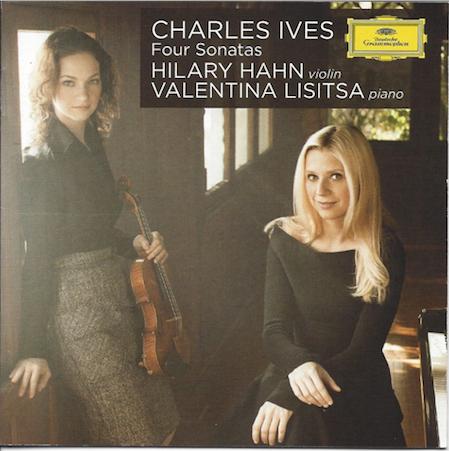
Anyway, I will let you know if this is in fact the piece by Machaut he chooses. The second concert is even more interesting, consisting of all four of Charles Ives' sonatas for violin and piano. Here is where the overcoming bias comes in: I'm not much of an Ives fan. I like some of his music (I owned the Tilson Thomas recording of the "Three Places in New England" orchestral set way back in the 70s and thought it was a fine piece), but other pieces, like his String Quartet No. 2 and the symphonies, I find to be either uninteresting musically or outright abuse of the audience. Sometimes he tried too hard to be the Ernest Hemingway of composers! But a while ago I noticed that Hilary Hahn, my favorite violinist, had recently recorded all four of the violin sonatas and now another very reputable musician is devoting a whole concert to them (with violinist Stefan Jackiw). That's two pretty important votes. So I am going to attend the concert and in preparation, I have just gotten the Hahn CD.
After a couple of listens to the album I'm surprised to find that these pieces are very fine and interesting music. Ives himself seemed to think they were back-pedaling, going too soft on the audience (not sure why this is a vice, though), and in his Memos he called them:
"weak-minded, retrogressive"
and described the First Sonata as:
"in part a kind slump backward, though in some places it is quite the opposite"
Ives, perhaps merely in self-defence against the small-minded conservatism he constantly encountered from musicians in his early years, tended to be tough-minded to a fault.
There is no question that Ives was a visionary pioneer, to the extent that, to this day, his music is perhaps less well understood than it might be. So let's have a look at it and see if we can achieve a few scraps of understanding. Here is the first page of the First Sonata:
You can certainly see why Hilary Hahn, in her notes to the album says.
When we got our hands on the sheet music, we attempted to read through it. That effort quickly stalled. Ives's music may sound at times transparent, but his notation turned out to be tremendously complex, filled with exacting markings for accents, articulations, disjointed dynamics, rhythmic intricacies, and changes of tempo.
You need to understand that these performers, Hilary Hahn and Valentina Lisitsa, are of a level of accomplishment that there are probably not many pieces in the repertoire that they can't simply read off at sight! But this music, even over a hundred years after its composition, is still very hard to read and understand. But, interestingly enough, it is not so hard to listen to! In fact, let's have a listen to this sonata:
The first page is about the first 50 seconds in the recording. What do we notice? Let's just take the first fourteen measures, ending just before the piano solo in the third measure of the last line. The piano begins with a brief phrase that seems to start in F minor, but quickly slides away from that. The notation is a bit perplexing because we have A flats and naturals at the same time, plus we have D# and E# and then D# and C# over an odd chord of E flat, B flat (then B natural) and F#. He is constantly beginning one kind of gesture (as in the first measure) that turns into an entirely unexpected one. The music is neither tonal nor atonal, but hovers between. I am very tempted to start re-spelling half these notes to try and make sense of them. But That Would Be Wrong! Let's look at the melodic lines and see what they reveal. The piano opens with
The phrase divides into two gestures, both opening with an ascending fifth (F to C answered by C to G) and the second one descends D# C# A G. It might almost be heard as a phrase in F ending on the dominant--except that the chord below is something else entirely: E B flat, C#! The next melody in the piano is this (in two sections):
Midway through the violin enters with a phrase that begins with a backwards version of the piano's first phrase:
Click to enlarge
Why does this sound familiar? The piano opened with rising 5th, falling major third: the first three notes of the violin phrase are falling minor third, rising fourth. It is a kind of obscure "family resemblance". This continues with the falling semitone, minor third, which echoes the rising whole tone, whole tone of the piano phrase. Yes, these are not the same intervals. Hey, I said "family resemblance". I mention this because we hear the violin phrase as being a kind of answer to or commentary on the piano phrase (while the piano is introducing another commentary itself). In an odd little gesture towards closure, both violin and piano end this phrase on a C#! The piano then has a tiny little phrase that also seems to echo something from before, then the violin has a new phrase. Incidentally, the piano had a turn with two whole tones (C B flat C D) and now the violin, in longer notes, has a bit of an echo of that: C D (B natural) E. That whole tone turn returns in the piano and both instruments continue with a new phrase that, without copying them exactly, again suggests the material from before. There is also another strong reference to the tonal practices of the past because the violin exactly reproduces the opening rising fifth of the piano (F# to C#) as if it were going to be a canon at the octave. But this does not continue. As I said, the music constantly hovers between tonal gestures and the repudiation of them by continuing in an unexpected direction. This last phrase, even though it began by outlining an F# chord, ends on a G minor minor seventh chord, which almost suggest the dominant of the dominant (if we are in F). Even though this is not really tonal music, it keeps hinting at tonal structures.
So that is a very brief and perfunctory analysis of the first page (50 seconds worth) of the First Sonata! You can see why I don't do many analyses here! Even a very cursory analysis of the first movement would take the whole day. But, it is my view that just a brief look at the bones of a piece gives you a good handle on how to listen to it. So let's go back and listen to the whole piece and see where it takes us.
As a longtime expatriate of Canada, I like to keep tabs on events back home. I once got a note from the Canada Council so someone in Canada may even be reading my occasional critiques. There is something to be said for living outside Canada for giving perspective on things.
Let me preface this with a joke that I am afraid I originated, though it is based on an old joke about Europe (in heaven the Swiss run the trains, the British run the government and the Italians are the lovers--in hell the Italians run the government, the British run the trains and the Swiss are the lovers...there are lots of variations). In my joke I note that the idea of Canada, cobbled together from all the British colonies in North America left over after the American war of independence, was to have British style government, French culture and American style know-how, based on the three primary sources of Canadian identity. Sadly, what we seem to have gotten is French style government, British style know-how and American culture! Funny, sure, but rather unkind.
The truth is that Canada is to this day, rather a subaltern culture, that is, a culture that has yet to find its way, one that tends to be mere reflections and echoes of neighboring cultures. The exception to this is likely Quebec where its own culture has had to develop in isolation from France due to the British conquest of the 1700s. But English Canada from the beginning to now is a kind of second-string hybrid of American and British influences.
An anecdote from my own history might illustrate this. Back in the 1970s when I was arranging to go to Spain to study the guitar (there being no Canadian masters of any stature) I applied for a passport as I had never left Canada before. You need the signature of some establishment figure like a minister, government official or university professor. No problem, I thought, so I hied myself up to the university where I had recently been a student and looked around for a professor. It was the summer break so many of them were out of town. Of the ones that were available, none were Canadian citizens! They were all Americans except for one Czech bassoonist. Finally we turned up a Canadian, but it was an illuminating experience. I recount this to set up an article in today's Globe and Mail: No Canadians need apply: the worrying trend in arts hiring. It is not a worrying trend, of course, but a long-standing practice. Here is an excerpt:
...this week the McMichael Canadian Art Collection in Kleinburg, Ont., named Briton Ian Dejardin as its new director...he is also the fifth international appointment to head a major Canadian cultural institution in the past 15 months. He follows two Americans (Joshua Basseches at the Royal Ontario Museum and Stephan Jost at the AGO) and two other Britons (Tim Carroll at the Shaw Festival and Anthony Sargent at the Luminato Festival, where an Australian was also recently appointed as artistic director).
Let me share another personal anecdote. A friend and colleague of mine at McGill when I was doing a Concert Diploma was Tim Hutchins, principal flute with the Montreal Symphony and much sought after by a number of big name US orchestras. When I knew him he was doing his masters in flute and we shared a performance of Hans Werner Henze's El Cimmaron, a chamber opera for baritone, flute, guitar and percussion. At around that time Tim auditioned for the principal flute position with the Montreal Symphony. They were done in two stages, behind a curtain so the judges could not see who was auditioning. The first stage, at which Tim played his usual superb best, resulted in no-one being hired. This was standard procedure as the basic assumption was that no Canadian would be good enough. So they went to the second stage: international, which meant mostly American candidates. Tim returned to audition for this stage as well and he won the audition to the great embarrassment of the jury. Turns out a Canadian was good enough after all!
So what does all this tell us: that Canada has a serious identity problem, I think. Canadians, in their own minds, are never quite good enough, especially in the cultural field, so we have to keep hiring Americans (and Britons and the occasional Australian) to help us with our own culture! Why in hell would we think that? I suspect because Canadians don't really think we have a high culture. Sure, we have lots of pop stars like Justin Bieber and old-time fiddlers and country stars like Stompin' Tom Connors, but high art? That comes from elsewhere. About all we seem to take genuine interest and pride in is the Group of Seven, plus Emily Carr. Who, you ask? Exactly! They were a group of Canadian painters in the early part of the last century.
In music the situation is, if anything, worse. I knew personally a leading composer from the first generation of Canadian composers who were not actually transplanted from Britain: Murray Adaskin. He studied with Darius Milhaud (and some Canadians like John Weinzweig) and was inspired by Igor Stravinsky.
Here is what the problem is: Canada, a nation with too much geography and not enough history, has so little confidence in its unique vision and perspective on the world, that we invite everyone else to teach us about high art! Perhaps this is normal with pioneer cultures, after all, Russia learned about music composition from a few generations of transplanted Italians, but Russians did not start composing Russian music until they stopped listening to them! See the careers of Mikhail Glinka and Modest Mussorgsky. I'm not sure if any Canadian composer has had the courage to do as they did: defy the conventions of art as practiced by European composers.
Canada is a nation heavily monitored and indoctrinated by the organs of government and media. There are only a few voices heard in the public space and any would-be artist has to somehow win their approval. Arts funding comes from a few sources, mostly government, and it is handed out by juries of peers, that is, established artists who are invested in the current practices. Of course they often give money to artists who demonstrate boldness, but none of this ever seems to coalesce into a uniquely Canadian style or voice. There seems to be the hidden assumption that only Americans or Britons truly have a professional understanding of high art. The question that Canada needs to ask itself is whether art and culture are based on something local and specific, or do they come from some kind of international professionalism?
Like I say, we seem to be a subaltern culture.
As an envoi, I offer a piece by the current grand old man of Canadian composition, R. Murray Schafer. This is a piece for chamber choir titled Miniwanka:
If I were to make an unkind comment, and I will, it sounds and looks rather like George Crumb after a frontal lobotomy.
One piano seller in New York has found a great way to promote his instruments: he loans them to musicians who have to agree to show them on request. Everyone wins! The Wall Street Journal has the story.
At any moment, about 30 piano lovers have seen their lives and living rooms enhanced, if only temporarily, by one unlikely musical angel: a 37-year-old former hair-removal expert named Ronen Segev, a classically trained pianist, who runs a used piano business called Park Avenue Pianos.
Mr. Segev recruits helpers, like Mr. Boente, who are lent pianos free of charge, but there’s a catch: they must agree to turn their homes, offices or studios into active showrooms. Their borrowed pianos are for sale, and Mr. Segev will be bringing potential buyers in to inspect the merchandise. (This reporter, whose entire piano repertoire consists of the theme song from “Beverly Hills Cop,” has been hosting one of Mr. Segev’s Steinways since June).
Sadly, there does not seem to be an equivalent program for classical guitars!
* * *
I might have put this up before, but it is such a cool tour-de-force that, what the heck, let's hear it again. Australia's the Axis of Awesome demonstrate that every pop hit ever uses exactly the same four-chord harmonic progression:
* * *
I'm not saying that Rihanna is just another entitled pop star, but she may have the world's largest collection of stolen wine glasses:
* * *
Due to my near-total ignorance of dance I rarely post anything about it. But I was tipped off to this astonishing display of Russian folk/character dancing by the Moiseyev troup:
We tend to forget the remarkable depth and variety of Russian culture, but this reminds me that three of my very favorite 20th century composers are all Russians: Stravinsky, Prokofiev and Shostakovich.
* * *
Duet with a quantum computer? Well, it is the 21st century! Wired has the story.
As Juliette Pochin, the Welsh mezzo-soprano, sang inside the castle-like manor house at the Port Eliot Festival in Cornwall, an Internet connection piped her voice across the world and into the D-Wave machine installed in the University of South California’s Information Sciences Institute in Marina Del Rey, outside of Los Angeles. The D-Wave is a quantum computer. Some question its bona fides, but it appears to exhibit something called quantum annealing. Working with USC professor Daniel Lidar, Kirke built algorithms that could take in Pochin’s voice and feed it through this quantum-ness, producing new sounds. The machine then sent these sounds back to Cornwall, and as they emerged from a laptop in the manor house, they dovetailed with the live mezzo-soprano.
Okaaay... There is a clip of the computer doing "superposition harmonies" at the link, but it just sounds like really dull Brian Eno to me.
* * *
For a lifetime subscription to the Music Salon, without using Google, list the names of all four of Frank Zappa's children. One of them is currently on tour and the name of the tour is: 50 Years of Frank: ******* Zappa Plays Whatever the (bad word) He Wants — the Cease and Desist Tour.
* * *
Here is something just for those gigging musicians out there: pretty well paying wedding gig. "Wanted: nude cellist for wedding" Well sure, the wedding is at a nudist resort, what did you think?
As classical music continues to deal with longstanding challenges, this observation remains profoundly true. Most concerts halls and opera houses are just too big. More intimate performance spaces have, with reason, become the rage.
Read the whole thing. Of course the trend toward larger and larger halls was a 19th century phenomenon that just continued in the 20th century. The fact is that the receipts are bigger, the bigger the hall which is why rock stars started playing in stadiums. But all the great pieces of music from the 18th and a good part of the 19th century were written for and mostly heard in small halls. Mozart's famous Lenten concerts were a subscription series at which he premiered a number of his greatest piano concertos. The average size of the audience was one hundred and twenty!
* * *
Shopping for classical music: A remembrance is a piece about when we all used to buy our classical records in actual stores. For me it was rather a frustrating experience because I had hardly any money so I usually couldn't buy what I wanted to!
* * *
The envoi for today is unconnected with the miscellaneous items, but will be the subject of an upcoming post. This is the Violin Sonata No. 3 (for violin and piano) by Charles Ives. The performers are Timothy Fain, violin and Jeremy Denk, piano:
I've been keeping an eye on how many posts are up due to my almost missing my 1000th post way back in 2013. The next big milepost will be my one millionth pageview! That is a couple of hundred thousand down the line, though. So this is my 2000th post and obviously an opportunity to bask in my wonderfulness. Or dedication? Prolificness? How about stamina?
I usually do something like put up links to particularly interesting posts that I feel are neglected. But I've done that enough, plus does anyone ever follow those links? Or I could talk about how wonderful my readers are, but I've done that before too and besides, you know how wonderful you are!
Hm, so what shall I do? Maybe I could reiterate how important it is that there be a place where you can actually criticize music and not just praise it indiscriminately--or ignore it completely. A place where you can actually say this is a good piece of music and that is a bad piece of music and in so doing delve beneath the surface of both. And where someone might agree or disagree and you can have a civilized discussion about it, weighing various factors without bias or favor. How many places does that happen? Sadly, it does not ever seem to happen in the mass media anymore. Alex Ross in the New Yorker seems to take it as his marching orders to never say an unkind word about anyone--well anyone progressive, at least! Real criticism such as was practiced everywhere as recently as forty or fifty years ago has almost completely disappeared. Instead, writing about music is largely restricted to feebly disguised marketing and promotion. This might be one reason there is so much crappy music around--everyone is afraid to mention that it is.
But I have been gratified to discover that there are quite a few readers out there with an appetite for the kind of writing about music I like to do. And we have even had a few heated disagreements and remained friends despite that.
So in two or three years this blog might even see its 3000th post! And I hope you will all stick around for that.
How about something celebratory by Scarlatti? Here are several sonatas, starting with K. 204a, which I used to play on guitar: