Wednesday, August 21, 2013

Looking at Music

Something I pointed out a while back is now supported by science: musicians win competitions and build careers with their looks. Here is the study reported in the Harvard Gazette.
“What I found was that people had a lower chance of identifying the eventual winner if they only listened to the sound,” Tsay said. “People who just had the video — even without the sound — had surprisingly high rates of selecting the actual winner. Even with professional musicians, who are trained to use sound, and who have both expertise and experience, it appeared that the visual information was overriding the sound.”
Because musical differences between two top performers are often slight, viewers can more easily pick up on visual cues they associate with high-quality performance, Tsay believes. Factors such as a performer’s engagement, passion, and energy resonate.
Chia-Jung Tsay is a pianist herself with significant performing experience so it is surprising that she, in my view, misinterprets the evidence. Yes, sure, of course appearance is a big factor: that is precisely why young performers building careers put so much emphasis on it. I have talked about that here and here. But, "musical differences between two top performers are often slight"? Where did this astonishing misapprehension come from? I can understand that an average concert-goer certainly being more swayed by the artist's garb or demeanor than by the strength of his or her interpretation: that is, after all, exactly why agents, managers and marketing advisors recommend what they recommend. But musicians? Chia-Jung Tsay seems to be saying that even musicians are oblivious to the actual musical content of the performance. But what is probably actually happening is that even in competitions judged by musicians, the visual aspect is given a lot of weight. I think this is simply because of the corruption of musical quality that has invaded even the classical musical world. Judges, perhaps even against their better judgment are saying to themselves, "oh yes, she has an excellent chance of a career because she plays pretty well and looks really great--audiences like that."

Want to know the truth? Despite the supposed "findings" of studies like these, musical differences between "top" performers are not "slight", but often enormous. There are gorgeous looking pianists that have wooden phrasing, and empty interpretations. There are very ordinary, or even off-putting in appearance, pianists that are as profound as anyone could wish for. A significant number of the posts on this blog are about distinguishing things like this, so just have a look around. There are so-called Bach specialists that play Bach really badly. There are string quartets with no feeling for Beethoven. And these are famous artists with big careers.

I think the real implication of the study I linked to at the top is that after decades of the unrelenting denial of aesthetic quality and difference, even people who should know better are giving in.

But vive la diffĂ©rence!

Now I'm going to put up two performances of a Chopin ballade. For the first artist there are NO clips on YouTube that do not feature a video of her playing, so to perform the experiment you will have to start the clip playing and NOT watch it.


Here is another clip of the same piece played by a different artist:


So, what do you hear? Any major differences between these "top performers"? Or are they "slight"?

Tuesday, August 20, 2013

Brief Hiatus

Tomorrow I will be going out of town for a few days and may not have the opportunity to post much to the blog. So in the meantime, there are lots of older posts that you might find interesting. Here are a few from the early days of the Music Salon, way back in June, 2011:

http://themusicsalon.blogspot.mx/2011/06/great-bach-fugue.html

http://themusicsalon.blogspot.mx/2011/06/time-quotient-of-music.html

Here is one of my more outrageous posts from back then:

http://themusicsalon.blogspot.mx/2011/06/how-to-listen-to-music-boring-quotient.html

A little discussion of a song by Bob Dylan:

http://themusicsalon.blogspot.mx/2011/06/one-song-three-times.html

On the transcendental in music:

http://themusicsalon.blogspot.mx/2011/06/transcendental-music.html

And a follow-up, on composition:


http://themusicsalon.blogspot.mx/2011/06/how-not-to-compose.html

That should keep you occupied for a bit. Now let's end with a great piece of music by Beethoven: the Archduke Trio. The artists are a rather remarkable trio oEmil Gilels, piano, Leonid Kogan, violin and Mstislav Rostropovich, cello.


The Loneliness of the Composer

I was reading a post over at NewMusicBox where Rob Deemer notes that the Bureau of Labor Statistics in the US does not have a separate category for composers, lumping them in with music directors and with "jingle writers", arrangers and songwriters. There is even a rather depressing map included that purports to show "Employment of music directors and composers, by area, May 2012":


See all those white spaces? Utah, North and South Dakota, Nevada, Alaska--apparently these places simply have no composers. As for Canada, I can't even find similar data. There is a long list of Canadian composers (that seems to be missing a lot of names), on Wikipedia. But, as in the US, if we were to see the concentration by area, it would be heavily focused on Montréal, Toronto and Vancouver with little patches in places like Halifax, Winnipeg and Victoria. In the US, outside of New York and adjacent areas, and Los Angeles, composers would be thin on the ground--again, with patches in Boston, Chicago and a few other places.

Being a composer is not easy. The Guardian recently put up an interview with a very successful composer, Philip Glass, where he mentions that he wasn't able to make a living as a composer until he was into his forties! He says,
I didn't make a living until I was in my 40s – I did construction work, moved furniture, anything. Nobody makes you choose the life of an artist. We do it on our own, and we take our chances.
In some ways music chooses you, though for most people it is not quite as open-and-shut as it seems it was for Philip Glass. I'm sure all composers have doubts, but they likely rarely share them with others. Our image of people like Beethoven is that of an indomitable will that was unstoppable. We don't think of Beethoven, on the verge of, say, the Fifth Symphony, thinking to himself, "I just don't know if I can write another symphony... do I even have any more ideas..."

I'm afraid that the vast majority of composers in both the US and Canada are quietly employed in universities teaching composition and perhaps theory to generations of undergraduates. Occasionally they may actually get a local performance: perhaps a string quartet or trio plays a piece of chamber music. On a rare occasion, the orchestra may play a short piece by the local composer, likely never to be repeated. There is little public profile and no glory for the average composer.

By "average composer" I don't mean some know-nothing schlemiel who can't write decent music to save his life. No, I mean an actual, sincere composer, who recognizes the nature and challenge of music composition, who sees him or herself as part of that great tradition of composition in the West that goes back to those shadowy figures Leonin and Perotin, working at Notre Dame in Paris in the 12th century.

Composers like Philip Glass that have actually achieved an international reputation and are showered with commissions are rare as hen's teeth. We could probably count them on the fingers of our two hands. And compared to pop stars, even Philip Glass is a near-nonentity.

It's a lonely vocation, being a composer. In terms of your daily existence, probably not that different from a Trappist monk. You sit alone with your working materials day after day, seeking to discover and create something that will be worth hearing for listeners, something that, if not entirely new and original, will at least be a real expression of a human being with perhaps some new perspectives on the materials of music.

We don't reward these people with very much and some receive no reward at all, but without getting too melodramatic, theirs seems to me to be a fairly important slice of our culture.

Let's listen to some Philip Glass to close. This is the third movement of his Symphony No. 8:


Monday, August 19, 2013

Schoenberg and the Paradox of Modernism

Suppose I told you that there was a good book on music composition that was thorough, intelligent and conservative? That the foundation of the method was the mastery of all the traditional elements: the musical phrase and cadence, the motif, the theme, the traditional forms such as the small ternary, the minuet, the scherzo, the rondo and the sonata-allegro. That the composer used as a model for all these was Beethoven and that the basic assumption was that the music to be written was tonal and that every theme implied a harmony, i.e. a tonal harmony. Who would you guess the author to be?

Hindemith? Well, possibly. Stravinsky? Certainly not! Brahms? No, this was written over quite a number of years up to 1948 and not published until 1967. Here is the cover of the current edition:


Yes, that's correct, the author of this very conservative guide to musical composition is Arnold Schoenberg, one of the main proponents of modernism in music. The one who invented 12-tone music; the one who destroyed, apparently for all time, tonality; the one whose music, it is claimed, can empty any concert hall, the teacher of those icons of modernism Alban Berg and Anton Webern.

Yet decades after he developed 12-tone technique in the 1920s, he was teaching at UCLA where he wrote this textbook for young students of composition. He taught there through part of the 1930s and the 1940s. Among his students were both John Cage and Lou Harrison. (He used to play tennis with George Gershwin!) On one occasion Schoenberg said, "My music is not modern, it is merely badly played."

Does no-one see the astonishing contradiction here? This is like the abstract expressionist painter Mark Rothko insisting that his students study traditional drawing working with still lifes and human models. Instead, according to Wikipedia:
In 1936, Rothko began writing a book, never completed, about similarities in the art of children and the work of modern painters.[25] According to Rothko, the work of modernists, influenced by primitive art, could be compared to that of children in that "child art transforms itself into primitivism, which is only the child producing a mimicry of himself." In this manuscript, he observed that "the fact that one usually begins with drawing is already academic. We start with color." Rothko was using fields of color in his aquarelles and city scenes.
"The fact that one usually begins with drawing is already academic." But Schoenberg, rather than regarding the study of tonal music as "academic", i.e. of interest only to historians, made it not only the foundation of his teaching of composition, but the only approach, based on his published texts at least. Atonal music is not even mentioned in this book, nor in Structural Functions of Harmony.

Why is it that the only one of the major figures in musical modernism to spend a significant amount of time teaching composition, taught according to the principles of tonal harmony? I don't want to make too much of this because obviously, as he taught the methods of 12-tone composition privately to Berg, Webern and others, he did not ignore his own method in his teaching. But none of his published works on theory deal with 12-tone composition.

I doubt I can resolve this contradiction; certainly not in a blog post. But I think there is a paradox here and I think the reason for it might be quite interesting. Let's listen to a little Schoenberg to end. This is the Violin Concerto, op. 36, written in 1936, soon after he began teaching at UCLA:


Perhaps in Schoenberg's music we can hear the tension between traditional musical structures and, as he saw it, the historical demands of modernism. And perhaps we could go even further and see these tensions as reflecting the tensions between the "progressivism" of certain 20th century political movements and the terrible struggle between them and the more traditional societies that resisted them. There is a kind of eerie authenticity in Schoenberg's music that is worth pondering...

UPDATE: Replaced the original clip with one of the complete concerto played by Louis Krasner who did the premiere in 1939.

Sunday, August 18, 2013

Is This Pseudoscience?

I think I can slip this into the Music Salon because it does mention Mozart. Here is a article I just ran across:

Gym workouts and sunbathing do more for your brain than crosswords and Mozart

Here is the key paragraph:
“Let me dispel a brain development myth,” Spitzer told The Economist. “Many people think classical music is going to enhance brain function (the Mozart effect) or playing particular games sharpens one’s cognitive function. These theories have been looked at in detail and they don’t stand up. It is disappointing in a way, but what we have learned is that exercise is the key thing for brain function.”
Brain development, brain function: are these code words? OK, sure this makes a kind of sense, but it seems woefully inadequate. In French they have a phrase that translates to "intellectual formation" and it means the training that you need to undergo in order to develop your thinking capacity. This training, oddly enough, does not consist of physical exercise and sunlight. It varies according to discipline, of course. In philosophy it might consist in reading some standard texts such as Aquinas' five arguments for the existence of God or Berkeley's dialogues between Hylas and Philonous about the existence of the material world or Kant's Prolegomena to any future metaphysics. Then you need to discuss these texts with a philosopher. This kind of training goes back to Socrates.

In music, there is a fairly standard kind of training that is partly intellectual and partly aural. You learn how to read music notation, study counterpoint and harmony and learn to write music down when you hear it and sing melodies at sight. This is also usually accompanied by a review of music history. There is no way to have a deep understanding of music without going through this sort of training. Exception: in pop music they take a different approach that is largely aural.

So when they talk about "brain development" and "brain function" they must mean just the physical activity of the brain. Because if all you do is exercise and get plenty of sun, you will be perfectly ignorant and incapable of actually doing anything with your brain! I think this is yet another example of scientists talking about the brain as a mere physical organ that they have only the slightest actual understanding of. What we use every day to perform every kind of mental activity, such as thinking (cognitive function in their nomenclature), is the mind, not the brain. Perhaps in a hundred years or more we might understand the relationship between them. But articles like the one I linked to do little more than demonstrate that the mind and the brain are two different things.

But of course, just listening to Mozart or Bach or anyone else is not equivalent to training your mind.

Now let's listen to some Mozart. Here are the Beaux Arts Trio with the first movement of the first Piano Trio in B flat:


Modulation

I've mentioned modulation quite a few times on this blog, but I haven't talked much about it. In music the term refers to the process of changing one key center for another. Here is the Wikipedia article. This Wikipedia article is not a particularly good introduction as it immediately proceeds into the technical details without giving much context.

You first have to have some idea of the notion of a "key". In music a key is a kind of basic structure that you could envision laid out like a baseball diamond:

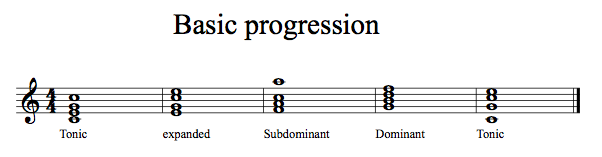
You start at home plate, the top corner, and then proceed anti-clockwise to first base, second base and third base before returning home. Similarly, in music, the basic structure is that you start with the tonic, which is often expanded, then you go to the subdominant or related chord, then the dominant and finally return to the tonic. Here is how this looks in notation:


Of course, in actual pieces, composers depart from and vary this basic structure in many ways. But you would be surprised at how much music is written according to this structure. The movement from dominant to tonic normally creates a cadence and it is used to end most phrases and all major sections and the end of every piece. I need to qualify that by saying "a cadence ends every piece in common practice style". That is, nearly everything in the 17th and early 18th centuries (the exception being some holdovers from modal harmony) and everything in the late 18th and through most of the 19th century. I challenged a commentor to send me one example of a piece by Haydn, Mozart or Beethoven that did NOT end with an authentic cadence. I don't expect to receive any examples. This is more important than a "rule": it is a basic principle of tonal music. The key is defined by the cadence and without this, the music really isn't tonal. You define a key by running around the bases as I have illustrated above.

So, you have run around the bases a few times and start to worry that you need more variety. The solution is often to modulate, or change gears into a new key. After a section or more in the new key (or possibly more than one new key) you move back to the original key. This is called modulation. How do you do it? There are a number of ways. One of the most common is to use a chord or even just a note that is common to both keys. This is called a pivot chord or note and I suppose you could metaphorically call it a kind of "clutch" that enables you to change gears.

The most typical kind of modulation, at least in major keys, is to the key of the dominant. In C major, this would be a modulation to G major. A signal of this change would be the appearance of sharps on the Fs as G major has a key signature of one sharp, F. If you were in the key of G and modulated to the dominant, which is D, you would suddenly see C#s appearing as D has two sharps in the key signature: F and C. Let's use as an example a famous song by Franz Schubert, "Heidenröslein". Here is the composer's autograph of the song:

Click to enlarge

That's pretty easy to read, unlike Beethoven's autographs. But we can find a clearer one:

Click to enlarge

What you see here are two phrases. The first is in the tonic key, G major, indicated by the key signature of one sharp (F). This phrase extends for four measures and the harmonies are tonic, supertonic (with tonic pedal), dominant, tonic. The supertonic serves the same function as the subdominant. In symbols it would be I, ii 4/2, V6/5, V4/2, I6, I. The next phrase, starting in measure 5, modulates to the dominant. It starts on what was the tonic, but this is going to be the pivot chord so we should now think of it as the subdominant. G is the subdominant of D major, the new key. So the harmonies in this second phrase, which is six measures going to the end of the second line, are subdominant, dominant, tonic, supertonic, dominant, submediant, tonic, supertonic, dominant, tonic. So in this phrase, instead of just running around the bases once, he does so three times. Every time we return to the tonic it is like returning to home plate. All Schubert has to do in the final phrase is return to G major, which he does. Simple! Let's have a listen to the song. This is Peter Schreier singing in the Schönbrunn Palace in Vienna. The first verse, which encompasses the first phrase in G major, the second phrase modulating to D major and the third phrase which returns to G major, takes only 36 seconds!


So that is the basic idea of modulation. Composers have found hundreds of ways to make it more elaborate, but the basic principle is as I have explained. It is rare to find a piece of classical music that does not modulate.

Saturday, August 17, 2013

Pop Music Fights Totalitarianism?

I just read a very troubling article by someone that I quite admire: Glenn Harlan Reynolds of Instapundit fame. Glenn doesn't publish his statistics, but based on past information he probably gets several hundred thousand visitors every day. He is the blogging equivalent of a regional newspaper. He is a libertarian at heart, a law professor who is a specialist in 2nd amendment law. He is also pro-choice and supports gay civil rights. He likes to say that in his perfect society every gay married couple would have an assault rifle in the closet. So, he doesn't fit into the usual political categories. As a libertarian, he has quoted the saying a few times that libertarians want to take over the government so they can leave you alone!

He just put up a link to an essay he wrote eleven years ago. Oh, one thing I forgot to mention, he used to be into music of the electronic dance music variety and his brother plays guitar in a band. So he has more knowledge of and exposure to music than most people. Ok, here is the article: "The King of Anti-Fascism". Here is the central claim:
Music took over the airwaves, and today in most of the world a crazed orator would have a hard time getting enough listeners to take over a country no matter how persuasive his spiel. After Elvis, the commercial culture of rock and roll simply occupied the mindspace that totalitarians need, and it out-competed them.
You should read the whole thing. He sets this up by noting that Hitler was able to sway the people of Germany through an emotional appeal that was especially powerful because it was made through the medium of radio:
Hitler was aided by a new technological innovation: the radio. Nazism's totalitarian sibling, communism, spread largely by print and took decades to gain a foothold. But radio allowed Hitler to manipulate emotions wholesale, in a way that had never been possible before. And the masses - starved for entertainment and desperate for catharsis, and a sense of purpose - ate it up.
He contrasts this with the way that Elvis Presley took over all the new media:
Hitler used the tools provided by new technology. But Elvis owned them: radio, television, movies, it didn't matter: he conquered them all. And the changes that he brought about helped to topple totalitarian regimes, and make new ones less likely, for he left behind a changed culture that short-circuited the mechanisms that Hitler had used to secure power - and the mechanisms that other regimes used to maintain it.
Since Elvis, the bonding-and-catharsis element of mass media has expanded to outdo anything that any politician can deliver. We describe an especially popular politician today as looking "like a rock star," rather than the other way around, after all.
Let's look at that central claim again:
Music took over the airwaves, and today in most of the world a crazed orator would have a hard time getting enough listeners to take over a country no matter how persuasive his spiel. After Elvis, the commercial culture of rock and roll simply occupied the mindspace that totalitarians need, and it out-competed them.
What is it that troubles me about all this? Actually this is a fascinating essay because of the things it implies as much as what it states in so many words. For example, there is the widespread, vaguely 60s idea, that rock music is the great liberator. I have run across this in a lot of different places. Alas, the corollary to that is that classical music is the great oppressor! Alex Ross, even though he writes on classical music, seems to share that view in his book The Rest is Noise. I engaged with some of this in this post. I dealt with the problem more directly in this post.

The first problem that occurs to me with Glenn Reynold's theory is that we have a very powerful counter-example right before us today. All over the Middle East the religious leaders use radio and television and the internet to spread exactly the kind of totalitarian message that Glenn says was "short-circuited" by rock and roll. The problem is that "hot" media like radio and television can easily be controlled and put to use for any purpose good or bad. You can listen to Elvis singing "Don't Be Cruel" or some member of the Muslim Brotherhood inciting people to burn down Christian churches in Egypt.

Glenn ends with these paragraphs:
When the Berlin Wall fell, Elvis and the musicians who came afterward deserved as much credit as General Dynamics or the Strategic Air Command.

The same holds wherever people try to tyrannize the minds of men and women. It's no wonder that the Taliban opposed dancing and Western music, and no wonder that the increasingly desperate mullahs of Iran are flogging people for dancing at birthday parties. They can't compete with the King and his descendants. And they know it.
It would be nice if this were so, but it's not. Elvis and the Beatles, who were the other great masters of rock and roll and the new media, had a huge cultural influence on Western society, but only on Western society. The mullahs hate Western music of all kinds. They probably hate Mozart as much as they hate Elvis. And they can keep Elvis and Mozart out of their societies because they can use the radio to spread their message just as Elvis did. And they do it with more focus and clearer intention: they are not there to entertain, but to indoctrinate.

I remember a quote from Joseph Stalin who asked, when warned about the influence of the Pope, "yeah, how many divisions does he have?" In Egypt right now there are 8 million Christians being terrorized by the Muslim Brotherhood. No cultural force, not even Elvis, has the ability to lend them any help whatsoever. But if they had an assault rifle in every closet that might be a different story.


UPDATE: I think I have few rosy illusions about the power and influence of rock music because I am one of the few people who discusses this issue who actually played in a (not-very-good) rock band in the late 1960s. Believe me, our music didn't liberate anyone! But we did have a good time.