It used to be the case the the Canadian Broadcasting Corporation, the CBC, had some sort of mandate to expose and educate the populace with a bit of classical music. I remember watching Glenn Gould do a half-hour show on Sunday afternoons on CBC television. But now it looks like the CBC, the public school system and even the Victoria Conservatory of Music, have thrown in the towel and decided that there is only one kind of music: popular music. Here is an article: Five music classes from Island finalists in CBC's Canadian Music Class Challenge. Here is the Victoria Conservatory entry:
So why this song?
The eighth annual contest is run by CBC Music in partnership with the charitable organization, MusiCounts. In order to qualify, music teachers at the elementary, middle, and high school level were asked to to submit videos of their students performing selections from a list of 24 pre-approved songs, including hits by Neil Young, Blue Rodeo, Trooper and Tegan and Sara, among others.
Ah, so a classical music conservatory was actually not allowed to submit a classical piece. But if they had I'm sure it would have been far more professional.
Weird times. I have the feeling that in a thousand little ways classical music is simply being pushed to the curb and not even allowed to win over new audiences.
UPDATE: And the Victoria Conservatory group won the contest in their category, Community/Independent/Private School. The prize? $1,000 in new musical instruments and a plaque.
Slipped Disc has an item about the announcement that Tom Jones will give a performance at the BBC Proms this year:
The BBC announced proudly today that the Welsh crooner Sir Tom Jones will make his Proms debut on September 1 in a concert marking the 50th anniversary of Stax Records’ 1967 tour. Stax is an American pop label, based in Memphis.
This commercial pop celebration is as low as the BBC has gone in dumbing down the Proms.
As is usual at Slipped Disc, Lebrecht tries to make it into a scandal of some sort. The comments section seethes with discontent:
It might, just might, have been justifiable if there were some higher purpose – like demonstrating a link between classical and some other genre.
I don’t see what “marking the 50th anniversary of Stax Records’ 1967 tour” has to do with the Proms, or anything much.
Can’t help feeling that there’s a long term objective of ditching classical entirely.
While others disagree:
Oh for goodness sake Norman get over yourself. It’s music, maybe not to your taste but it’s people like you who put Joe Public off classical music with your small minded snobbish attitude to popular music.
He’s a great entertainer with the ability to hold an audience in the palm of his hand. I can only think of Adele, Shirley Bassey and Dollly Parton with the same ability and charisma. There’s nothing wrong with the Proms introducing his kind of music. As long as they don’t give Russell Watson and Alfie Boe Proms I’m happy.
I'm not sure who Russell Watson and Alfie Boe are, but we can speculate.
What is the problem here? Is it that some people like Tom Jones and others don't? Is it that celebrating a Stax Records anniversary at the Proms is a bit odd? Is it that the Proms is a venue primarily for classical music and not for pop music genres? Is the problem the snobbishness of classical music lovers? Probably all of the above except for the first one. All performers have fans and non-fans, so that really isn't the issue. With disputes like these, I like to step back and see if I can find some underlying principles.
First of all, what are the Proms? From Wikipedia:
The Proms, more formally known as the BBC Proms or Henry Wood Promenade Concerts presented by the BBC, is an eight-week summer season of daily orchestral classical music concerts and other events held annually, predominantly in the Royal Albert Hall in central London, England, UK. Founded in 1895, each season currently consists of more than 70 concerts in Albert Hall, chamber music concerts at Cadogan Hall, additional Proms in the Park events across the UK on the Proms' final night, The Last Night of the Proms, and associated educational and children's events. In 2009 the total number of concerts reached 100. The season is a significant event in British culture. In classical music, Jiří Bělohlávek described the Proms as "the world's largest and most democratic musical festival".[1]
I have to confess that while I have attended a number of concerts in London whenever I have had a chance, I have never been to the Proms. But I have seen many, many clips on YouTube of Proms concerts and it sounds like a wonderful festival and one with a long history. One thing seems fairly clear: the festival is one of classical music, including light classics and children's and educational concerts. No particular reason to include Tom Jones or a tribute to an American pop label unless the organizers were feeling some pressure to be more "inclusive" or "diverse". On the other hand, while inclusiveness and diversity tend to dilute and blur the focus, they are not so harmful in moderation.
I think that other underlying factors are the simple insecurity of the organizers and administrators about their role in promoting classical music. As with all manifestations of Western civilization, there is a feeling that we have to abase ourselves to avoid being called colonial oppressors or promotors of the patriarchal hegemony or something. So perhaps putting on a concert as a homage to Stax Records and featuring Tom Jones is just a mild example of virtue signaling: "look at us! We're not bad people, we even have a concert with Tom Jones!"
Another aspect is one of being sensitive to distinctions, something that seems to be a rare element these days. The key word in one of the comments above is "entertainer" as in Tom Jones is a "great entertainer." And so he is. But that is precisely the reason why he may not be a suitable artist for this venue. Classical musicians are not entertainers, they are artists. While the boundary is often unclear and definitions of both terms are vague, the difference is a real one, and easily demonstrated. This is a performance by an entertainer (Tom Jones in a recent performance):
And this is a performance by an artist (Thomas Quasthoff accompanied by another artist, Daniel Barenboim):
Now you could certainly make an argument that Tom Jones and his accompanying musicians are also artists and that would be an interesting discussion. In fact, sooner or later we would get down to the differences in artistry between the two groups of performers and I for one would make some points about the kind of expression involved and what sorts of moods they seek to promote in the audience. Actually, I don't mind if the argument ends up with my acknowledging that, ok, sure, we can call Tom Jones an artist as long as we notice that his kind of artistry is very different from that of Quasthoff and Barenboim. Those kinds of discussions lead to the uncovering of lots of interesting details at the very least.
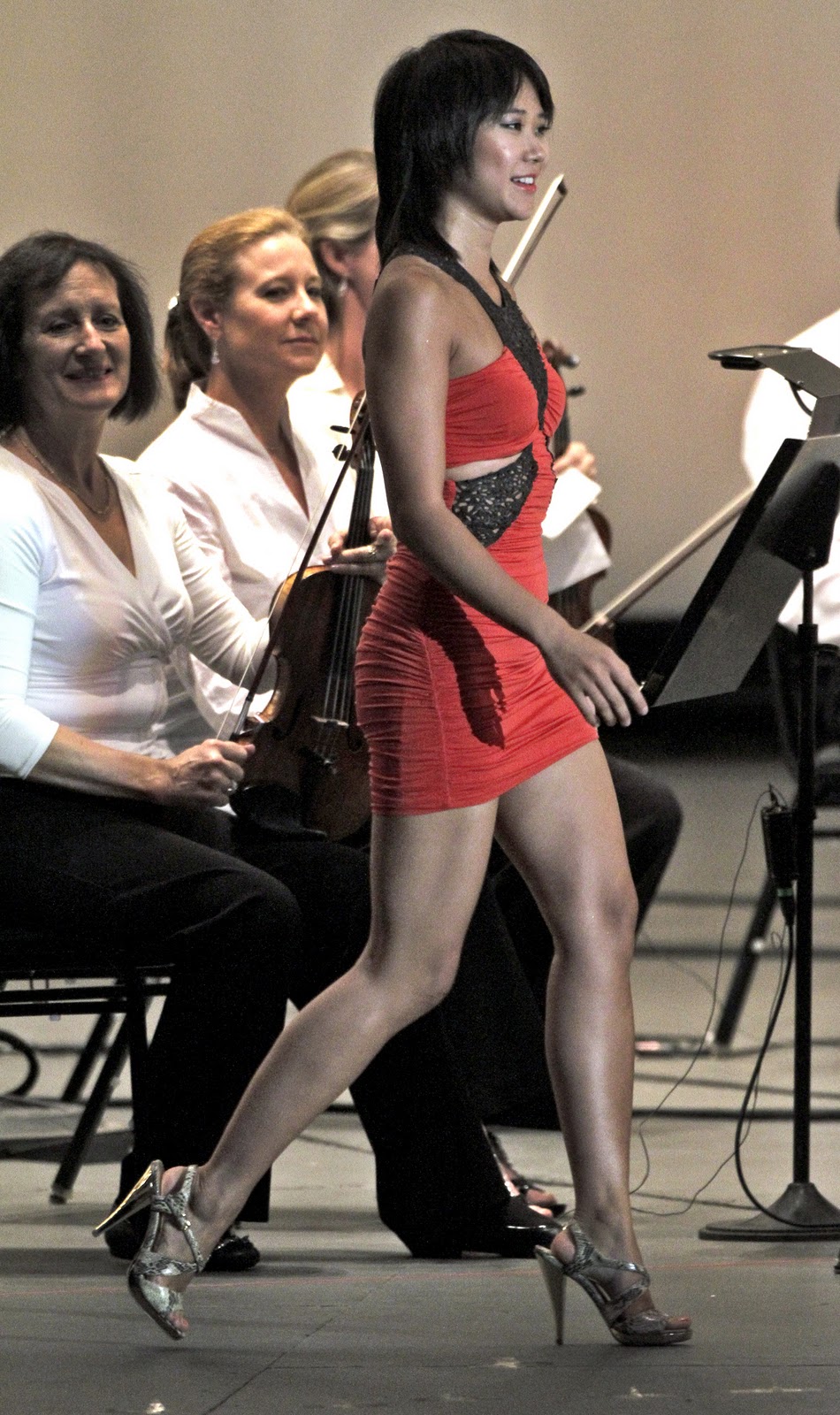
How much has a pop music sensibility invaded the classical music world? Have a look at this article with accompanying photo of pianist Yuja Wang. If you didn't know she was a pianist what would you have guessed? Escapee from a reality TV show? Pole-dancer?
This has been going on for quite a while. Remember Vanessa-Mae?
Her first big album was released in 1995 combining classical and pop music, but she was really a pop musician who played violin, though she started out as a classical musician. More and more these days, though, a pop music sensibility seems to be invading all of classical music. Here is another article. By "pop music sensibility" I suppose I am talking mostly about sexuality. We are always, it seems, looking for the next young thing, but isn't it the case these days that the next young thing, especially if she is female, just always seems to be extremely good-looking? Here is another young pianist:
This is slightly troubling because while the playing is a bit dull, the artist is extremely attractive. I've always had the idea that the performer should not overshadow the piece. But this is hardly a fundamental principle--just a feeling. I do know that how she looks sticks in my mind, but how she plays, in this and other music, does not.
Now what is the probability that all the young stars of today also happen to be very attractive? Surely there must be some stupendous young musicians out there who are rather plain? And if there are, then they seem to be being eliminated somewhere along the line? Is it in school, university or conservatory? At Julliard or Peabody? Or does it happen at the competition level? Faced with two brilliant players do the judges tend to choose the more attractive one because they know their chances of a career are better? Based on my experience with competitions I strongly suspect that the most interesting musician will always place second or third just out of the sheer obtuseness of the judges. So a very beautiful competitor with facility will often win the competition over an interesting musician. That seems to be what Buniatishvili has: facility. Oh, and Yuja Wang, too:
They both sound rather alike to me. Smooth (though not with an entirely even touch), facile and predictable. Good fingers without much actually happening under the surface. In order to confirm this impression--for it is nothing more--I looked for some Beethoven by these artists without much luck, at least on YouTube. But I did find them together doing this:
Now that reminds me of the lesbian scene with Natalie Portman and Mila Kunis from Black Swan. Yes, very, uh, enjoyable. But not a primarily musical experience. Both of these artists seem also to avoid Bach the way vampires avoid holy water. Possibly for similar reasons. It is not very easy for me to decide much about a performer's depth of musical understanding if all they play is music with itself very little depth. But perhaps that's the point.
Oh, I understand the motivation. You have to do whatever you need to, to get noticed in the very competitive musical world of today. It's the same in pop music. But I think that at some point someone ought to point out that a sexy dress and a moving performance are actually different things.
Here is a performance from a famously hip and eccentric pianist from not that long ago:
Sure, I know he played a couple of wrong notes, but it is a musically strong performance of a powerful piece of music (with an interesting and unexpected ornament at the end). Could Friedrich Gulda manage to become known if he appeared today? Or Martha Argerich?