Showing posts with label music and economics. Show all posts

Tuesday, March 18, 2025

Money and Art

As frequent readers know, I am a frequent attendee at the Salzburg Festival held, for the last one hundred plus years in Salzburg, Austria in July and August. For those six weeks, Salzburg is the center of the world's classical music. Over 250,000 tickets are sold and the concerts have an average attendance of around 94%. But even with this enthusiastic support the festival needs a lot of patronage. This comes from the Austrian government and corporate support. The main sponsor is Audi and one often sees Audi cars on the street proudly inscribed with "Main Sponsor of the Salzburg Festival." However, the festival also seeks private patrons and a couple of months ago, as a frequent attendee, I received a request for a donation. Here is what I think is happening.

Austria and Germany are very strong supporters of classical music as being a central element in their national cultures. Germany has around eighty opera houses compared to perhaps a dozen in all of North American including Canada, the US and Mexico. But the strength of the Germany economy in particular is now in question. Here is a recent headline: Audi to cut 7,500 jobs amid ‘challenging’ switch to EVs.

Carmakers are slashing jobs as the industry struggles with weak demand among customers for EVs but demands by lawmakers across the UK and EU to shift to electric.

Total EV sales across Europe, including the UK, fell by 1.3pc in 2024, according to the European Automobile Manufacturers’ Association.

Audi has been hit hard by slowing EV demand. The carmaker’s deliveries of fully-electric vehicles slid 8pc year-on-year in 2024, to some 164,000. In February it closed a plant making EVs in Belgium that employed about 3,000 people.

Cuts at Audi are the latest in Germany’s auto industry, which has been hit hard by a slower-than-expected shift to electric cars, the loss of cheap Russian fuel and fierce competition from Chinese rivals. Audi’s parent company Volkswagen announced in December it would cut 35,000 jobs at its VW brand in Germany by 2030.

It's not just cars, of course, the really lunatic climate change policies being practiced in Germany are resulting in a slow but inevitable deindustrializing of the country.

A much poorer Germany means less support for things like the Salzburg Festival. I mention Germany in particular because the main patrons are all German companies. Austria, a much-smaller economy, provides much less funding.

The truth is that things like the Salzburg Festival are formidably expensive to put on. I have to research the budget sometime if I can get the numbers. But it would not surprise me if they needed between $100 and $150 million dollars annually. And that is just a wild guess.

Let's listen to some cheering music. From the 2005 Festival here is Valery Gergiev conducting the Vienna Philharmonic in Rimsky-Korsakov's Scheherazade.


Sunday, December 8, 2024

AI kills music workers

The actual headline is: Music sector workers to lose nearly a quarter of income to AI in next four years, global study finds.
The study concluded that under current regulatory frameworks in most countries, creators stand to lose on two fronts. Unauthorised use of their works by generative AI models will eat into remuneration earned through copyright, while at the same time work opportunities will shrink as AI-generated outputs become more competitive against human-made works.

The report predicted that by 2028, exponential growth in generative AI music would account for about 20% of traditional music streaming platforms’ revenues, and about 60% of music libraries’ revenues.

AI developers and providers in the music industry stand to gain €4bn (up from €0.1bn in 2023) while developers and providers in the audiovisual sector stand to gain €5bn over the same period.

It will be revenue “derived directly from the unlicensed reproduction of creators’ works, representing a transfer of economic value from creators to AI companies”, the report warned.

Reports like these are actually written mostly to benefit governments (who provided the grants to fund their production). They provide governments the opportunity to do something:

“We must ensure strong protections for their work, especially Indigenous Cultural and Intellectual Property, so that AI platforms respect protocols and enhances rather than exploits First Nations culture. The Australian and New Zealand governments need to take the lead and act decisively to protect the livelihoods of creators and the future of our creative industries.”

That's just blather, of course--and poor grammar. The real truth is that music, as an art form, is not actually an industrial "sector" because it is not actually a commercial product. Of course the music business consists entirely of commercial product, that's why it's a business, but that has little to do with music as an art. If you are a creative artist working to create music, your should not expect to have remuneration or earnings or income from copyright or work opportunities. Because you are not producing a marketable commodity. Whew. That's a relief.

Our non-commercial envoi of the day: Carlo Gesualdo, Moro lasso


Sunday, September 10, 2023

Heaven for the bean-counters

Let's start with a quote that got me thinking:

As David Mamet told Tablet last year, “I’ve started a couple theaters. Had the time of my life. And at some point if a theater is successful the bean counters come in and … in any business there’s a situation where the bean counter drives the other guy [the artist] out and that’s what happened in the regional theater.”

That's from The Toxic Gentleness of the American Theater over at Tablet magazine. So many things in the music world signal that yes, the bean counters are in charge, and have been in charge for a very long time. There used to be some interesting hold-outs: Frank Zappa, the Talking Heads, even David Bowie and in the classical world, most ensembles just clinging to a few donors and government subsidies. The truth is that the money is always in appealing to the greatest number. In restaurants that means McDonald's and Starbucks over your local joint or your gourmet palace. In music that always means the easily consumable over the challenging and complex or, hell, it doesn't even have to be complex. But it does have to not be easily consumable. That way lies Zamfir and Kenny G. Oh, and Taylor Swift of course.

The regional theatre world seems really different from the classical music world and one wonders why. Here is the take from the above article:

Things have been changing for a long time now, but the changes were accelerated by the pandemic, with the power shifting heavily in favor of ambitious, angry, younger members of the community. The pandemic shut America’s theater doors. Then, while everyone was on Zoom trying to figure out how the show would go on, the principles of the Black Lives Matter movement—including the idea that “show must go on” culture is “driven by fear” and disproportionately harms nonwhite artists—became the new religion. If theaters couldn’t put on shows, they could certainly change their mission statements, promise to cull white staff and creatives to achieve diversity quotas, and scare off any wrong thinkers who might still be lingering in the wings, including unvaccinated artists.

Much of the revolution has been led by youthful millennial Bolsheviks with little to no experience starting a theater, producing a play, or fundraising at scale. (Forget about focusing a light, sewing a dress, or building a backdrop.) What they do have are extremely strict ideas about how to enact “justice” in their industry, a desire to maintain a bourgeois lifestyle in a profession that requires some degree of lack, and a mission to fundamentally change the purpose of theater, from being dedicated to the goal of sharing some transcendence with their audience to making everyone involved in the production feel “seen.” They are proponents of what I call “toxic gentleness.” The reality now, as one perceptive theater-maker pointed out to Tablet, is that most of the younger generation coming up in the industry are far more interested in activism than art. The elders, meanwhile, have been under such unrelenting pressure to prove their loyalty to the cause of progressive goodness that they would rather retire than attempt to guide the kinderlach on their mission. And many have.

The forces of progressivism seem far weaker in the classical music world. Perhaps it is the highly demanding technical requirements that screen out the activists. Perhaps it is the more or less conservative audiences or perhaps it is still the tenuous influence of the European and historical background. But whatever the cause, it seems as if the classical environment is pretty far from the situation described above. But maybe it is just down the road. Or maybe we are just not worth the trouble of killing off.

I've always noticed or been drawn to the music and artists that are not the most popular. Well, with the exception of the Beatles who somehow managed to be both hugely successful and hugely good. But usually it is the more obscure that draws my interest: The English Beat and the Incredible String Band over The Rolling Stones and U2. The entire world of classical music is just a financial rounding error these days so preferring it puts you into the weirdo category, something I am entirely comfortable with.

As long as I can listen to, stream, purchase or attend concerts by those artists and repertoire that interest me, I don't care what the hell the rest of you are listening to. I just hope there are enough weirdos like me to support a few artists who are, you know, still artists and not just crowd-pleasers beloved by bean counters.

Here is a fun concert I just stumbled across. I have actually played two of those lute pieces.


Sunday, June 19, 2022

An Orchestra Disappears

Whenever I see an orchestra in concert or watch a clip of a particularly engaged orchestra, such as that of musicAeterna I put up the other day, I am again struck with what a wondrous thing a fine orchestra is. The fruit of a thousand years of musical development in terms of notation, theory, orchestration, performance practice, and instrumental training, it is really a metaphor of what a harmonious society could be. I always delight in the sight of so many different kinds of people united in a single project, the performance of a piece of music. Young people, old people, people of various different ethnic groups and, less visibly, of different economic classes in society, of different social groups, often hinted at by wildly different hairstyles. A symphony orchestra is a model of a well-functioning society. Or, conversely, of a society with deep-rooted problems.

In one orchestra I knew very well, the principal French horn and the principal trumpet had a nasty breakup and afterwards the horns and the trumpets refused to tune to one another. I forget how long that lasted, but it was not optimal! You could draw a lot of interesting sociological conclusions from observing orchestras of which the most mundane might be that engaging in working together does tend to unify a group of people. The well-defined lines of responsibility tend to reduce the possibility of intra-group friction, for example. Also, an orchestra is not a simple democracy as it is the conductor's job to direct and mold and train the ensemble. Overall leadership also devolves to the concertmaster who has special responsibilities in the string section and generally. Within each group of instruments there is a principal as well. An orchestra is a kind of corporation, though with a very low hierarchical profile. There is a democratic dimension, however: in many European orchestras such as the Berlin Philharmonic, the orchestra votes on who they want to appoint as music director.

This is all inspired by this news story: San Antonio Symphony to Dissolve Amid Labor Dispute.

For almost nine months, the musicians of the San Antonio Symphony were on strike, resisting steep cuts proposed by management that they said would destroy the ensemble. As the dispute dragged on, much of the 2021-22 season was canceled, the players found part-time jobs and mediators tried to negotiate a compromise to save the 83-year-old orchestra.

The impasse came to an end on Thursday with the announcement that the symphony had decided to file for bankruptcy and dissolve. The symphony’s board, which had argued that maintaining a large orchestra had grown too costly, especially during the coronavirus pandemic, said it did not see a path forward.

And that was that. Yes, symphony orchestras are costly, and opera is even more so. But in this, as in everything else, you get what you pay for and if you don't want to pay for something, you don't get it. It seems that San Antonio did not contain sufficient wealthy donors who were willing to support the orchestra.

It is a sad truth that the artistic elite have a tendency to believe that art makes us better people, which is not supported by the evidence. But the arts do have a valuable role in society in terms of inspiration, consolation, the realization and development of personal growth and a bunch of things that are very hard to describe or categorize. Suffice it to say that civic life in San Antonio just got a little less fulfilling, a little less culturally rich and a duller place. A society without art is not a very enjoyable one, even though it might be materially prosperous.

There is not much on YouTube from the San Antonio Symphony Orchestra, but here is the coda to Scheherazade by Rimsky-Korsakov:


Saturday, January 22, 2022

Radio Play

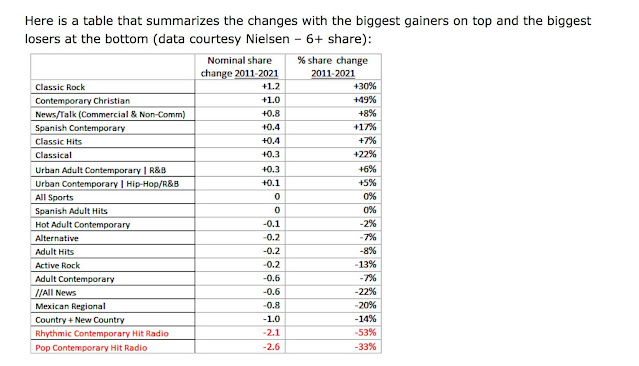
This is a postscript to my post the other day on music and business. Somewhere I was saying I wish we had some hard data and lo and behold Ted Gioia shared this table on his blog that a reader sent:


You probably have to click on it to see the numbers. But what knocks me over is that classical is up pretty substantially while pop contemporary is way down. Of course I imagine classical is coming up from a pretty low share, but still...

Thursday, January 20, 2022

Music and Business

I am including a link to a new essay by Ted Gioia in the Friday Miscellanea tomorrow, but there is one phrase from it, the last one in fact, that I want to just muse on for a bit.

music is too powerful for them to kill

He says this because he sees a grass-roots music revolution turning things upside down the way rock 'n' roll did in the mid-50s. Well, maybe, but back then the music business was a tiny fraction of what it is today so the people running it were proportionally less powerful. Now it is a large industry and more invulnerable to revolution, aesthetic revolution at least!

But let's have a look at the sentiment Ted expresses: music is too powerful for them to kill. The underlying assumptions are interesting. Music has some kind of Platonic Form that has an aesthetic power above the mere instances of it in the world. I might even like to believe that! But I don't think that is the actual question here. It is not music that is being put into a mindless algorithm box: it is rather people's tastes. If you feed people the same thing over and over, they will have no taste for anything different and will even reject it as "bad." In the past there was enough regional variation that music was more of a cottage industry. Every group of producers followed their own methods and formulas like traditional cheesemakers in France. But now we have a globalized homogeneity that is fed to the whole world. That is a pretty powerful creator of musical taste.

But I very much would like to believe that musical revolution is possible. But wait, we had one just fifty years ago. No, I'm not talking about The Beatles, though there is an argument to be made there. I am referring to the so-called minimalist music of Steve Reich and Philip Glass which very much overturned the maximal complexity model of the post-war avant-garde. But this revolution only caused tiny ripples in the music business and hardly affected the commercial models at all.

"Music" --that is, some ideal form of music, may be too powerful for them to kill, but they can certainly keep it locked up in a closet somewhere so it doesn't upset the commercial applecart.

Steve Reich: Drumming


Steve Reich: Music for 18 Musicians


Sunday, January 12, 2020

A Socio-Economic Theory of Guitar

I had an odd thought I wanted to share: I notice that fine classical guitarists seem to come in waves from different parts of the world. Here they are over the last hundred years.

  • First wave from Spain late-nineteenth through first half of 20th century: Francisco Tárrega, Miguel Llobet and Andrés Segovia
  • Second wave from Latin America and southern Europe: Alirio Diaz, Abel Carlevaro, Oscar Ghiglia
  • Third wave: the UK and Australia: Julian Bream, John Williams, Pepe Romero (the Romeros are a bit of an anomaly--they moved from Spain to the US in the 1950s)
  • Fourth wave: the US, Cuba, France: Manuel Barrueco, Eliot Fisk, Sharon Isbin, Leo Brouwer, Ida Presti and Alexander Lagoya
  • Fifth wave: Eastern Europe, Canada: Ana Vidovic, Marcin Dylla, Drew Henderson
I'm not doing any actual research here and closer examination might reveal something quite different, but it seems to me as if the classical guitar is something of a transitional instrument. It does well in cultures that are neither wealthy nor highly developed culturally. And as a particular culture becomes wealthy and more developed, young musicians tend to gravitate to instruments other than the guitar. For example, there don't seem to be too many first rank players coming from Spain these days (or am I wrong?) or the UK, or the US. Instead they are coming from places like Eastern Europe. I could have included China there, but while there is one very fine Chinese guitarist, Xuefei Yang, most music students in China are singers, violinists or pianists. That's where the money is!

The other thing I notice is that, with each wave, the economic rewards grow less and less. Segovia did very well, as did Bream and Williams, Pepe Romero had a rewarding career as did Manuel Barrueco. But since then, even very fine guitarists, easily as accomplished as any of those, have meagre careers with very modest rewards.

Here is the terrific Canadian guitarist Drew Henderson with some fine Bach:


Thursday, October 24, 2019

Blue Over Red

What if your kid comes up to you one day and says, "dad, I can't decide whether to become a visual artist or a composer? What do you recommend?" Not that that is ever going to happen, of course. He or she is more likely to not even ask and to end up choosing between computer coding or marketing. Yes, these are the End Days. But supposing it did happen, you might point out that the odds of making a success of either calling is likely to be 100 to 1. Or perhaps 1,000 to 1.

I was prompted to this thought by an article in Barron's, the financial newsweekly: Mark Rothko’s ‘Blue Over Red’ Could Top $25 Million. That might be behind the paywall so you could try googling the headline. But here is the meat of it:
Mark Rothko’s Blue Over Red from 1953, a critical period during which the artist developed his signature style of abstraction, will headline a Sotheby’s contemporary art auction in New York on Nov. 14.
The painting is expected to fetch between $25 million and $35 million, and will be on public view at Sotheby’s York Avenue galleries beginning Nov. 1.
I suppose that this might be the equivalent of what, in music? An early piece by Steve Reich like Eight Lines? I don't know how much money Steve has made off that piece, but if it were more than a few thousand dollars I would be surprised. I also don't know how much money Mark Rothko made off Blue Over Red, but somebody sure has made a pile. Let me just speculate for a moment: let's say he sold the painting when it was new for, what, $10,000? $50,000? Some collector bought it and either sold it to another collector or collectors until finally it goes up for auction. The individual or group of collectors are going to make an enormous profit. Ok, fair enough.

But now consider the poor composer: not only does he make a pittance from an early commission and performances, he will also make a pittance from sales of the score by his publisher. And two or three pittances does not make much of a muchness. So how do composers make a simple living? The answer is, they don't. Stravinsky did ok for commissions early on, but that was a different time and not duplicable today. Nowadays either you have a university job teaching theory and composition for not much money, or you starve. Philip Glass, a very successful composer, had to work as a moving man, taxi-driver and plumber into his forties before he was making enough in commissions to live on.

It seems to be the case that if you create a unique purchasable object like a painting there are potentially huge gains. But if you create a piece of music, there are not. Unless, of course you are a pop diva. Weird, huh?

Here is Blue Over Red:


And here is Steve Reich's Eight Lines:


From an aesthetic point of view it is hard to see how one is worth $25,000,000 and the other is worth almost nothing.

Saturday, May 4, 2019

The New 1%

I am very far from being any kind of socialist--my basic belief is that free markets create the most prosperity--but the music business often makes me shake my head in perplexity. The Wall Street Journal today has an article on the new one percenters: music superstars. (If you google "Music Superstars Are the New One Percenters" you might be able to get past the paywall.)
A small number of superstars like Beyoncé and Taylor Swift is gobbling up an increasingly outsize share of concert-tour revenues, as music’s biggest acts dominate the business like never before.
Sixty percent of all concert-ticket revenue world-wide went to the top 1% of performers ranked by revenue in 2017, according to an analysis by Alan Krueger, a Princeton University economist. That’s more than double the 26% that the top acts took home in 1982.
Just 5% of artists took home nearly the entire pie: 85% of all live-music revenue, up from 62% about three decades earlier, according to Mr. Krueger’s research. “The middle has dropped out of music, as more consumers gravitate to a smaller number of superstars,” 
This is not a new phenomenon as various technical advances have steadily biased the playing field going back more than one hundred years. Historically, the amount a performer could earn was limited by how much the market would bear in terms of ticket price and by the size of the venue. I'm not talking about the music marketplace prior to the French Revolution when most professional musicians were employed by the nobility who just competed among themselves for talent. After the Revolution, as the public market for music grew, patronized by the middle class, public concerts and publishing became lucrative sources of income. But musicians can only give a limited number of live concerts and prior to amplification, concert halls were limited in size to one or two thousand seats.

Music publishing of works designed for domestic performance opened up a new revenue stream that lasted until the development of the photocopy machine. These days, music publishers are fairly poor!

The two technologies that really had an impact were first the development of recording technology and second the development of amplification. Up until the Second World War, these developments made an incremental difference, but after the war, and especially from the 60s on, the trends became huge. The Beatles were a big part of these developments. The huge number of records they sold freed them from the rigors of touring even as large amplifiers made it possible to play in large venues like Shea Stadium in New York which seated something like 55,000 people. That's a lot of tickets. But the royalties from record sales dwarfed even that and after August 1966 the Beatles gave no more scheduled live performances.

When the internet came along, for a brief moment it seemed as if was going to have an impact similar to the photocopy machine: suddenly the gatekeeper power of the record companies disappeared overnight as people could share, peer-to-peer, recordings with one another over the web. It didn't take long for the copyright holders to put a stop to that and now a few streaming services like iTunes and Spotify dominate that medium. Revenues for most performers are fairly small, however, so it is the live concert that is generating the most income.

I have a new CD of selections of my chamber music I would love to market somehow, but frankly, the whole commercial music scene is so perplexing, I'm not sure what I want to do!

UPDATE: Just realized that an appropriate envoi for this post would be this: the Beatles taking the state at Shea Stadium in 1965:


UPPERDATE: Wait, I have it figured out! T-shirts, that's the ticket! Music Salon t-shirts! With that logo:


Sunday, November 11, 2018

What Does It Cost?

...to book a popular musical act. Suburban Men has the story. Follow the link for the details (and I wonder at the accuracy...). Some examples, Adele, north of $750,000. Some acts around 1 million: Bon Jovi, Bruce Springsteen. On the other hand, you can get Jefferson Starship for a modest $15,000 to $25,000. Rihanna will cost between $500,000 and $750,000.

But what about our favorite classical musicians? What would it cost to book, say, Hilary Hahn for your birthday party, wedding or funeral? Sadly, the website for her management, IMG Artists, does not list fees for this sort of engagement. What about Grigory Sokolov? Sure, he won't travel outside continental Europe, but what if you wanted to book him for a special party in the hills south of Florence? Sokolov is with Artists Management Company and again, there is no information at the website regarding fees. What about Igor Levit? He is with Classic Concerts Management and again there is no information regarding fees. It is almost as if these folks are simply too busy playing with the Vienna Philharmonic or performing at the Salzburg Festival to bother with your birthday party! No wonder people think classical musicians are elitist! They are!

Of course, you can hire a classical ensemble for your wedding, funeral, bar mitzvah, whatever. Here is a trio available in the UK.


But again, search as I may, I cannot find an actual fee quoted. A friend of mine gigs with a string trio in California and I think she mentioned that they charge around $500 for a two hour gig. Or was that $300 for each musician? I forget!

I suspect that the performing musician marketplace is as competitive as any other market, but there are likely huge factors that wildly affect pricing. I have a tiny amount of background knowledge on this from my work on the board of the local concert society. You can book a middle-rank piano soloist for around five or six thousand dollars plus expenses. A front rank guitarist will be about the same. This is for a single performance or perhaps a pair of concerts back to back. I would speculate that if you wanted to book a front rank soloist like Igor Levit or Hilary Hahn in your concert series you would have to start the negotiation process about two years ahead and expect to pay, what?, $20,000? $30,000? $50,000? Perhaps even more. Just based on my attending one concert by Grigory Sokolov last summer I would estimate that since he probably fills every hall that books him, and this would typically be a 2,000 seat hall and given ticket prices around sixty euros per then the receipts would run around €120,000 and it would be a poor management indeed that did not get at least half for the artist. Therefore, €60,000 per concert. Or you could get Jefferson Starship for a lot less...


Tuesday, August 21, 2018

Music and Value

Last year a commentator alerted me to the brilliant scholar and critic Pierre Ryckmans who used the pen-name Simon Leys. Since then I have been slowly working my way through his collected essays: The Hall of Uselessness. Except for the outstanding quality, one of his essays, titled "Writers and Money" is very like something I might have written for this blog. He modestly says that his essay has no other purpose than to quote Hilaire Belloc on the topic. Let me offer a slightly abbreviated version:
...there is no relation between the function of letters and the economic effect of letters, there is no relation between the goodness and the badness of the work, or the magnitude of the work, and the sums paid for the work. It would not be natural that there should be such a relation, and in fact, there is none.
The truth is missed by people who say that good writing has no market. That is not the point. Good writing sometimes has a market, and very bad writing sometimes has a market ... Writing important truths sometimes has a market; writing the most ridiculous errors and false judgements sometimes has a market. The point is that the market has nothing to do with the quality attached to writing. It never has and never will ... The relationship between the excellence or the usefulness of a piece of literature, and the number of those who will buy it in a particular form, is not a causal relationship, it is a purely capricious one.
This is a truth that has often eluded me. I have long puzzled over the fact that, despite their enormous commercial success, the Beatles actually created some music of high quality. On the other hand, despite their enormous commercial success, musicians like U2 did not. In the classical world, a composer as brilliant and original as Igor Stravinsky has long enjoyed an enviable success and prominence while other brilliant and original composers like Olivier Messiaen, while well-known, are much less celebrated.

The classical music world is perhaps slightly less capricious than the popular one, or at least it used to be. Music critics used to perform the role of bringing musical talent to the awareness of the public as Robert Schumann did with Chopin. But that occurs less and less often as the machines of marketing take over. Typically what we read and see in the mainstream media is no more than an uncritical puff piece serving as promotion for an upcoming album or tour. Also typically, musical value is these days reduced almost entirely to the sole criterion of sales figures. Artists that sell a lot of copies are celebrated and ones that don't are scarcely noticed. This is starting to erode aesthetic standards in the classical world as well as marketing and promotion take their inexorable toll. The only amelioration is in the area of grants and awards that are sometimes based on sober aesthetic evaluation (but often not).

On the other hand, I keep seeing hints and traces of the objectivity of aesthetic judgment. A simple anecdote: yesterday I was in a meeting with several people and before the meeting began we were chatting about some upcoming chamber concerts. One person, a non-musician, said how much she liked Brahms. I disagreed, saying that his music was over-worked and tedious. She looked quite surprised as, well, Brahms is really well-known, how can you be critical? Then another fellow, a jazz pianist, interjected saying that he agreed about Brahms. To which I said, "more evidence of objectivity in aesthetics!" I have noticed this over and over that musicians often have an unstated common judgement about performers and composers and particular pieces that differs from that of the general public.

Some examples? Most musicians that I have talked to rate Haydn just as highly as Mozart, something not the case in the public view. They rate Debussy over Ravel as well. There are very well-known performers that are known to most musicians as simple hacks, but I will forgo mentioning their names!

I don't want to overstate the case, but objective aesthetic judgment is not a chimera, even though it is not always easy to sort out. If you go back and read the Hilaire Belloc quote you will see that the simple fact of good and bad in an objective sense, underlies his whole argument.

How about an envoi? We haven't had any Messiaen for a while. This is his Catalogue d'oiseaux, Book I, for piano, with the score. Yvonne Loriod is the pianist.


How about another one? This is the Flower Duet from the opera Lakmé by Léo Delibes sung by Sabine Devieilhe & Marianne Crebassa:


Delibes is not nearly as celebrated as the composers he influenced, including Saint-Saëns, Debussy and Tchaikovsky.

Saturday, March 31, 2018

The Guitar Center in Debt

The LA Daily News reports that The Guitar Center is one billion dollars in debt! How is that even possible?
Guitar Center, the nation’s leading musical-instrument retailer, is in trouble. Changing musical tastes are partly to blame.
Ratings agency S&P Global downgraded Westlake Village-based Guitar Center Holdings Inc. for the second time last week as the troubled instrument retailer seeks to refinance and restructure more than $1 billion of debt.
“Most of what’s really selling today is rap and hip hop,” said George Gruhn, owner of the Gruhn Guitars shop in Nashville. “That’s outpacing other forms of music and they don’t use a lot of recognizable musical instruments.”
Or recognizable musical materials, for that matter, like melody and harmony.
The instrument is also facing an identity crisis. Guitar heroes – who have inspired many a player and fueled strong instrument sales – are few and far between these days, according to Gruhn.
Instead of people like Eric Clapton who could really play we have people, and I won't name them, who can really mug for the camera. Ok, yes and some of them can sing--but mostly they are singers chosen for their looks and ability to dance. When did pop music turn into a weird form of ballet?
The bigger problem, according to Concotelli, is that most aspiring players don’t want to put in the time to become proficient on the instrument.
“If they do want to learn they’ll just go to YouTube, but they’re not getting the proper instruction,” he said. “With kids these days, it’s all about instant gratification. No one wants to take six months or a year to learn. They don’t want to do the work.”
Uh, six months to a year? You think that's how long it takes? As I recall Clapton spent several years woodshedding, learning from old blues records. My estimate of how long it takes to become a really capable classical guitarist is five to ten years. That's IF you have a basic ability on the instrument.


Here's a couple of pretty fair guitarists, George Harrison and Eric Clapton and a few other folks playing George's song "While My Guitar Gently Weeps" which seems a nice eulogy for The Guitar Center.


Saturday, March 17, 2018

The Real Recompense

I was standing in the doorway to my office the other day when a guitarist, passing by, stopped to greet me. It took me a minute to remember his name, Antonio. He teaches guitar at the local music school and a few years ago he came to see me for two or three lessons because he was having trouble with his right hand. Due to using the muscles in an odd way, he had developed severe tension in his hand to the point that it was nearly immobile. I worked with him on rebuilding his right hand technique and he seemed to be improving. I hadn't seen him in years so I asked him how his hand was. He thanked me effusively and said I had saved his guitar-playing! We talked a bit about what he was playing these days (Villa-Lobos etudes and preludes). He said again, "gracias, maestro!" and took his leave. "Maestro" in the context he used it, means "master."

A few years ago I helped out two other professional guitarists with similar problems and they too ended up rebuilding their technique and credit me with saving their ability to play. It is often the very enthusiasm and dedication to the instrument that gets musicians in trouble because they practice even though their body is trying to tell them something is wrong. I remember a video of Isaac Stern one time saying that every hour you practice incorrectly takes a couple of hours of practicing correctly to fix. Sad, but true.

I'm not sure exactly how I figured out guitar technique, but starting on the electric bass guitar might have had some influence. I was fifteen or sixteen when I finally got interested in music. I wanted to play the drums but my mother, after visiting the local music shop, came home and said "we can't afford to rent drums for you, they cost $10 a month!" Let me hasten to say that this was 1965 and my mother got paid about $250 a month. Our mortgage was $80 a month. Long time ago! You could rent a bass guitar for only $4 a month so that's what I started on. As my mother said "the bass guitar is also in the rhythm section!" She was a fiddler, by the way. So, apart from some abortive piano lessons when I was eleven, the bass guitar was my first instrument. Four very big heavy strings that you play with your right hand index and middle fingers. Pretty demanding for your left hand as well--you need lots of muscle.

Soon after I took up the six-string guitar as well and a few years later switched to classical guitar. I have a photo of myself taken in 1973 just before I went to Spain to study with Maestro José Tomás, so this is me before high quality instruction:


I'm playing a cheap student guitar, but the interesting thing is my hand position. For both hands it is quite good, no over-extension or obvious tension. There are a host of things that go into being a good player, but one of them is some basic physical aptitude, what my mother called "touch." She was a naturally good fiddle player and she used to say that so-and-so had a good "touch" on the instrument. That's a quality of string players and, I guess, keyboard players as well. I suspect it is something you really can't teach. Another element that is important is your sense of timbre. How aware are you of the exact kind of tone color you are producing? I have had students that were good in every other aspect, but they just could not seem to make a good sound. Another element is your sensitivity to the phrase. This is a purely musical element, of course. How you feel and direct the flow of a phrase comes directly from how you feel the music. On a higher level it is how you handle the structural flow of the piece.

With great musicians all the elements are present and reinforce one another. With pretty good musicians they have a lot of them and have to work on whatever ones they are weak on. So being able to analyze your own strengths and weaknesses is a crucial skill because you really can't count on anyone else, even a master teacher, to do it for you. And that's about all I have to say on the matter!

Here, by way of envoi, is Carora - vals venezolano by Antonio Lauro in my recording:


Friday, March 16, 2018

Fee Schedule

A long time ago I put up a post on the official performance fees for didgeridoo players in New South Wales. You really should follow the link. This reminds me of a pianist I used to know (he ended up the musical director of the Shaw Festival in Niagara-on-the-Lake, Ontario). He used to do the occasional cocktail piano gig and his specialty was Rhapsody in Blue by Gershwin. But he would only play that demanding piece if he was given a $50 tip. Makes sense. An old friend of mine who has retired to a beach in Brazil writes me that he wishes I would do a classical arrangement of The Girl from Ipanema that he could listen to while relaxing on his veranda. I wrote him back that my fee would be $1,000 US plus another thousand for recording costs. Heh! This gets me thinking about performance fees and I see the opportunity for a bit of satire.

Based upon my experience in the professional business world since retiring as a classical guitar virtuoso, this is what I would charge for performances these days, if I were giving any. All amounts in US dollars.

  • Short 20 minute program of 16th century Spanish vihuela music with original ornaments derived from my own research: $500
  • Longer 30 minute program adding favorite pieces by Bach in my original transcriptions: $1,000
  • Full recital program of about an hour and ten minutes including intermission of the above works plus music by 20th century Spanish composers (Rodrigo and Moreno Torroba): $2,000
  • The same but with entertaining remarks before pieces, add an additional $500
  • Full recital program including selections from above but featuring original compositions that might include one of my two suites for guitar: $3,000 (add $500 for informative commentary)
  • Full recital program with music for violin and guitar including original transcriptions of works by Rameau, Debussy and Shostakovich as well as my Four Pieces for violin and guitar and my new piece "Dark Dream" for violin and guitar. $5,000
  • Performance as soloist in concertos by Castelnuovo-Tedesco ($5,000), Villa-Lobos ($8,000) or Rodrigo ($10,000)
These are actually quite reasonable fees based on the level of professional training, experience, creativity and sheer work involved.

OK, now what did I actually get paid for a performance back when I was a touring virtuoso? For being the featured soloist in the Villa-Lobos Guitar Concerto (as well as playing two of his preludes for guitar) in a gala concert before the Brazilian Consul-General in the gloriously restored Orpheum Theatre in Vancouver with the CBC Vancouver Orchestra conducted by Mario Bernardi, recorded for national broadcast: $1,300 dollars. Canadian dollars.

Here is one of my pieces for violin and guitar: Surreal Reel.


Monday, February 26, 2018

Neil Young on Music Economics

The economics of the music business are a perennial item of interest as that was one reason I retired (cough*went on strike*cough) as a professional soloist. Over at Breitbart they have an article on Neil Young's views on the matter: Neil Young Blasts Google in Epic Rant: They Don’t Pay Musicians a ‘F*cking Cent’
“Today, in the age of FaceBook, GOOGLE, and Amazon, it’s hard to tell how a new and growing musical artist could make it in the way we did,” Young wrote. “The Tech Giants have figured out a way to use all the great music of everyone from all time, without reporting an artist’s number of plays or paying a fucking cent to the musicians. Aren’t they great companies!!! It makes you wonder where the next generation of artists will come from. How will they survive?”
On the other hand, Neil, I don't know if you have noticed, but some artists are doing rather well. The top three last year were:

  1. Sean Combs, $130 million
  2. Beyoncé, $105 million
  3. Drake, $94 million
So what is Mr. Young doing wrong? The fine arts are a very awkward area for social justice ideologies. They assert the underlying principle of economic equality, but the only way to achieve that in the arts is to tightly control all artists' earnings as they did in the Soviet Union. Because even if you hinder artists by making them conform to rigid aesthetic criteria such as "socialist realism" the talented few will figure out how to make great art notwithstanding. It is always the case that, in the arts, there are a tiny minority who excel and the vast majority who merely do journeyman work. In the Middle Ages when most artists were anonymous and there was only a rudimentary free market in the arts, no-one made much of a living from it. With the Renaissance came wealthy patrons with developed tastes and artists, even musicians, started to have some earning power. This system lasted up into the early 19th century in music with Mozart and Beethoven being the first to start to move away from noble patronage. Schubert is an example of a great musical talent who made virtually nothing from his music.

With the 20th century came entirely new income streams. Commissions from wealthy patrons were rare apart from donations to musical institutions, such as opera and concert series. These institutions would pass on a few crumbs to composers now and then. More and more governments, especially in Europe, set up bodies to grant money to artists and institutions.

But something else also happened in the 20th century. Due to the development of recording technology an entirely new way of commodifying music was developed. An early recording artist like Caruso could make more money from recordings than from concerts because he could only give one concert a day, but he could sell thousands of recordings. By mid-century recordings of popular music were, for the first time, outselling recordings of classical music. By the time Elvis Presley and the Beatles arrived, the economics of pop music dwarfed classical music entirely.

So now we have the top ten musicians, all in popular music, earning between fifty and over one hundred million dollars a year. This is many, many times what musicians were able to earn in previous eras. Doesn't that shed a rather ironic light on Mr. Young's remarks?

He should have been saying something like, "wow, musicians now can become fabulously wealthy, wealthier than even the richest potentates in past eras; the only problem is that some technology companies make even more money!"

The interesting question that comes to my mind is exactly how does one earn over $100 million dollars in the music business? Details, please.

Sorry, Neil!


Saturday, September 23, 2017

Models of Artistic Lives

Artists of all kinds are outliers in the social fabric. The reasons for this are probably complex, but they likely include things like the difficulty of earning money through artistic creation, a disinterest in the usual criteria of success in life and an ambiguous relationship with the social hierarchy. All this does tend to free one to focus on the creative act, but it also complicates ordinary life.

In the era of patronage, when most artists were funded by the church or the nobility, often in competition with one another, what you had to do was fairly clear, I would imagine: appeal to the tastes or vanity or ambition of your patron. Italy seems to have been particularly blessed with wealthy, visionary patrons which partly explains the great art of the Renaissance and Baroque. As the eighteenth century came to an end the patronage began to shift from the aristocracy, more and more eliminated by revolution and social change, to a widespread support by the middle class, who began to adopt some of the artistic tastes of the nobility. Haydn was supported for most of his life by a single aristocratic family, the Esterházys, Beethoven by a circle of wealthy patrons, but Schumann wrote music criticism and edited a journal. Chopin taught private students, Mendelssohn was a conductor, as was Mahler, and director of an important music school. Some composers, like Wagner, still had aristocratic patronage, but that was rare in the later 19th century. By the time we get to someone like Sibelius (1865 - 1957) the struggle to support a family was dire indeed. Here is a lament he wrote in 1911:
My domestic harmony and peace are at an end because I cannot earn sufficient income to supply all that is needed. A constant battle with tears and misery at home. A hell! I feel completely unworthy in my own home ... Poor Aino! [his wife] It can hardly be easy to manage the house on so little. It makes me more than aware of the truth in the old saying: do not marry if you cannot provide for your wife in the style to which she was accustomed before. The same food, clothes, servants -- in a word the same income.
Sibelius, like many Finns, was a family man. He and Aino had six daughters. Most artists, while they are, as I said, outliers, they are outliers from a certain level in society--the upper middle class. Yes, there are working class artists and aristocratic artists, but I suspect that they are the minority. Most come from some level of the middle class, especially considering that this is the largest part of modern societies. All his life Sibelius struggled with the two problems of providing for his family and his overindulgence in cigars and alcohol. He received support from the state and an income from publishing, but this was never quite enough.

Charles Ives' life (1874 - 1954) illustrates the difficulties of an artist in the New World. Though he studied music at Yale, he never seriously attempted to earn a living as a composer. Soon after graduation he entered the insurance business and later on founded his own company. It was Charles Ives who invented the field of estate planning for the wealthy! He composed a great deal of largely experimental music, but stopped around 1927. His manuscripts moldered in a garage and his music was largely ignored until Leonard Bernstein did some important premieres in the 1950s.

In the later 20th century things got even worse because few governments outside of northern Europe provide any pension for their artists, just a few paltry and sporadic grants. Nearly every composer has to follow the path of academia, teaching theory and composition in a conservatory or university. This does not seem to lead to much brilliant, creative work! The outstanding composers all seem to be outside that model. Philip Glass worked at lower class jobs like driving a taxi, being a plumber and a furniture mover and he did this well into his forties when he started getting enough commissions to scrape by. He lived a largely bohemian life. Steve Reich seems to have found enough patrons to subsist until he formed his ensemble and began doing a lot of performances and recordings.

Stravinsky seems to have been the last composer to have achieved enough fame in society to generate a good income. Early on he got significant commissions from Diaghilev and continued to write well-received ballets for decades after. He got a lot of important commissions and also derived income from performances, recordings and a long series of books written with Robert Craft.  Alas, with the exception of Philip Glass, who has followed a similar path in his prolific writing for theatre and film, this seems out of reach for anyone else.

One siren call these days seems to be to figure out a way to emulate or share in the bounty of popular music where it is possible to earn fantastic sums of money. But while the occasional popular artist might dabble in art music and the occasional classical composer might dabble in popular music, the two seem largely unreconcilable.

It ain't easy!

Let's listen to a fairly early piece by Charles Ives. This is Central Park in the Dark, composed in 1906. This the Northern Sinfonia conducted by James Sinclair:


Wednesday, July 26, 2017

Art and Money

I've often puzzled over the different economic directions the visual and performing arts have taken in the last century. At the bottom end of the economic spectrum, both beginning visual artists and composers are struggling in poverty. But at the top end, the visual artists are far ahead. Vincent van Gogh provides an example. During his lifetime he sold only one painting for less than $2000 in today's money. Few of his paintings go to auction these days as they are mostly held in museums, but one sold in 1990 for over $150 million in today's money. A Willem de Kooning sold recently for $300 million. Yes, it is usually, but not always, the case that it is not the artist that benefits, often being dead, but someone does!

Composers are far less well off. The very famous American composer Philip Glass had to work at various menial jobs (driving a cab, moving furniture, plumbing) until he was into his 40s when commissions began to be enough to barely support him.

The situation seems to be that there is a lot of money in visual arts, but a lot of expenses in performing arts!

As I say, I have puzzled over this and never come up with much of an explanation other than rich people like to buy things they can hang on their walls. But Ann Althouse put up a post the other day that offers a suggestion, The Art Donation Tax Evasion. You need to read the whole thing, but the idea is that the New York Times evasively describes a long-standing strategy for avoiding taxes that depends on donating art to museums at inflated values. But the NYT commentators are on to it:
"Ah, the good old-fashioned donation evaluation for taxes. The wealthy have been doing this for a very long time. Museums are there for this very reason. To deposit overly valued art pieces in lieu of a tax deduction. Same goes for property, buildings and other funding to arts, medicine and pet projects. Art is tricky. How is it exactly evaluated? And by whom?"
Could this be part of the reason that prices for visual arts seem a little high?


Monday, October 24, 2016

High (Remunerating) Culture

I'm all for economic decisions being made on the basic of economic facts, but I'm also all for aesthetic decisions being made on the basis of aesthetic facts. The Wall Street Journal has some tough love from Terry Teachout to the orchestral musicians currently in salary disputes with management in Fort Worth, Pittsburgh and one recently settled in Philadelphia. He reviews the history of orchestral pay in the US and concludes:
...in a market economy, the price of labor is determined by the interaction of supply and demand. You get what someone else is willing to pay you—and nothing more.
“Demand” is the key word here. In 1967, classical music still occupied a central position in our high culture. Now it doesn’t. Most Americans don’t care about classical music and don’t go to orchestral concerts. I think they should, but it doesn’t matter what I think. They’ll do what they want to do—and one thing they don’t want to do is go out of their way to hike the salary of a violinist in Philadelphia who already makes over $2,400 a week, especially when the median weekly household income in the U.S. is $1,073 (which is roughly what the average London orchestra player earns per week).
The mention of the year 1967 refers back to some research Mr. Teachout did:
Prior to 1968, membership in the Cleveland Orchestra was a part-time job. When [Arnold Steinhardt] joined the orchestra, the regular season was just 30 weeks long, with lower pay for summer concerts. In 1952, the base salary was $3,240—$29,231 in today’s dollars. By 1967, it had only gone up to $11,700. (The current base salary is $120,000.) The U.S. median household income in 1967, by contrast, was $7,970. According to a 1952 survey, 60% of the players moonlighted in nonmusical jobs, and many of them did so until 1968, when Cleveland, in keeping with other top-tier American orchestras, finally lengthened its season to 52 weeks.
If you read the whole thing, Mr. Teachout is making two points: first of all that conductors and administrators are paid very high salaries while players make much less, but even so, players in orchestras like Philadelphia's make double the median household income. Therefore, they should shut up and play. Well, ok. As I said, economic truths are economic truths. But the problem I have is with the mention of "high culture".

We live in topsy-turvy times when all those who are supposed to be educating us about the value of culture and high culture in particular are instead off fighting social justice wars. One gets the distinct impression from this article that high culture in the form of classical music concerts has no importance whatsoever now. If you look only at remuneration, the central position in "high" culture these days is obviously occupied by Taylor Swift (earnings in the past year: $170 million), Beyoncé and Katy Perry. That's the little logical hiccup in the column: yes, in a market economy, you get what someone is willing to pay you, the classical violinist in Philadelphia, $2400 a week and Taylor Swift, $170 million a year. But I don't think you should connect market value with the concept of "high culture" which is an aesthetic concept, not an economic one. Hopefully, the Philadelphia Orchestra does still occupy a central position in high culture.

It seems as if in the USA these days, high culture, like music programs in schools, could be dropped entirely. Contrast this with another article at The Huffington Post: Kent Nagano Discusses Ten Years with Montreal Symphony:
When I first got to the city, many people on the administration staff said, ‘...oh dear, we have a grey-haired syndrome here...,’ meaning that our audience is getting older and older. But, we decided over the course of the season, that we would never change one thing - we felt that the one thing that transcends generation is the natural human tendancy to appreciate exceptional quality.
So rather than push the bar down, we pushed the bar very, very high, where we challenge the audiences with extremely adventurous programming. We promote not only very well-known marquee international soloists, but we support young and up-and-coming soloists that our audience takes under its own wing. They feel that the young soloists belong to them, and are a part of our tradition in Montreal. The same thing with young composers.
The result, after ten years, is that the audience today—and I think you probably felt that when you came to our concerts—is so much more homoginized. All from as young as 8, 6 years old up to people who have already retired from their profession and everything in between. Families come. In short the concert hall looks like Montreal. It looks like what you see when you walk in our parks, walk on our streets. That’s what our public looks like.
 What I take away from this is that if you lose focus on the reason why you are playing this music, that is, the aesthetic reason to give to the audience, the community, the highest quality music you can, then you end up squabbling over the "market value" of your work and when you do that, then Terry Teachout will tell you that most people don't go to orchestral concerts. Well, they never did. Just the ones who appreciated aesthetic quality.

This is the Stravinsky Capriccio for piano and orchestra with Yulianna Avdeeva, piano and Kent Nagano conducting the Orchestre symphonique de Montréal:


Tuesday, October 4, 2016

Musicianship and the Music Business

A lot of what you read about music in the mass media is flat-out depressing, but sometimes a ray of light shines through. This article on The Smart Set is titled Does the Music Business Need Musicianship? and it is actually pretty good. The hook is what has been happening to MTV, but the story is wider than that:
MTV is a good symbol for the larger crisis in music. That network set the tone years ago for a glamor-driven music business, built on pizzazz and personalities instead of musicianship. That paradigm is now deeply entrenched in the entire industry. And it doesn’t seem to work anymore.
MTV was always ambivalent about that M, and enamored with the TV part of its acronym. From the moment of its inception, MTV worked relentlessly to downplay the role of musicianship in music. No organization in history has done more to turn music into performance art, and put the people making the actual sounds out of sight. And not just those playing traditional instruments — tell me how often you see the programmers and beat-makers behind today’s pop hits in a video, or even given credit for their contributions.
And as I have written about many times, this shallow, glitzy approach has leached into the classical music business as well (cough*Yuja Wang*cough).
This formula of glamor-driven pop music has enjoyed an amazing run. For more than 30 years, success at the highest levels of the music business has demanded very little grasp of music. With the right look, the right camera angles, and the right booty . . . well, almost anything was possible.
The astonishing trajectory of popular music beginning with Elvis and the Beatles has led inevitably to, shudder, Nikki Minaj:

https://www.youtube.com/watch?v=LDZX4ooRsWs

(Blogger won't embed the original.) For a truly biting bit of criticism, I doubt you could do better than Ozzie Man. But, warning, the commentary is larded with strong language:

https://www.youtube.com/watch?v=Dltb5gj4HvI

After pointing out that the younger listeners basically don't pay for music any more--they would rather spend the money on shoes--the article mentions that the old guys, the Stones, Paul McCartney, Bob Dylan, Paul Simon, are still notching up pretty good sales, but their audiences are as old as they are. The article laments:
Believe it or not, there is no hot superstar guitarist under the age of 30. There is no next Hendrix. There is no next Clapton. Oh, there are plenty of fine young guitarists out there, but none of them can get the kind of media platform necessary for true superstardom in the year 2016. Mull that over, and think about the implications. The same is true for keyboards, drums, and even all those software programs that create the fabric of contemporary pop music.
I really don't know if that is true as I don't follow pop music that closely, but it certainly seems to be the case that all the young stars are singers. But, and this may speak well for the future health of the music business, there are plenty of up and coming young classical artists. I've been raving about Igor Levit lately, but he is not the only one. There are a host of young violinists like Hilary Hahn:


Other pianists like Daniil Trifonov:


Not to mention the ones that have, just a bit, edged into glamour territory like Yuja Wang:


and Khatia Buniatishvili:


So maybe the strong foundation that classical music has of actual musicianship will serve it very well in coming years.

Friday, August 26, 2016

Music and the Numbers

We were just talking about music as a business and coincidentally a friend sent me this link: Pop Singer Taylor Swift Gives $50,000 to Seattle Symphony. I saw this a few days ago, but it didn't strike me as blogable. But in conjunction with my last post, there might be something to note. I was saying before that classical music has always needed the support of an enlightened minority because it has never been feasible as a business. So three cheers to Taylor Swift for her contribution. If every pop diva contributed...

But let's put this in context. Taylor Swift's 2016 earnings, according to Forbes, are $170,000,000 USD. $50,000 is a little less than 3/100ths of a percent of her income. If I were to give a proportional amount of my modest income it would be, let me do the math here,  $15! What the numbers tell us is that the very wealthy only need to contribute a small amount of their resources in order to give healthy support to classical music. The question we should be asking is what would encourage them to make these modest contributions?