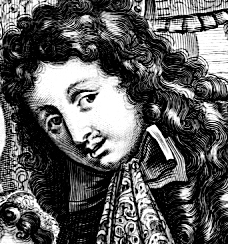
First let's start with a performance of the piece, a chaconne for voice and continuo by Marc-Antoine Charpentier. This is "Sans frayeur dans ce bois" performed by Lea Desandre and Thomas Dunford and yes, I have posted it before, but stick with me, this might get interesting.
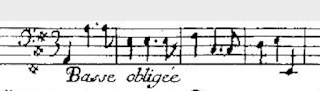
I really liked the accompaniment so I started looking around for the score. Quite nice all those things Dunford is playing, right? Well this is all he had to work with:
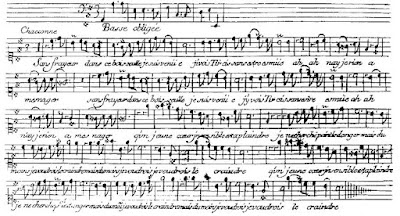
Yes, that's correct, every single thing you hear, apart from those simple bass notes, was invented by Dunford. Was it improvised? Certainly the first couple of times, but by the time they got to the recording studio I'm sure he had settled on what he was going to do. Here is the complete score, the rest is the vocal part:
Click to enlarge
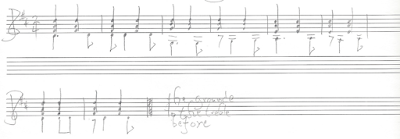
Now I am quite familiar with this sort of thing as I have played lots of lute duets written in a similar fashion. Here is a piece by John Johnson for lute duet titled "The Queen's Dump." The accompanying musician (I think she is playing an orpharion) keeps playing the same simple chord progression, but when I played it I only did that a couple of times and then started strumming, changing the rhythm, doing everything I could to change it up. I can't find anything like that on YouTube, and sadly we never recorded it, but trust me, it is the thing to do!
I love that they changed the title to something less suggestive, but I transcribed it from a photostat of the original manuscript, Jane Pickering's Lute Book, and the title is "The Queen's Dump." A dump was a kind of dance in the 16th century.
I think this is the ground to The Queen's Dump, but it is not labeled as such in this manuscript, but whether it is or not, it shows you what the original notation looks like, French lute tablature.
Click to enlarge
And here is my transcription of the ground to The Queen's Dump:
I take a very tiny amount of credit for doing some wild, improvisatory accompaniments in these kinds of pieces (there are lots of other examples) twenty and thirty years ago, but only a very tiny amount because, of course, the musicians of the 16th and 17th centuries were doing it all the time.
Now go back and listen to Desandre and Dunford one more time and groove on the inégale.
I'm deceiving you a bit with the title. This is not a rondeau by Forqueray, this is La Portugaise by Forqueray performed by Jean Rondeau. I used to have Gustav Leonhardt's album of Forqueray which was lovely. But this is the first time I have heard a performance as good. Great playing. No, it is not a rondeau. It is in binary repeated form with some minuet in its genes.
I'm working on a large post about the Music for Strings, Percussion and Celesta by Bartók, but it isn't ready yet. Those analytical posts take more time!
First of all, my apologies for the very light blogging recently. A combination of things have held up new posts, among them the fact that four guys with hammers are pounding on my ceiling most days as they are building another level above me. This makes blogging, or even coherent thought, difficult. So I am spending a lot more time in my office, which is a little less conducive to blogging. Also, I have been involved with a new piece for orchestra I am working on.
But I got a good suggestion from a commentator so here we go: the case of George Frideric Handel (1685 - 1759).
When I was in first year music at university, the professor teaching music history told us a terrible joke about Handel that I am afraid I have remembered ever since: One hoary old orchestral musician speaking to another: "Last night I dreamed I was playing Handel's Messiah and suddenly I woke up and, by God, I was!" I'm afraid that for many years I had the tendency to always fall asleep whenever I heard the Messiah--except if I were actually singing in the chorus!
Handel, one of the most famous Baroque composers, was born in what is now Germany, but at the time was the Duchy of Magdeburg in the Holy Roman Empire. His early education was in Hamburg and later in Florence and Rome. In his later 20s he became resident in London and spent the rest of his career there enjoying the patronage of Queen Ann, a couple of Georges, and members of the nobility. From the death of Henry Purcell in 1695 to the career of Edward Elgar in the very late 19th century, the most important composer in Great Britain was undoubtedly Handel, a non-native.
In 1727, for the coronation of George II, Handel was commissioned to write four anthems, since known as the Coronation Anthems, on a translation of the traditional antiphon Unxerunt Salomonem. This text has been used for English coronations ever since, believe it or not, the coronation of King Edgar at Bath Abbey in 973! Prior to Handel's a setting by Henry Lawes had been used. But since 1727, every coronation of an English and later, British, monarch, has used the first Coronation Anthem of Handel, titled Zadok the Priest. As it displays some of Handel's best qualities, his broad strokes and monumental solidity, let's have a listen.
The very traditional British are also using the same chair for coronations that they have used since the coronation of Edward I in 1308!
Other very famous pieces by Handel written for the British monarchy include his Water Music, written in 1717 for performance on a barge on the Thames to accompany George I as he traveled from Whitehall up the Thames to Chelsea. This is a suite of typical Baroque dances including the very British hornpipe but also minuets, airs and bourrées as well as movements with just tempo indications. Again, it is music perfectly suited to the occasion and it has been popular ever since. Here is a performance of all three suites of the Water Music by John Eliot Gardiner and the English Baroque Soloists:
The strengths of this music are simplicity, clarity and perfection that does not overtax the listener. In the same genre is his Music for the Royal Fireworks, commissioned by George II in 1749 to celebrate the end of the War of the Austrian Succession. This was again intended for performance in the open air and is a suite for wind band and kettledrums. Here is the English Chamber Orchestra, conducted by Raymond Leppard:
The first rehearsal, for which the ticket price was two shillings and six pence, was attended by twelve thousand people, resulting in a three hour traffic jam on London Bridge. That gives you some idea of how enormously popular Handel's music was.
Handel was also extremely successful as a composer of oratorios and opera. The Messiah is popular not only in Great Britain, but one of the most-performed and famous pieces of choral music. It was premiered in 1742 and its success caused Handel to focus thereafter on choral music in English and away from Italian opera. This is the Choir of King's College, Cambridge (full credits in the clip):
But we should not leave Handel without some mention of his operas, which were very successful, both in Italian and English. Perhaps his most successful and considered the best of the pastoral opera genre is his Acis and Galatea. In 1788 Mozart even made an arrangement of it. As Wikipedia notes:
As is typical of the genre, Acis and Galatea was written as a courtly entertainment about the simplicity of rural life and contains a significant amount of wit and self-parody.
Acis and Galatea seems to have never left the repertoire. Here is a complete performance with Joan Sutherland in the lead, conducted by Adrian Boult:
Handel also wrote an enormous amount of instrumental music including a number of suites for harpsichord. Here is one of the most famous of these, the Suite No. 5 in E major, nicknamed "The Harmonious Blacksmith" because it ends with a set of variations on a theme later given this title. This suite, along with seven others, was published in 1720.
So there you have it. Three great Baroque composers were all born in the same year, 1685: George Frideric Handel, Johann Sebastian Bach and Domenico Scarlatti.
Recitative is an interesting musical genre that was developed specifically to handle the need to set a lot of words, often in ordinary prose rather than verse. Its origins were in the research that members of the Florentine Camerata did into Greek drama. Based on the idea that the ancient Greeks actually sung, not just the choruses, but all of the texts of their dramas, the late-sixteenth and early seventeenth-century Italians tried to re-invent the music. In the process they came up with a lot of new forms and genres including the very idea of opera. Let it not be said that musical experimentation is sterile!
Here is an early example of the kind of thing they came up with. This is not pure recitative, but the words and vocal line certainly dominate:
Here is a more typical kind of early recitative by Monteverdi:
The most important thing is the words, so the melody just serves to heighten the normal rise and fall of expressive speech. The accompaniment is bare bones chords and there is no audible pulse as the chords are pitch and place-holders inserted between vocal phrases.
Bach, as you might expect, gives us a much more elaborate example. Here is the Evangelist describing the rending of the veil of the temple from the St. Matthew Passion. The recitative is the first minute and a half of the clip and it is followed by a chorus.
Here is the beginning of the score:
Click to enlarge
Sorry for the blurry bits; couldn't get the book to lie flat on the scanner. As you can see, there is a very active bass line, put there to depict the rending. You will notice little numbers above the longer bass notes. These indicate what notes the player should use to fill out the harmony. The first 6 indicates a first inversion chord. Since it is over an E note, that means a C major chord.
Since there always seems to be some prosy text to get through, at least if the whole musical work is to be sung, the recitative had quite a long history, persisting right into the operas of Rossini. There are analogous passages even in Wagner and more ironic usages in Kurt Weil. Beethoven was a particular master of using the style of recitative, which has the feeling of speaking to us directly, in purely instrumental music. The third movement of his Piano Sonata in A major, op 110 begins with a very expressive instrumental recitative:
The use of the voice in a less melodic, more speech-like manner also returned in the 20th century in numerous contexts. I'll pick out two utterly different examples. The first is a kind of speech-song style that has a similar effect to recitative. Schoenberg called it "sprechstimme" and used it in Pierrot Lunaire:
And for my final example, the inimitable Tom Waits with a song that would be recitative if jazz had such a thing. Here it is, the only product you will ever need, "Step Right Up":
Composer Nathan Shirley takes me to task in a comment on my last post: Origins of the Keyboard Sonata. He says:
But what about Handel? It's said Beethoven considered him the greatest composer, and of the late Baroque composers he certainly had some of the strongest influence on on the course of western music. Personally he's a bit hit and miss for me, but when he hits? Fantastic stuff!
Why did I ignore Handel? Well, I also ignored Buxtehude, Corelli, Telemann and a host of others. But Nathan is correct, Handel is a large figure and Beethoven thought very highly of him. The problem I have with Handel is I find him dull. I have never been able to listen to a performance of the Messiah without falling asleep; which reminds me of the joke about the two hoary old orchestral musicians. One says to the other, "last night I dreamed I was playing Handel's Messiah and suddenly I woke up and, by God, I was!"
When I have performed Handel, starting with singing in the chorus for Judas Maccabeus when I was an undergraduate, playing the continuo part to some chamber sonatas and transcribing some of the Water Music for guitar ensemble, I have also found him dull. Let's have a listen and see if I have a point or if I am just irrationally prejudiced. Here is the famous chorus:
That is certainly stirring, but I doubt I could listen to it very many times. If Beethoven preferred that to a similar piece by Bach, then I don't know what to say. Here is a chorus from the Bach Magnificat:
The passacaglia from the suite in G minor for harpsichord has been a popular piece, especially in an arrangement for violin and cello by Halvorson. Here is the original:
And here is the arrangement:
Let me see, what might we compare that to? I was trying to find a different passacaglia, but performances of this one run on for pages and pages in YouTube. So here it is, the Passacaglia in C minor for organ by Bach:
How about one more example? The Hornpipe from the Water Music is a wonderful little piece:
But we could compare it to this, the first movement of the 2nd Brandenburg Concerto by Bach:
Of course, there is an element of unfairness here! Handel is a terrific composer who wrote a lot of enduringly popular and fine music. But he falls short of Bach in many aspects. His music is made of broader strokes, simpler construction. Nothing wrong with that, but while it has immediate impact, it begins to pall after a while. Handel's themes are just a bit too obvious and his sequences too predictable. The vast majority of Baroque music is dull and predictable, cranked out for numerous festive and social occasions and never intended to last. Acres of Telemann and a host of other Baroque composers attest to this. Much of Handel falls into this category, I think. But there are some great pieces, like the three I put up above, that really stand out, that really do transcend the time. That Hornpipe is perfection, in its way. But the music of a truly great composer like Bach (well, there are no composers like Bach), when put alongside music by Handel, shows us, I think, the difference between a really good composer and a great composer.
Which reminds me of an endearing thing Osvaldo Golijov said once: "I'm a second-rate composer, but a really good second-rate composer." Like Handel!
The world of classical music lovers divides easily into two large groups: those who love Bach most of all and those who love Beethoven most of all. (There are also the Wagnerians, but we try to keep them sedated.) Lists of the greatest composers usually have B and B in first and second place--even the one in the New York Times last year. I'm a big fan of both because, really, they are both indispensable and so different from one another. My "masterpieces of music" series, since it is in chronological order, means that here is where the post on Bach should go. But I have already done many, many posts on Bach! Here are most of them. The third post I ever put up on this blog was on a Bach fugue:
October last year was devoted to Beethoven piano sonatas and string quartets by Shostakovich and Haydn. But in November I put up a post on Bach and invertible counterpoint:
My march through the corridors of music history now leads me to Vivaldi, but way back in July I put up one of my evaluative "The Case of ..." posts on him in which I talk about him and his influence on Bach. All I left out were his dates: born 1678, died 1741, so just a bit older than Bach. Here is a portrait of Vivaldi:
Apart from Couperin, the other great French Baroque composer is Rameau, born in 1683 and died in 1764.
His greatest fame came late in life when he became the master of French opera, but before then he published a number of books of wonderful harpsichord music and, in 1722, possibly the most important book of music theory every published, the Traité de L’Harmonie: Reduite à ses Principes
naturels. This was the first book to systematically discuss all the harmonic discoveries and innovations of the Baroque that began around 1600 with Giulio Caccini's Le nuove musiche. One of the basic observations that Rameau made was that the chords C E G, E G C and G C E are not three different chords, but three versions of the same chord. This may seem obvious to us, but the funny thing is that a lot of great discoveries are like that: obvious only as soon as some genius points them out. You might compare this with Newton's thoughts on gravity after being hit on the head by a falling apple. Rameau's idea was that the chord C E G is the root-position version of a C major chord, while the ones that have E and G in the bass, but the same three notes, are inversions of a C major chord. A perfectly simple and useful idea that is taught in every music theory class to this very day. Here is the title page of the first edition of Rameau's book:
Rameau's harpsichord music is inventive and virtuosic. Here is "Tambourin", the last movement of the E minor suite from his Pièces de Clavecin of 1724:
And here is the rather gentler "Les Tendres Plaintes" from the D minor suite in the same collection:
From the age of fifty, Rameau devoted himself almost exclusively to opera and it was this that made him famous in the eyes of the public. Here is the overture to Zaïs, an "heroic pastorale":
I think we can hear why his operas were such a success!
UPDATE: After Nathan Shirley commented on "Tambourin" I just have to add another favorite. Here is Leonhardt playing several pieces--the one I recommend is the first, "La Triomphante":
I seem to be unfolding a mini-course in music history here! A lot of my love for early music stems from the first course I took in music history way back in the early 70s. At the time many of the students and other professors were scandalized that the professor teaching the course spent the entire first half, up to Christmas, just barely managing to get up to Monteverdi. This meant that by the end of the year she had to add on an extra class just to do most of the 20th century. The last class covered Stravinsky, Bartok and Hindemith, as I recall. At that point in time, the progressive composers of the 20th century were held in very high esteem and jamming the whole era into one--extra--class, seemed outrageous. But in retrospect, it meant that we were able to give a lot more attention to the earlier periods. My feeling these days is that the jury is still out on the music of the 20th century and the Deuteronomy that was recited thirty or forty years ago: Schoenberg begat Berg and Webern and they begat Stockhausen and Boulez and also of that tribe were Messiaen and Stravinsky and Bartok... this litany is going to be overturned as we get more distance from that time.
In any case, now we are up to the Baroque and choosing just a couple more composers is going to be very hard indeed! I chose one from the Middle Ages, Machaut, one from the transition to the Renaissance, Dufay, one from the early Renaissance, Josquin and one from the high Renaissance, Orlande de Lassus. Monteverdi is the logical choice for the early Baroque. Today I am going to do the French Baroque, a truly magnificent time. I am sorely tempted to talk about Robert de Visee, the composer of lovely guitar music for Louis XIV, but I have already mentioned him in a couple of posts. Forqueray would be another possibility but I talked about him in this post. But to pick out someone who really sums up the French Baroque there are only two possibilities:François Couperin, le Grand and Jean-Philippe Rameau.
Couperin was born in Paris in 1668 and died there in 1733. He is known as "le Grand" because he is the most famous member of a musically-gifted family that included his uncle, Louis Couperin.
I have a particular love for French Baroque music because it has an expressiveness and elegance that no other music of any time or place has. Here is an example from Couperin:
This is, above all, harmonic music. It is heavily ornamented, but all the ornaments are based on the tension/resolution of dissonant to consonant tones. It is largely in two voices, treble and bass, with other voices added for emphasis. It is rhythmically flexible--one of the features of this style isthe use ofnotes inégales as you will hear in the first piece whenever there are sixteenth notes: the first of each pair is held slightly longer than the second. This is the first part of a suite for harpsichord, the 21me Ordre in E minor from the Quatrieme Livre. In the clip are the first three movements: "La Reine des Coeurs", a slow prelude in 3/8; "La Bondissante", a gigue-like piece in 6/8; and "La Couperin" a rather brisk allemande in duple time. French composers at this time were very influenced by Italian music--after all, the Florentine Camerata and composers like Monteverdi had just invented an entirely new kind of music. Then as now, the French were more conservative and restrained than the Italians. As Couperin remarked, "I love much better the things which touch me than those which surprise me." What the French truly excelled at was subtlety and expressiveness. Here is the first movement of the suite in the original edition of 1730:
Click to enlarge
What is going on here shows a momentous development in music. As I pointed out before, the big discovery of the early Baroque was functional harmony: how to use the tensions and resolutions of harmony to give music a sensation of forward movement. For a long time the device of the cadence, that which concludes a passage, had been in use. But the Baroque made all that led up to the cadence more dynamic. The fundamental device was the harmonic sequence. A sequence is nothing but a repetition--but in music the idea of repetition is a very powerful one. Some composers (*cough* Steve Reich *cough*) do nothing but repeat. Indeed, the usual problem with student composers is that they have one idea, then another idea, then another idea, which is the most incoherent thing you can do. The discovery of the harmonic sequence was a huge one because it solves two problems: how to move the music forward and how to organize it for clarity. A harmonic sequence is nothing but a simple two chord group that is repeated on different steps of the scale. Usually after two or three repetitions there is a cadence. To put it very simply, Couperin's method is to begin with a simple motive, do some harmonic sequences using that motive and end the phrase with a cadence. If you look at the third line, second measure of the score you will see an example. After the cadence on G, there is a two measure group, repeated up a step, repeated again up another step followed by a one measure idea repeated down a step, then a cadence. Couperin does this in hundreds of different ways in hundreds of different pieces.
Not only Couperin, of course. Once the idea of the harmonic sequence was discovered, every single composer started using it. There are different kinds of sequences and more and more were discovered all the time. But in all Baroque and Classical period music, the sequence is used extensively. Whenever you sense the music shifting gears or turning a corner (notice how I use driving metaphors), you are probably hearing a sequence. You might suddenly sit up while listening to Vivaldi and say, "my God, everything is a sequence!" The Baroque discovered how to drive music along a path. And how to do so with real elegance. Here is one of his most delightful pieces harmonically, "Les baricades mistérieuses" from the Second Book of suites for harpsichord:
One of the fascinating things about looking at the history of music is that when you come to a really big transition, like the one from the Renaissance to the Baroque, you come to notice not only those aspects that are important in the new period, but you also become aware of aspects of the older period that had not stood out before. What I'm trying to say is that we see in early Baroque music the movement towards a strong delineation of the outer voices, the soprano and bass, with the middle being filled in with functional harmony. This seems quite normal to us now, but at the time it was an innovation. The Renaissance instead treated all the voices equally as you will hear if you go back and listen to the music of Orlande de Lassus or Josquin in my previous posts. So, in looking at the Baroque, we notice not only things about it that are new, but we also notice, in retrospect, things about the Renaissance.
The life of Claudio Monteverdi, born 1567, died 1643, spans the transition from Renaissance to Baroque. Here is the earliest portrait of him, painted in 1597, just when the Baroque was beginning in music. It is interesting that he is shown playing a bass instrument as it was with the bass line that the innovations of the Baroque were particularly important:
The beginning of the Baroque in music is attributed to the activity of a group known as the Florentine Camerata who were most active between 1577 and 1582. Since then we have had many instances of private associations like this, cultural or artistic collectives who are pursuing common aims, but they were the very first we know of. The Wikipedia article is worth reading. As they say, these thinkers were interested in reviving music by going back to the ideals and practices of the ancient Greeks. For example, as they understood Greek drama to have been sung, they wanted to revive this and to do so they decided that the complex polyphony of the Renaissance had to go. The text had to be sung in a more dramatic and easily understood fashion. So they created a new style of melody, half spoken, half sung, and invented recitativo and opera. Most interesting, from a composer's point of view, is that the search for drama in music, also seems to have led to the idea of functional harmony where the harmony is one of the driving forces in the musical 'narration'. The first really successful result of the ideas and experiments of the Camerata was Monteverdi's opera L'Orfeo, based on the Greek legend of Orpheus, who went to the Underworld to rescue his bride Eurydice. L'Orfeo was composed in 1606 and 07 and performed for the first time in February 1607. It was much performed and admired for the next fifty years or so, but then was forgotten until the late 19th century and was not performed again until 1904. The historical instruments and style necessary for a really accurate performance all had to be rediscovered and it wasn't until after WWII that performances were given that were an accurate reproduction of the original. Here is an excellent production that captures the feel of the work. This is part 1 of 12:
This is a whole new musical world and it feels so much closer to our own. A lot of what is going on here for the first time has stayed with us. A dramatic text, declaimed clearly, with largely chordal accompaniment? This is exactly what we hear in many operas from 1600 until now. In fact, it is also what we hear in Schubert lieder, Bob Dylan and even rap music. The big aria for Orfeo comes in Act 3 on the text "Possente spirto". Here is just that aria from a different production:
And here is the first page of the original printed score with the aria:
Click to enlarge
Apart from a few incidentals like odd-looking clefs and rests, this is a score that many contemporary musicians could simply read from. It looks rather bare, but all the sung melody is there and all the little runs in the violins. What is not on the page, but we hear, are the plucked chords in the various lutes and other harmony instruments. This is an entirely new concept of harmony: if you give the player the only really important note, the bass note, then he is free to strum and pluck chords with that as the root. This is new both in terms of performance and in terms of harmony.
I am blessed with some very wise commentors, so let me take up the conversation about my last post, which delved into the problem of authenticity, and expand a bit. Whereas with the two posts on "Depths and Dimness" I was trying to strike a cautionary note, here let me take a different tack.
The whole project of expanding our horizons outside of the music of our immediate surrounds and present time has been an incredibly fruitful one. What Mendelssohn started in 1829 by reviving Bach's St Matthew Passion, has expanded to include not only the music of Europe going back a millenium, but also to the few scraps we have of ancient music and the music of other cultures as well--not to mention music from the folk traditions of Bulgaria, Romania and so on. As long as we bear in mind that we will inevitably see things from where we are standing, we are so much richer for it.
My anonymous commentor brought up the idea of "historically informed performance" (HIP). Yes, we just might get an inkling about how differently music was performed in the past if we study the past. One of the first things that was noticed was that the instruments have changed. The revival of the harpsichord, which has been going on for nearly a century, now is an accomplished fact. There are harpsichord builders in many places and many fine professional harpsichordists and teachers and programs. We can purchase innumerable recordings of the complete works of Rameau and Couperin and many others performed by many different players. Playing on the harpsichord, it is felt, helps get "into the skin" of the musicians of the Baroque and helps us to sense how the music might have been played at the time. The same is true of the lute, the viola da gamba and a host of other instruments. Before I go any further, let's listen to a wonderful Baroque performance:
That is going to be so, so different if played on cello and piano. It is also interesting that some pianists are playing harpsichord music on piano with rather a different sensibility than they would have before our ears were filled with the sound of the harpsichord:
UPDATE: This post has been particularly hit with a bad case of link-rot, so I am replacing all the original musical clips with new ones.
Following on the last post, another well-known music joke concerns Vivaldi and goes like this: Vivaldi didn't really write five hundred concertos, he wrote the same concerto five hundred times! Bada-bing!
Antonio Vivaldi really is one of the most important Baroque composers. His career was fascinating. For thirty years his principal employment was as music instructor in the Conservatorio dell'Ospedale della Pietà in Venice, an orphanage supported by the state. Vivaldi taught violin and wrote music for both sacred and secular occasions. The boys had to leave the orphanage at 15, but the girls could stay and received a fine musical education. Under Vivaldi's instruction and performing his music the instrumental and choral ensembles became famous throughout Europe.
Yes, Vivaldi really did write more than 500 concertos for his students: 230 for violin, others being for bassoon, cello, oboe, flute, viola d'amore, recorder, lute, or mandolin. About 40 are for two instruments and strings, and about 30 are for three or more instruments and strings. I have played on a few occasions the Concerto in D major for mandolin, known most of all in its version for guitar.
Vivaldi was much-appreciated by Bach who copied and transcribed several of his concertos. Vivaldi brought to the table a rhythmic vivacity and harmonic clarity that Bach absorbed and added to the blend of French dance genres and ornamentation and German counterpoint in his summation of Baroque style. Without Vivaldi's influence, Bach's music might have much less impact than it does. Two pieces by Bach that show this particularly strongly are the Italian Concerto for harpsichord and the prelude to the Partita no. 3 in E major for violin. Here is the first movement of the Italian Concerto on harpsichord:
Here is a violin concerto by Vivaldi from a particularly influential collection the L'estro Armonico of 1711.
There certainly are a lot of familiar sequences there. An harmonic sequence is one of the most useful and frequently used devices of the Baroque and Classical periods. The basic idea is to take a brief harmonic pattern and repeat it two or three more times at a different level. It provides both unity and impetus. Here is another first movement from L'estro Armonico.
Here is another concerto for two violins:
And finally one for four violins:
Well, it is obviously not true that he wrote the same concerto five hundred times. But the grain of truth in the joke is that he used much the same harmonic, rhythmic and melodic devices in all his concertos. Now let's hear one of Bach's violin concertos. This is the Violin Concerto in E major, BWV 1042 with Gidon Kremer and the Academy of St. Martins:
There is a lot more depth and interest to the harmony. Things are not nearly so predictable. The thing is that Bach does Vivaldi better than Vivaldi did.
I said in a previous post that the term 'classical' music is a back-formation, meaning that until popular music became an economically huge force, there was just music with different flavors for different purposes. For listening, you went to the symphony or a chamber or lieder recital, for dancing you had Viennese walzes--just to choose a couple of examples. But once recording technology and television came along, popular music grew to dwarf what we now call 'classical' music. My view is that any music that has long-lasting value, of whatever genre or style, will sooner or later become 'classical' in the sense of "the best that has been done". As you may have noticed, I place the oeuvre of the Beatles in that category.
That aside, people new to classical music notice that it comes in different flavors. The repertoire of symphony orchestras roughly spans the period from when the symphony was invented, mostly by Joseph Haydn around 1770, to the present day, though in the current environment most composers do not choose the symphony as the main focus of their work. But we can divide this repertoire into phases. The Classical phase includes Haydn, Mozart and Beethoven--and possibly Schubert. But between 1820 and 1830 a new spirit came to be: that of Romanticism. This is a bit confusing because we use the word 'classical' in two senses. In one sense it is all that music that is not popular. But in the narrower sense it means music of a particular historical period: from 1770 to the death of Beethoven in 1827. The Romantic phase of 'classical' music starts from then and goes to the late 19th and early 20th centuries. Composers like Berlioz, Schumann, Chopin, Bruckner, Mahler, Liszt and Wagner are all Romantic composers.
Another interesting thing happened in the 19th century: there began to be more interest in the music of the past than ever before. This really started in 1829 when Mendelssohn organized a performance of Bach's St. Matthew Passion in Berlin one hundred years after it was first performed in Leipzig. Even though composers like Beethoven had studied the works of Bach, he was not well-known among the general listening public. This changed radically during the 19th and 20th centuries. Bach is from the period known as the Baroque, or what we might call pre-Classical classical music. It was not just Bach that was re-discovered. He brought along with him a host of other Baroque composers like Rameau, a couple of Couperins, Froberger, Corelli and, that bane of background music, the Vivaldi Four Seasons. After that, it was easy to develop an interest in pre-Baroque music and today we have lutenists and madrigal groups that go around playing Renaissance music. There are also ensembles that go further back to the Middle Ages. The wonderful thing is that we have discovered outstanding pieces of music going right back to the beginnings of Western music around the year 1000.
I won't talk about the discovery of non-Western music here, but that has been a trend for the last fifty years or so. But I should mention what came after the Romantic period. In the early 20th century there was a great paroxysm in Western Civilization. One symptom was World War I, followed by the sequel, World War II. Some have called this a "suicide attempt by Western Civilization". There were similar events in music as well. The organization of music in terms of the modes or scales was overthrown with the development of atonal music and the incorporation of percussion, noises and chance procedures. The names to note are Schoenberg, Berg and Webern on the one hand and Cage, Stockhausen and Varese on the other. The first group followed the traditions of using ordinary instruments but in an atonal context; the latter group incorporated new instruments, electronics, noise and chance procedures. It is still an open question whether much of this music will become 'classical' in my sense of the word. I'm sure that some will, but much won't.
So there you have a quick march through several different flavors of classical music. Now for some listening. Here is a piece from the early 20th century that I am fairly sure will become a 'classic' if it isn't already. The Lyric Suite for string quartet by Alban Berg, completed in 1926: