Some fine Beethoven from a young string quartet:

THE MUSIC SALON: classical music, popular culture, philosophy and anything else that catches my fancy...
Showing posts with label Ludwig van Beethoven. Show all posts
Showing posts with label Ludwig van Beethoven. Show all posts
Thursday, November 21, 2024


Friday, November 1, 2024
Beethoven at Wigmore with Boris Giltburg
We haven't put up a Wigmore Hall recital for a while. This one just appeared on YouTube.
Wigmore Hall, in London has always been a favorite of mine, not least because I did my debut there, many years ago. It is a lovely small hall with excellent acoustics. It seats a modest 545 listeners and specializes in solo recitals, chamber and early music.
Tuesday, November 28, 2023
Today's Listening
 |
| Cover of Levit, Beethoven, Late Sonatas |
One of the things I have admired about Igor Levit is how he launched his recording career: with four double CD sets. The five late piano sonatas by Beethoven, followed by the six partitas of Bach, followed by a collection of three variations: the Goldbergs of Bach, the Diabelli of Beethoven and the big set by Rzewski (actually, that's three CDs) and then the Preludes and Fugues in all the keys by Shostakovich. Whew, after that, a lot of pianists would just retire. This is what you record at the end of your career, not the beginning.
Anyway, here is the Piano Sonata No. 30 in E major by Beethoven in a live performance by Igor Levit from Wigmore Hall:
Would it be inappropriate to note that Beethoven re-invented the design of the piano sonata with every one he composed? This one is in three movements:
- Vivace ma non troppo (compressed first movement in under four minutes--he establishes the tonic, states the first theme and modulates to the dominant, all in the first seven seconds or so)
- Prestissimo (one of Beethoven's brilliant scherzos)
- Gesangvoll, mit innigster Empfindung (Andante molto cantabile ed espressivo) --six transcendent variations which take up two thirds of the length of the sonata
Friday, October 1, 2021
Finishing Beethoven's 10th?
I ran across this just too late to include in the Friday Miscellanea. In this article in the National Post, we are given an account of a project to "complete" a 10th Symphony of Beethoven from a few fragmentary sketches: How a team of musicologists and computer scientists completed Beethoven’s unfinished 10th Symphony. The headline is the usual journalistic hyperbole. Here is the reality:
In early 2019, Dr. Matthias Röder, the director of the Karajan Institute, an organization in Salzburg, Austria, that promotes music technology, contacted me. He explained that he was putting together a team to complete Beethoven’s 10th Symphony in celebration of the composer’s 250th birthday. Aware of my work on AI-generated art, he wanted to know if AI would be able to help fill in the blanks left by Beethoven.
The challenge seemed daunting. To pull it off, AI would need to do something it had never done before. But I said I would give it a shot.
Röder then compiled a team that included Austrian composer Walter Werzowa. Famous for writing Intel’s signature bong jingle, Werzowa was tasked with putting together a new kind of composition that would integrate what Beethoven left behind with what the AI would generate. Mark Gotham, a computational music expert, led the effort to transcribe Beethoven’s sketches and process his entire body of work so the AI could be properly trained.
The team also included Robert Levin, a musicologist at Harvard University who also happens to be an incredible pianist. Levin had previously finished a number of incomplete 18th-century works by Mozart and Johann Sebastian Bach.
So, a committee of musicologists and computer experts sat down and composed an entirely new piece of music based on a few brief fragmentary sketches by Beethoven. There is no possible sense in which this could be regarded as "completing" an imaginary symphony by Beethoven which could only have come into existence in the usual way, through Beethoven's own torturous compositional process. So if and when there is a performance the program should read:
A Symphony in the Style of Beethoven based on Sketches for a 10th Symphony -- composed by Matthias Röder, Walter Werzowa, Mark Gotham and Robert Levin.
And nothing else.
Tuesday, August 17, 2021
Beethoven: Missa Solemnis
I'm off to Vienna this morning, a two and a half hour train ride, to have lunch with a friend. It will be my first visit to Vienna. But I have a few minutes before I have to get to the train station so I wanted to leave a few impressions of last night's concert. Riccardo Muti, whose 80th birthday it is this year, has been conducting concerts at the Salzburg Festival for fifty years! Last night he led the Vienna Philharmonic and the State Opera Choir in a performance of the Missa Solemnis of Beethoven.
By this point in music history, the late 1820s, composers had pretty much stopped doing mass settings. Haydn's six for his patron and the few by Mozart are the last previous significant contributions. As Muti notes in the program, Beethoven struggled with the religious and aesthetic questions and devoted over three years to the composition, for which he made many, many sketches in one of which he even analyzed portions of Mozart's Requiem.
Years and years ago I owned a multi-LP recording of the work conducted, I think, by Otto Klemperer. I never really took to it as it seemed to me then a massive, shaggy, indigestible lump of a work. I much preferred the large religious works of Bach such as the B minor Mass, the Passions and the Magnificat. I was rather hoping that the performance last night would change my mind! Alas, it did not. My feeling still is that the music is overlong, lacking characteristic themes, with belaboured counterpoint and a lugubrious texture. And, I'm sorry, but I just don't think Beethoven writes well for voices. Both solo and choral they sound awkward and strained.
But let me hasten to say that I may be alone in my folly as the audience last night seemed to love the performance and called back the artists many times for bows. There was calling out and foot-stamping as well, so they really enjoyed it.
I guess it's just me.
The performance was in the Grosses Festspielhaus and it was sold out.

Tuesday, October 20, 2020
Beethoven/Levit
Here is the sixth concert in Igor Levit's Beethoven sonata cycle from this year's Salzburg Festival. This one includes a couple of the most popular sonatas, the Pastoral and the Moonlight. Rather lovely playing. The thing about the Beethoven piano sonatas is that they, along with the Bach chorales, are probably the best course in composition there is.
Tuesday, September 22, 2020
A Canadian Weighs in on Beethoven
Canadian columnist Rex Murphy of the National Post has a few things to say in his latest column: When 'progressives' who can't create stoop to denigrate.
There is a vicious element in our culture, which, unable to add matter of worth to the world, and lacking even the ambition to do so, vents its sorry envy and anger at high culture via the cant of progressive ideology and identity politics to denigrate and dismiss the finest works of the creative human mind.
It’s mud or the stars, folks. And they’re cheering for the mud.
Show them the Pietà and they will complain Christ is “foregrounded.” The Sistine Chapel and they would smear witless graffiti over it. They narrow all to personal politics. They squeeze the world into their cloistered ideological preconceptions. And should art not speak to their preoccupations, or mirror their tiny fascinations, why then it’s racist or colonialist or phobic or marginalizing. It is always something other than what it really is.
Politics is not everything. In fact, politics is hardly anything. You may force politics on everything, but no one in their real heart agrees. The left wants to shrink life to its own obsessions. It wants to constrict human experience and human response to set slogans and narrow obsessions. It cannot listen to great music because its ears only hear what it seeks. It doesn’t seek pure music. It wants grad studies politics.
He is responding to the critiques of Beethoven's Fifth Symphony as an instrument “of wealthy white men … who turned it into a symbol of their superiority and importance.”
I would rather see the elegant and rejoicing music of the late 18th and early 19th century as celebrating the spectacular achievements of the Enlightenment and Industrial Revolution that were moments of light in what is often a dark and meagre human history.
Tuesday, March 10, 2020
Beethoven vs Mendelssohn in the Piano Concerto
My post yesterday provoked a couple of interesting comments so I would like to do a follow up. Please go and read the post and especially the comments:
https://themusicsalon.blogspot.com/2020/03/beethoven-canonic-iconoclast.html
What I was doing in the post was contrasting Beethoven, at the core of the classical music canon, with Mendelssohn, a composer whose position seems to be sinking a bit, and Shostakovich, a composer who is rising in the musical world's estimation. My commentators presented some statistics on the one hand, showing that Mendelssohn is performed quite a lot, and with some words in support of Mendelssohn's piano concertos and of Hummel, a rather neglected composer. Let's set Hummel to one side for now and look at the piano concertos of Mendelssohn alongside those of Beethoven.
But before getting into that, I want to briefly note that mere statistics of how often a composer is performed can be deceiving. As I said in my comment, it is where and by whom that is more important. For example, when Leonard Bernstein conducted the Symphony No. 9 of Beethoven on the occasion of the falling of the Berlin wall, that was acknowledgement that Beethoven, and that work in particular, is at the heart of Western musical culture. When Igor Levit, one of the most promising young pianists today, made his recording debut on Sony he chose to record all five of the Beethoven late piano sonatas. This coming summer, the Salzburg Festival is programming all of the Beethoven piano concertos in one mammoth concert--oh, and Levit is playing all the sonatas in a series of eight recitals. Sure, this is partly because of the Beethoven 250th anniversary. But programming all the sonatas, or all the string quartets, or all the symphonies is not that unusual in a serious European festival. When I was there as a student they had the Alban Berg Quartet playing all the string quartets in a series of concerts and it wasn't any kind of anniversary.
Mendelssohn does not get the same attention. Yes, during 2009, the 200th anniversary of his birth, there was some celebration--a performance of the rarely-heard Symphony No. 2 "Lobgesang" at the 2009 Proms, for example, and a conference at Oxford University. But, very telling, the conference was devoted not just to Mendelssohn, but to four composers who all had an anniversary that year:
Let's put that alongside the Piano Concerto No. 1 by Beethoven, here played by Krystian Zimerman and the Vienna Philharmonic:
Now, try and remember the opening theme of the Mendelssohn. No? I think that the most salient element in a really outstanding piece of music is its individuality and hence its memorability. Sorry to say, but the Mendelssohn seems almost generic next to the Beethoven. The pianist is playing a forest of notes, but to little effect. Is this just my subjective impression? Do you agree? I don't want to sit down and start analyzing the scores and I think that we can easily hear the difference. How about a different pair of concertos? Here is Mendelssohn's Piano Concerto No. 2:
And Beethoven's Piano Concerto No. 3, chosen because it is also in a minor key:
Hm, well, more of the same. Undistinguished music from Mendelssohn and really memorable themes from Beethoven. But don't take my word for it. Here is what Robert Schumann had to say about the Mendelssohn:
https://themusicsalon.blogspot.com/2020/03/beethoven-canonic-iconoclast.html
What I was doing in the post was contrasting Beethoven, at the core of the classical music canon, with Mendelssohn, a composer whose position seems to be sinking a bit, and Shostakovich, a composer who is rising in the musical world's estimation. My commentators presented some statistics on the one hand, showing that Mendelssohn is performed quite a lot, and with some words in support of Mendelssohn's piano concertos and of Hummel, a rather neglected composer. Let's set Hummel to one side for now and look at the piano concertos of Mendelssohn alongside those of Beethoven.
But before getting into that, I want to briefly note that mere statistics of how often a composer is performed can be deceiving. As I said in my comment, it is where and by whom that is more important. For example, when Leonard Bernstein conducted the Symphony No. 9 of Beethoven on the occasion of the falling of the Berlin wall, that was acknowledgement that Beethoven, and that work in particular, is at the heart of Western musical culture. When Igor Levit, one of the most promising young pianists today, made his recording debut on Sony he chose to record all five of the Beethoven late piano sonatas. This coming summer, the Salzburg Festival is programming all of the Beethoven piano concertos in one mammoth concert--oh, and Levit is playing all the sonatas in a series of eight recitals. Sure, this is partly because of the Beethoven 250th anniversary. But programming all the sonatas, or all the string quartets, or all the symphonies is not that unusual in a serious European festival. When I was there as a student they had the Alban Berg Quartet playing all the string quartets in a series of concerts and it wasn't any kind of anniversary.
Mendelssohn does not get the same attention. Yes, during 2009, the 200th anniversary of his birth, there was some celebration--a performance of the rarely-heard Symphony No. 2 "Lobgesang" at the 2009 Proms, for example, and a conference at Oxford University. But, very telling, the conference was devoted not just to Mendelssohn, but to four composers who all had an anniversary that year:
This conference combined a consideration of four major composers Purcell, Handel, Haydn and Mendelssohn. Each composer had a relevant anniversary in 2009 – Purcell, 350 years after birth; Handel, 250 years after death; Haydn, 200 years after death; and Mendelssohn, 200 years after birth...Let's get to the music. The proof of the pudding is in the eating. Here is the Piano Concerto No. 1 by Mendelssohn with Stephen Hough and the Radio Philharmonic:
Let's put that alongside the Piano Concerto No. 1 by Beethoven, here played by Krystian Zimerman and the Vienna Philharmonic:
Now, try and remember the opening theme of the Mendelssohn. No? I think that the most salient element in a really outstanding piece of music is its individuality and hence its memorability. Sorry to say, but the Mendelssohn seems almost generic next to the Beethoven. The pianist is playing a forest of notes, but to little effect. Is this just my subjective impression? Do you agree? I don't want to sit down and start analyzing the scores and I think that we can easily hear the difference. How about a different pair of concertos? Here is Mendelssohn's Piano Concerto No. 2:
And Beethoven's Piano Concerto No. 3, chosen because it is also in a minor key:
Hm, well, more of the same. Undistinguished music from Mendelssohn and really memorable themes from Beethoven. But don't take my word for it. Here is what Robert Schumann had to say about the Mendelssohn:
This concerto, to be sure, will offer virtuosos little in which to show off their monstrous dexterity. Mendelssohn gives them almost nothing to do that they have not already done a hundred times before. We have often heard them complain about it. And not unjustly! ...One will ask how it compares with his First Concerto. It's the same, and yet not the same; the same because it comes from the same practised master hand, different because it comes ten years later. Sebastian Bach is discernible in the harmonization. The rest, melody, form and instrumentation are all Mendelssohn.
Monday, March 9, 2020
Beethoven: Canonic Iconoclast
As we swing into the Beethoven 250th anniversary year (I tried to put that into Latin a while back with mixed results), it might be interesting to look at the current reception of the Viennese master. The celebration itself is a bit of a slap in the face to the new musicologists who poo-poo the whole notion of a canon. Beethoven, like Bach, Mozart and Schubert, looms so large that no matter what you say about him, he will continue to be at the core of the canon.
I define "canon" as simply those works of music that are truly indispensable, ones that are performed very frequently and that all young players have to come to terms with. Ones that listeners consistently seek out decade after decade. The canon is always in flux, of course, as composers wax and wane in the estimation of musicians and audiences. Concert promoters and orchestra managers are always reviewing attendance figures to see what music and what performers are popular. If your music remains unpopular or receives unenthusiastic response for long enough, you will slowly fall out of the canon.
I think that this is what is happening with Mendelssohn, though this may be just a personal opinion. What is happening with him is that he used to be in the front rank of composers based on a lot of very charming music and a wide appreciation of his whole oeuvre. More and more, however, much of his output has fallen by the wayside. Some of his symphonies are rarely performed. His "Songs Without Words" for piano used to be much more popular than they are. What does get performed is a pretty short list consisting of the Violin Concerto, the Overture to A Midsummer Night's Dream, a couple of symphonies and the Octet. This is how a composer fades, with only a few works remaining in the active repertory. (Please vehemently disagree with me in the comments.)
Some other composers slowly fight their way from obscurity to prominence and one of these is Shostakovich. I was having lunch with a patron of the arts last week and she declared that Shostakovich was one of her favorite composers. This was not always so! When I was an undergraduate he was never studied and rarely mentioned except in connection with a supposed satire of him in the Bartók Concerto for Orchestra. Now his symphonies, concertos and string quartets are performed in virtually every concert season and music festival.
Schubert, now in the very front rank of composers, was once considered to be second rank at best. He was known only for a couple of symphonies and a host of lieder. But in recent decades his stature has grown and grown as his chamber music and piano music has become better and better known.
But Beethoven, since his debuts in early 19th century Vienna, has been, along with Bach, simply the most important composer in classical music. With the exception of opera, where he only wrote one significant work, he looms large in every genre: his symphonies are unexcelled, as are his string quartets, piano sonatas and concertos. He is at the center of musical thought and the only reason that more musicologists are not cranking out books on him is simply that they have written so many already. The one piece of music that seems to lie at the core of classical music is the Symphony No. 9 of Beethoven whose theme is used as the anthem of the European Union. I am rather looking forward to hearing the Vienna Symphony perform it in August at the Salzburg Festival as I have never heard it in concert.
While other composers rise and fall, for the last two centuries Beethoven (yes, along with Bach and Mozart) persists. He will be with us for a long time to come. So why do I call him an "iconoclast"? For a long time, the basic narrative assigned to Beethoven, based on some empirical evidence, was that he was a revolutionary, someone who uprooted music and rewrote all the rules. This, while containing a grain of truth, is only part of the story. If we consult Donald Francis Tovey we find the other side of the coin: for him, Beethoven's music was built on a solid foundation of musical "normalcy" not tortured dysfunction. What Beethoven did more and more as he developed as a composer, was delve into the very depths of musical expression and structure. As his music became more transcendent it became more profound--just one of those contradictions we find in art.
This is Riccardo Muti conducting the Chicago Symphony:
I define "canon" as simply those works of music that are truly indispensable, ones that are performed very frequently and that all young players have to come to terms with. Ones that listeners consistently seek out decade after decade. The canon is always in flux, of course, as composers wax and wane in the estimation of musicians and audiences. Concert promoters and orchestra managers are always reviewing attendance figures to see what music and what performers are popular. If your music remains unpopular or receives unenthusiastic response for long enough, you will slowly fall out of the canon.
I think that this is what is happening with Mendelssohn, though this may be just a personal opinion. What is happening with him is that he used to be in the front rank of composers based on a lot of very charming music and a wide appreciation of his whole oeuvre. More and more, however, much of his output has fallen by the wayside. Some of his symphonies are rarely performed. His "Songs Without Words" for piano used to be much more popular than they are. What does get performed is a pretty short list consisting of the Violin Concerto, the Overture to A Midsummer Night's Dream, a couple of symphonies and the Octet. This is how a composer fades, with only a few works remaining in the active repertory. (Please vehemently disagree with me in the comments.)
Some other composers slowly fight their way from obscurity to prominence and one of these is Shostakovich. I was having lunch with a patron of the arts last week and she declared that Shostakovich was one of her favorite composers. This was not always so! When I was an undergraduate he was never studied and rarely mentioned except in connection with a supposed satire of him in the Bartók Concerto for Orchestra. Now his symphonies, concertos and string quartets are performed in virtually every concert season and music festival.
Schubert, now in the very front rank of composers, was once considered to be second rank at best. He was known only for a couple of symphonies and a host of lieder. But in recent decades his stature has grown and grown as his chamber music and piano music has become better and better known.
But Beethoven, since his debuts in early 19th century Vienna, has been, along with Bach, simply the most important composer in classical music. With the exception of opera, where he only wrote one significant work, he looms large in every genre: his symphonies are unexcelled, as are his string quartets, piano sonatas and concertos. He is at the center of musical thought and the only reason that more musicologists are not cranking out books on him is simply that they have written so many already. The one piece of music that seems to lie at the core of classical music is the Symphony No. 9 of Beethoven whose theme is used as the anthem of the European Union. I am rather looking forward to hearing the Vienna Symphony perform it in August at the Salzburg Festival as I have never heard it in concert.
While other composers rise and fall, for the last two centuries Beethoven (yes, along with Bach and Mozart) persists. He will be with us for a long time to come. So why do I call him an "iconoclast"? For a long time, the basic narrative assigned to Beethoven, based on some empirical evidence, was that he was a revolutionary, someone who uprooted music and rewrote all the rules. This, while containing a grain of truth, is only part of the story. If we consult Donald Francis Tovey we find the other side of the coin: for him, Beethoven's music was built on a solid foundation of musical "normalcy" not tortured dysfunction. What Beethoven did more and more as he developed as a composer, was delve into the very depths of musical expression and structure. As his music became more transcendent it became more profound--just one of those contradictions we find in art.
This is Riccardo Muti conducting the Chicago Symphony:
Sunday, November 24, 2019
Could Beethoven be Canceled?
Frank Zappa is reported to have said that "All the good music has already been written by people with wigs and stuff." In today's environment he might add that they were also white males. Culture produced by dead white males is the target of "cancel culture," the drive to eliminate anything that might be construed as "oppressive." There was a recent example of a Canadian school eliminating Shakespeare from a literature course in favor of works by Indigenous authors. Today I read an article about a move to cancel Gauguin, another dead white male: The move to cancel Gauguin could kill off Western culture.
The whole idea makes me uneasy... You might remark that Beethoven's biography does not offer the kind of shortcomings that we find in Paul Gauguin: no dallying with young girls or owning of slaves [UPDATE: I didn't mean to imply that Beethoven owned slaves; I was thinking rather of the accusations against the Founding Fathers in the US, some of whom did own slaves]. But I have the distinct impression that the real reason great artists are being "canceled" is simply that they are great artists and greatness is perceived by those who are mediocre as being, well, oppressive. Pathetic, really.
At a current Paul Gauguin exhibition at London’s National Gallery, visitors are warned that the famous French painter had sexual relationships with young girls, including two with whom he fathered children.A wall text notes, “Gauguin undoubtedly exploited his position as a privileged Westerner [in French Polynesia] to make the most of the sexual freedoms available to him.”
This is likely an exaggeration of course, rhetoric to make a point. Alongside projects to show only women painters or publish only women writers, it does make one wonder, will we get to the point where someone like Beethoven, undeniably a dead white male, will simply be "canceled" in favor of Clara Schumann or Fanny Mendelssohn? It really doesn't seem possible at the moment. I was just at a concert a few weeks ago where music by Clara Schumann for violin and piano was programmed alongside music by Beethoven and frankly, the comparison was not to her advantage. Will music-lovers simply ignore the fact that Beethoven is at the heart of the Western classical tradition and replace him with lesser composers simply because they are women or of a racial minority? It doesn't seem possible, does it? But a few years ago we would have denied the possibility of replacing Shakespeare by Indigenous authors.The “warnings” against Gauguin are another step toward excommunicating every Western creative talent from the realm of permissible enjoyment. If left unopposed, the PC fascists will inevitably ban everything by Western-world artists, writers and musicians due to perceived “sensitivities” or “colonialist” violations.
The whole idea makes me uneasy... You might remark that Beethoven's biography does not offer the kind of shortcomings that we find in Paul Gauguin: no dallying with young girls or owning of slaves [UPDATE: I didn't mean to imply that Beethoven owned slaves; I was thinking rather of the accusations against the Founding Fathers in the US, some of whom did own slaves]. But I have the distinct impression that the real reason great artists are being "canceled" is simply that they are great artists and greatness is perceived by those who are mediocre as being, well, oppressive. Pathetic, really.
Wednesday, October 2, 2019
Antiquarian Fantasies and the New Sound of Beethoven
I'm just about to receive the box set of Beethoven symphonies and concertos with the London Classical Players conducted by Sir Roger Norrington and I realize that Richard Taruskin must be right about the historically informed performance being so popular with audiences now NOT because it is actually historically informed, but more because the crisp, rhythmically taut, transparent sounds are what WE prefer. In other words, the popularity of HIP performances is not really due to an antiquarian fantasy, but more to the tastes of the 20th and 21st century audiences (and players).
I also have Nicolaus Harnoncourt doing the Schubert symphonies and I enjoy that in a way that I don't quite enjoy similar performances by Herbert von Karajan and others of his generation. I find them too thick and too rhythmically soggy. So I am looking forward to Norrington et al delivering a "new sound" for Beethoven that I am probably going to like a lot and it will be one that is not too much like the kinds of performances of fifty years ago, nor, likely, much like the performances of two hundred years ago either when new orchestral works were lucky to get ONE rehearsal and standards of tuning and precision of ensemble were a far cry from what they are today.
I have heard one of the Norrington Beethoven symphonies before, years ago, but I don't recall which at this point. Now I am listening to the whole box, Symphony No. 4 at the moment. The performances are a delight. What is especially outstanding are the winds, brass and kettledrums. For the latter we have a crisp thud instead of the boom of the modern instrument. The winds and brass are more nasal with a bit of a bite instead of the smooth mellifluousness of the modern winds and brass. And much as the marketing advertises the antiquarian aspect, it is really the modern sensibility that informs the performance: taut, crisp, transparent and oh so defined. Sure, this is likely related to how the music might have been played in the 18th century, not that we have any way of really knowing, but what it mostly is, is the 20th century's reaction to the thick, rubatoed blanket of 19th century performance practice.
Here is the Norrington performance of the Symphony No. 4 by Beethoven:
I also have Nicolaus Harnoncourt doing the Schubert symphonies and I enjoy that in a way that I don't quite enjoy similar performances by Herbert von Karajan and others of his generation. I find them too thick and too rhythmically soggy. So I am looking forward to Norrington et al delivering a "new sound" for Beethoven that I am probably going to like a lot and it will be one that is not too much like the kinds of performances of fifty years ago, nor, likely, much like the performances of two hundred years ago either when new orchestral works were lucky to get ONE rehearsal and standards of tuning and precision of ensemble were a far cry from what they are today.
I have heard one of the Norrington Beethoven symphonies before, years ago, but I don't recall which at this point. Now I am listening to the whole box, Symphony No. 4 at the moment. The performances are a delight. What is especially outstanding are the winds, brass and kettledrums. For the latter we have a crisp thud instead of the boom of the modern instrument. The winds and brass are more nasal with a bit of a bite instead of the smooth mellifluousness of the modern winds and brass. And much as the marketing advertises the antiquarian aspect, it is really the modern sensibility that informs the performance: taut, crisp, transparent and oh so defined. Sure, this is likely related to how the music might have been played in the 18th century, not that we have any way of really knowing, but what it mostly is, is the 20th century's reaction to the thick, rubatoed blanket of 19th century performance practice.
Here is the Norrington performance of the Symphony No. 4 by Beethoven:
UPDATE: One of the shocking things that Richard Taruskin proposed in his paper on "The Presence of the Past..." was that the 20th century taste for crisp, clean textures and rhythmic regularity originated with, among others, Stravinsky. So when we listen to an "historically informed" Baroque performance we are hearing something that may be played on original instruments by folks that have read some treatises on early music performance practice, but the performance itself is not nearly as "historic" as we might believe. What it really is, is a performance informed by modern tastes--as it should be given that the listeners are modern. All this stuff about "original" and "authentic" is mostly marketing. I just recalled seeing on the Salzburg Festival programs a concert on August 11 that I wanted to attend, but didn't get to. The conductor, Sir Roger Norrington, with the Salzburg Camerata. The program? Mozart, Haydn and Stravinsky!
 |
| Click to enlarge |
Sunday, April 16, 2017
Four Fifths
This will not be a post about bottles of bourbon!
I had a theory professor once, when he was teaching 20th century theory, would devote one class to compositions written in the year 1951--the only reason for this was that was the year of his birth. But looking at things from a seemingly arbitrary angle can be interesting and rewarding because it shakes you a bit loose from the standard or common perspectives and allows you to, perhaps, see things from a new angle.
So the idle thought crossed my mind the other day of comparing, putting together, four different symphonies that all happen to have the number five. Number five, number five, number five, number five...
The first one is the venerable and much admired and discussed Symphony No. 5 by Beethoven, the mother of all fifth symphonies. It is a tightly-written piece that has been a kind of icon for tightly-written (or "organic") pieces ever since. It absolutely fixates on the falling third interval and the three short and one long note rhythm that we hear at the open.

Incidentally, while these little rhythmic cells are often (by me and others) referred to by the names they have in metric prosody, this one never seems to be given its proper name, which is quartus paeon. Another odd thing is that, while Beethoven often sought to emulate Mozart, in this particular realm he is really following in Haydn's footsteps, who was the one who invented this extremely focussed kind of composition. A perfect example is his "Quinten" quartet, the entire first movement of which is based entirely on two falling fifths in half notes!
The Beethoven symphony was began in 1804 and first performed in 1808. It is inconceivable that either Haydn or Mozart would have taken four years to write a symphony!
Let's listen to the Beethoven as the first of our fifths. This is the enthusiastic Gustavo Dudamel conducting the equally enthusiastic Orquesta Sinfónica Simón Bolívar of Venezuela in a recent performance in Paris:
The next fifth is by Franz Schubert and it was written in September and October of 1816. In some ways it is in an older tradition than Beethoven's and is a bit reminiscent of Mozart. Schubert did not really carve out his unique symphonic voice until his last two symphonies. This one is full of charm and grace, quite different from the Beethoven. Let's have a listen. This is Franz Brüggen conducting the Orchestra of the 18th Century:
We are going to jump way into the 20th century for our next two fifths. The first one is by the Finnish composer Jean Sibelius who wrote his Symphony No. 5 in 1916 and revised it in 1919. In this period of his life Sibelius was feeling not only the storms of the First World War like any European, but also the stresses coming from the feeling that his kind of composition was being made obsolescent by the early winds of modernism. His Fourth Symphony, premiered in 1911 was the first to receive mixed reviews, perhaps because there had been so many new kinds of writing from composers like Debussy, Schoenberg and Stravinsky. My feeling about this symphony is that it is a kind of structural marvel, like an intricate kaleidoscope of beauty. Sibelius wrote this about it in his diary: "It is as if God Almighty had thrown down pieces of a mosaic for heaven’s floor and asked me to find out what was the original pattern." This is Esa-Pekka Salonen conducting the Bayerischer Rundfunk:
For our final fifth, I choose the Symphony No. 5 of Dmitri Shostakovich. This is certainly one of the most exigent symphonies ever written. Faced with the disapproval of Stalin, who, in the company of his cronies had recently heard a performance of the composer's opera Lady Macbeth of the Mtsensk District, and was very offended by it, Shostakovich withdrew his Fourth Symphony, already in rehearsal, and set out to salvage his career (and possibly his life) from disaster. He somehow had to write something that would both reach out to the long-suffering Russian people and satisfy the demands of "socialist realism" required by the apparatchiks. Bear in mind that the symphony was written in 1937, right in the middle of one of Stalin's most devastating purges. Millions of people, including army officers, artists, government and party officials and just anyone who might be suspected of pretty much anything were sent into Siberian exile or simply shot. This might have been Shostakovich's fate, like so many other artists, if he had not been able to write a successful symphony. But he did and the Symphony No. 5 had a spectacular premiere with a half-hour standing ovation. Listening to it, you almost feel that you lived through these times along with him. This is Valery Gergiev conducting the BBC Symphony:
I had a theory professor once, when he was teaching 20th century theory, would devote one class to compositions written in the year 1951--the only reason for this was that was the year of his birth. But looking at things from a seemingly arbitrary angle can be interesting and rewarding because it shakes you a bit loose from the standard or common perspectives and allows you to, perhaps, see things from a new angle.
So the idle thought crossed my mind the other day of comparing, putting together, four different symphonies that all happen to have the number five. Number five, number five, number five, number five...
The first one is the venerable and much admired and discussed Symphony No. 5 by Beethoven, the mother of all fifth symphonies. It is a tightly-written piece that has been a kind of icon for tightly-written (or "organic") pieces ever since. It absolutely fixates on the falling third interval and the three short and one long note rhythm that we hear at the open.

Incidentally, while these little rhythmic cells are often (by me and others) referred to by the names they have in metric prosody, this one never seems to be given its proper name, which is quartus paeon. Another odd thing is that, while Beethoven often sought to emulate Mozart, in this particular realm he is really following in Haydn's footsteps, who was the one who invented this extremely focussed kind of composition. A perfect example is his "Quinten" quartet, the entire first movement of which is based entirely on two falling fifths in half notes!
The Beethoven symphony was began in 1804 and first performed in 1808. It is inconceivable that either Haydn or Mozart would have taken four years to write a symphony!
Let's listen to the Beethoven as the first of our fifths. This is the enthusiastic Gustavo Dudamel conducting the equally enthusiastic Orquesta Sinfónica Simón Bolívar of Venezuela in a recent performance in Paris:
The next fifth is by Franz Schubert and it was written in September and October of 1816. In some ways it is in an older tradition than Beethoven's and is a bit reminiscent of Mozart. Schubert did not really carve out his unique symphonic voice until his last two symphonies. This one is full of charm and grace, quite different from the Beethoven. Let's have a listen. This is Franz Brüggen conducting the Orchestra of the 18th Century:
We are going to jump way into the 20th century for our next two fifths. The first one is by the Finnish composer Jean Sibelius who wrote his Symphony No. 5 in 1916 and revised it in 1919. In this period of his life Sibelius was feeling not only the storms of the First World War like any European, but also the stresses coming from the feeling that his kind of composition was being made obsolescent by the early winds of modernism. His Fourth Symphony, premiered in 1911 was the first to receive mixed reviews, perhaps because there had been so many new kinds of writing from composers like Debussy, Schoenberg and Stravinsky. My feeling about this symphony is that it is a kind of structural marvel, like an intricate kaleidoscope of beauty. Sibelius wrote this about it in his diary: "It is as if God Almighty had thrown down pieces of a mosaic for heaven’s floor and asked me to find out what was the original pattern." This is Esa-Pekka Salonen conducting the Bayerischer Rundfunk:
For our final fifth, I choose the Symphony No. 5 of Dmitri Shostakovich. This is certainly one of the most exigent symphonies ever written. Faced with the disapproval of Stalin, who, in the company of his cronies had recently heard a performance of the composer's opera Lady Macbeth of the Mtsensk District, and was very offended by it, Shostakovich withdrew his Fourth Symphony, already in rehearsal, and set out to salvage his career (and possibly his life) from disaster. He somehow had to write something that would both reach out to the long-suffering Russian people and satisfy the demands of "socialist realism" required by the apparatchiks. Bear in mind that the symphony was written in 1937, right in the middle of one of Stalin's most devastating purges. Millions of people, including army officers, artists, government and party officials and just anyone who might be suspected of pretty much anything were sent into Siberian exile or simply shot. This might have been Shostakovich's fate, like so many other artists, if he had not been able to write a successful symphony. But he did and the Symphony No. 5 had a spectacular premiere with a half-hour standing ovation. Listening to it, you almost feel that you lived through these times along with him. This is Valery Gergiev conducting the BBC Symphony:
Friday, April 7, 2017
How Tall Was Beethoven?
I just learned this and immediately had to pass it on: Beethoven was only 5'3! I learned this here, where I also learned that Prince was only 5'2! Paul Simon is 5'3 and Pablo Picasso was 5'4. Bob Dylan, 5'6.
Let's have a little Beethoven. Oops, sorry! This is Igor Levit playing part of the Piano Sonata op. 110:
Sunday, March 5, 2017
Beethoven in Havana
Over at Slipped Disc I ran into this arrangement of the second movement of Beethoven's Symphony No. 7 as a rumba:
In the comments there we get the two typical responses: "it's fun and creative" versus "it's a vile, tasteless desecration." You might expect me to come down on the side of those who dislike the whole idea, but I have a bit more nuanced view. I don't think that we should be in the habit of thinking that any composer, even one as great as Beethoven, is not to be desecrated. A piece of music is not a sacred object. It is also kind of fun to hear this familiar music in a radically different arrangement.
But notice what happens when you alter Beethoven in this way: instead of the shades and hues of the original, we have the more one-dimensional motoric frenzy of Cuban dance. Nothing wrong with that, but it is like taking a colorful original and making a sepia reduction. It rather illuminates the quality of the original, doesn't it?
Or, in a more romantic vein:
Essentially, rumbaizing Beethoven takes a complex manifold of musical moods and gestures and turns them into a single mood.
In the comments there we get the two typical responses: "it's fun and creative" versus "it's a vile, tasteless desecration." You might expect me to come down on the side of those who dislike the whole idea, but I have a bit more nuanced view. I don't think that we should be in the habit of thinking that any composer, even one as great as Beethoven, is not to be desecrated. A piece of music is not a sacred object. It is also kind of fun to hear this familiar music in a radically different arrangement.
But notice what happens when you alter Beethoven in this way: instead of the shades and hues of the original, we have the more one-dimensional motoric frenzy of Cuban dance. Nothing wrong with that, but it is like taking a colorful original and making a sepia reduction. It rather illuminates the quality of the original, doesn't it?
Or, in a more romantic vein:
Essentially, rumbaizing Beethoven takes a complex manifold of musical moods and gestures and turns them into a single mood.
Wednesday, November 2, 2016
Beethoven as Philosopher
The title is completely misleading, I'll tell you right off! Instead this is going to be a bit of forensic musicology. One of my favorite books, and one I hope to finish reading one day, is by Frederick Copleston, S. J., his A History of Philosophy in nine hefty volumes. It was originally published in the 60s and I started reading it in the 70s, but hit a wall in volume vi when we got to Kant. But I've been getting back to it in a newish edition. I was just reading the chapter on Marx in volume vii when I noticed something odd about the cover:

Do you see it? No? Ok, here is the cover to volume ix for comparison:

Everything is just as it should be. The volume covers philosophy from the French Revolution, represented by a distorted detail from the famous painting by Eugène Delacroix, "La liberté guidant le peuple":
And there is a photo of Jean-Paul Sartre (though not one I can find the original of--I suspect they added the dark glasses!):

Ok, now go look at the first cover again. See what's odd? There is an image of a half-mask such as might appear in a Venetian masque, and that guy with the pen and manuscript. Which philosopher is he? Kierkegaard, maybe? Nope, that is a very famous portrait of Beethoven by Joseph Karl Stieler from 1820:

Absolutely no doubt about it! They got the wrong guy! Beethoven may be many things, but he is emphatically not a post-Kantian idealist!

Do you see it? No? Ok, here is the cover to volume ix for comparison:

Everything is just as it should be. The volume covers philosophy from the French Revolution, represented by a distorted detail from the famous painting by Eugène Delacroix, "La liberté guidant le peuple":
 |
| Click to enlarge |
And there is a photo of Jean-Paul Sartre (though not one I can find the original of--I suspect they added the dark glasses!):
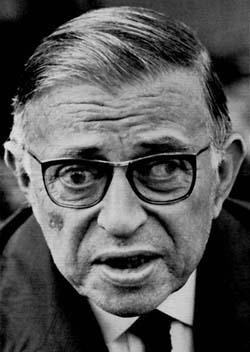
Ok, now go look at the first cover again. See what's odd? There is an image of a half-mask such as might appear in a Venetian masque, and that guy with the pen and manuscript. Which philosopher is he? Kierkegaard, maybe? Nope, that is a very famous portrait of Beethoven by Joseph Karl Stieler from 1820:

Absolutely no doubt about it! They got the wrong guy! Beethoven may be many things, but he is emphatically not a post-Kantian idealist!
Thursday, September 15, 2016
Battle of the Hammerklaviers!
Reminds me of an old joke: the English Baroque Concert Society played Vivaldi last night, Vivaldi lost! Yes, there is always the feeling that music and out-and-out competition do not quite go together. But after reading the New Yorker article on Yuja Wang and how splendiferous her Hammerklavier Sonata is, I thought maybe it was time to do some side by side listening. After all, they end the article by asserting Ms Wang's "incomparable musicality." Well, maybe it is not so incomparable after all. Let's see.
The piece in question, one of the great thorny challenges of the piano repertoire, is the Sonata in B flat, op 106 by Beethoven. Here is the original title page:

Now "Hammer-Klavier" in German just means "keyboard with hammers" as opposed to the older harpsichord which is a keyboard with plectra. Beethoven went through a nationalist phase where he began to use German tempo words instead of Italian ones. "Pianoforte" is, of course, an Italian word that points to the ability of the keyboard with hammers instead of plectra to play both soft and loud. In any case, the word "Hammer-Klavier" does not signify that this piece is particularly loud or fierce. It is just a handy nickname like "Moonlight" Sonata or "The Tempest".
In order that the comparisons be fair, you should listen to these clips with the score and NOT watching the videos.
This is quite a long sonata, between forty and fifty minutes depending, so I will just talk about the first movement. I have listened to two performances of the the first movement by each performer. Let's listen first to Yuja Wang at the Verbier Festival this year:
The first movement is about nine minutes long in this performance. Next is the performance at Carnegie Hall this year and the first movement is a little over eleven minutes long:

The piece in question, one of the great thorny challenges of the piano repertoire, is the Sonata in B flat, op 106 by Beethoven. Here is the original title page:

Now "Hammer-Klavier" in German just means "keyboard with hammers" as opposed to the older harpsichord which is a keyboard with plectra. Beethoven went through a nationalist phase where he began to use German tempo words instead of Italian ones. "Pianoforte" is, of course, an Italian word that points to the ability of the keyboard with hammers instead of plectra to play both soft and loud. In any case, the word "Hammer-Klavier" does not signify that this piece is particularly loud or fierce. It is just a handy nickname like "Moonlight" Sonata or "The Tempest".
In order that the comparisons be fair, you should listen to these clips with the score and NOT watching the videos.
This is quite a long sonata, between forty and fifty minutes depending, so I will just talk about the first movement. I have listened to two performances of the the first movement by each performer. Let's listen first to Yuja Wang at the Verbier Festival this year:
The first movement is about nine minutes long in this performance. Next is the performance at Carnegie Hall this year and the first movement is a little over eleven minutes long:
Then we have Grigory Sokolov in a performance at Munich in 1975. He also takes around eleven minutes for the first movement:
The final one I listened to is on this CD: Sokolov: Schubert/Beethoven and it is the longest of all; the first movement takes almost fourteen minutes. For some inexplicable reason, Blogger won't embed the clip, so just follow the link:
Trust me, it is worth it. This last clip, recorded in a concert in Salzburg in 2013, was just put up on Aug. 23 and so far has had only five views! It has been released on this CD, which I recommend (for the Schubert even more than the Beethoven):

What I would like to do at this point is nothing. I have taken away Yuja Wang's huge publicity advantage and just posted two of her performances followed by two of Grigory Sokolov's and all you have to do is listen to them. Preferably watching the score, not the video! Then you can simply come to your own conclusions! But I am happy to offer a couple of thoughts. It is actually very hard to put one's reactions into words. Often one musician will run into another coming out of a concert and one will simply shake their head while the other returns that with a smile. Yes, we both know what we think and no need to put it into words.
It is hard to put into words because, while I think it is quite clear who is the better performer of this sonata, exactly why is not so accessible in language. For example, while what Yuja Wang does is certainly very accomplished and quite correct: notes in the right places, dynamics tidily done, phrases phrased and so on, it never seems to amount to much. Whereas, Sokolov, even in the early performance which is full of fire and rhythm, always seems to be revealing something: inner voices, that bass line you never noticed, the whole of that odd harmony. And he is always with where the harmony is going. The last performance, the slowest of all, is also the finest. Things that don't make a lot of sense when they are rushed become clear and inevitable at the slower tempo. And yes, there is some controversy about Beethoven's tempo markings.
But really, were you expecting anything else? Really? As a very seasoned Czech violinist said to me as we ran into one another leaving a concert by a young Canadian cellist, "what, you were expecting Rostropovich, maybe?"
Nope.
Saturday, October 10, 2015
Paltry Post Today!
I just don't have time to do much of a post this morning. In the comments we have been talking about Beethoven's Piano Sonata op. 28, the "Pastoral", but after searching The Music Salon I see that I haven't done a post on this absolutely lovely sonata. I will do, but in the meantime, why don't you just give it a listen:
Tuesday, September 29, 2015
Beethoven's Cheeriest Piano Sonata
We have this biased image of Beethoven as a kind of musical wild man, furiously writing tortured but profound music:

Or even this, a very common image:

And then we tend to focus, at least in our talk and writing about Beethoven, on the most demanding, not to say depressive pieces like the Symphony No. 9 or the Great Fugue.
But the truth is that Beethoven, like Haydn and Mozart before him, wrote a great deal of amazingly cheerful music. And I'm going to prove it by introducing you to his Piano Sonata Op. 31, No. 3 in E flat major. It has four movements, all very lighthearted and cheerful. There isn't even a true slow movement. That function is given to a minuet, moderato e grazioso. Here are the beginnings (in the biz we like to call them "incipits") of each movement:
A fast, but somehow coy and graceful first movement:
A scherzo (which literally means "joke" in Italian):

The very elegant minuet:

And finally, the finale, a presto con fuoco, somewhere between a shindig and a hootenanny:

All together about 20 minutes of sheer, effervescent pleasure and fun. Now let's have a listen. My favorite Beethoven piano sonatas are by Friedrich Gulda. Here they are complete. To listen to just this one, go to YouTube where they are listed with links, or scroll ahead to the 5:12:54 mark:
Now why would we want to privilege Beethoven's more tortured efforts over sheerly beautiful and joyous ones like this? Are we just neurotic?

Or even this, a very common image:

And then we tend to focus, at least in our talk and writing about Beethoven, on the most demanding, not to say depressive pieces like the Symphony No. 9 or the Great Fugue.
But the truth is that Beethoven, like Haydn and Mozart before him, wrote a great deal of amazingly cheerful music. And I'm going to prove it by introducing you to his Piano Sonata Op. 31, No. 3 in E flat major. It has four movements, all very lighthearted and cheerful. There isn't even a true slow movement. That function is given to a minuet, moderato e grazioso. Here are the beginnings (in the biz we like to call them "incipits") of each movement:
A fast, but somehow coy and graceful first movement:
 |
| Click to enlarge |

The very elegant minuet:

And finally, the finale, a presto con fuoco, somewhere between a shindig and a hootenanny:

All together about 20 minutes of sheer, effervescent pleasure and fun. Now let's have a listen. My favorite Beethoven piano sonatas are by Friedrich Gulda. Here they are complete. To listen to just this one, go to YouTube where they are listed with links, or scroll ahead to the 5:12:54 mark:
Now why would we want to privilege Beethoven's more tortured efforts over sheerly beautiful and joyous ones like this? Are we just neurotic?
Wednesday, August 5, 2015
Don't believe what you read in the papers
A few days ago one of my commentators drew my attention to a Tom Service piece in The Guardian about the Leif Ove Andsnes complete cycle of the Beethoven piano concertos with the Mahler Chamber Orchestra. Andsnes not only played the piano part, he also conducted the orchestra as would have been done during Beethoven's life. Sounded like an excellent project, excellently delivered. The problem came with Tom Service's coverage of the event. He manages to get some pretty fundamental things wrong while blathering on about some more obscure things. Go read the article first: "What would Beethoven have thought of Leif Ove Andsnes's take on his piano concertos?"
I think that he goes astray in a few places. First of all, that quote from Beethoven. He says "It appears in William Kinderman’s 1814 essay on Beethoven’s piano music in the Cambridge Companion to Beethoven" which makes it sound as if Bill Kinderman wrote an essay in 1814. Not so! Bill is a musicologist working today, and probably the leading authority on Beethoven. He and I used to teach together at the University of Victoria. I also think that Tom Service's interpretation of the quote goes astray. Beethoven is likely talking about the new style of piano playing that was coming into favor around then, exemplified by figures like Hummel and Dussek. Far more about finger-virtuosity than the likely more musically profound improvisations of someone like Mozart (whom Beethoven may have had in mind) or Beethoven himself, for that matter.
The other big error is in what he says about equal temperament: "Beethoven would have heard Andsnes’s instrument as being crazily out of tune." No, he wouldn't. The big shift in temperament from Pythagorean or meantone to equal temperament, that we use today, took place in the 17th and first half of the 18th centuries. By the time of Bach, it had largely been completed. Between meantone and equal temperament were a variety of compromises, many of them the work of a theorist named Andreas Werckmeister who published some works in the 1680s and 90s in which he argued for a kind of well-tempered tuning that would do away with most of the unpleasantness of the meantone system. Bach's Well-Tempered Clavier is an obvious reference to Werckmeister. This work, often cited as being the first example of equal temperament, was probably not intended to be played in our modern system, but in one of the ones worked out by Werckmeister. But it was close to our modern equal-tempered tuning because all of the keys were usable.
Beethoven, of course, coming well after this, and using all the keys with equal freedom, wrote for equal temperament. Oddly, one thing that Tom mentions completely disproves his case: "the distance between the C minor of the first movement and E major of the slow movement is a shocking shift from one world of feeling to another, which he then makes a joke of at the start of the third movement, translating G sharp to A flat." G sharp and A flat are the same note only in the equal tempered system. Tom is completely confusing the distance between C minor (three flats) and E major (four sharps) in the circle of fifths with the difference between G sharp and A flat in Pythagorean tuning: it is called the Pythagorean comma and it is why the use of remote keys like A flat is only possible in equal temperament or something close to it.
It is bad enough when writers in the mass media--or even in program notes--try to completely avoid any technical discussion of music theory, but it is even worse when they get it wrong.
Now let's listen to Beethoven's Piano Concerto No. 2 in B flat major, op. 19, which was actually composed before the No. 1. This is Steven Lubin, fortepiano, with the Academy of Ancient Music directed by Christopher Hogwood. Brace yourself, because the instrument is one from Beethoven's time so it sounds quite different from a modern piano.
I think that he goes astray in a few places. First of all, that quote from Beethoven. He says "It appears in William Kinderman’s 1814 essay on Beethoven’s piano music in the Cambridge Companion to Beethoven" which makes it sound as if Bill Kinderman wrote an essay in 1814. Not so! Bill is a musicologist working today, and probably the leading authority on Beethoven. He and I used to teach together at the University of Victoria. I also think that Tom Service's interpretation of the quote goes astray. Beethoven is likely talking about the new style of piano playing that was coming into favor around then, exemplified by figures like Hummel and Dussek. Far more about finger-virtuosity than the likely more musically profound improvisations of someone like Mozart (whom Beethoven may have had in mind) or Beethoven himself, for that matter.
The other big error is in what he says about equal temperament: "Beethoven would have heard Andsnes’s instrument as being crazily out of tune." No, he wouldn't. The big shift in temperament from Pythagorean or meantone to equal temperament, that we use today, took place in the 17th and first half of the 18th centuries. By the time of Bach, it had largely been completed. Between meantone and equal temperament were a variety of compromises, many of them the work of a theorist named Andreas Werckmeister who published some works in the 1680s and 90s in which he argued for a kind of well-tempered tuning that would do away with most of the unpleasantness of the meantone system. Bach's Well-Tempered Clavier is an obvious reference to Werckmeister. This work, often cited as being the first example of equal temperament, was probably not intended to be played in our modern system, but in one of the ones worked out by Werckmeister. But it was close to our modern equal-tempered tuning because all of the keys were usable.
Beethoven, of course, coming well after this, and using all the keys with equal freedom, wrote for equal temperament. Oddly, one thing that Tom mentions completely disproves his case: "the distance between the C minor of the first movement and E major of the slow movement is a shocking shift from one world of feeling to another, which he then makes a joke of at the start of the third movement, translating G sharp to A flat." G sharp and A flat are the same note only in the equal tempered system. Tom is completely confusing the distance between C minor (three flats) and E major (four sharps) in the circle of fifths with the difference between G sharp and A flat in Pythagorean tuning: it is called the Pythagorean comma and it is why the use of remote keys like A flat is only possible in equal temperament or something close to it.
It is bad enough when writers in the mass media--or even in program notes--try to completely avoid any technical discussion of music theory, but it is even worse when they get it wrong.
Now let's listen to Beethoven's Piano Concerto No. 2 in B flat major, op. 19, which was actually composed before the No. 1. This is Steven Lubin, fortepiano, with the Academy of Ancient Music directed by Christopher Hogwood. Brace yourself, because the instrument is one from Beethoven's time so it sounds quite different from a modern piano.
Wednesday, June 10, 2015
Our Polyrhythmical, African Beethoven
You have to be very, very excessively loony to provoke Tom Service at the Guardian. Usually he is a reliable supporter of every wacky idea of political correctness, but even he has his limits. And they were breached recently by a group called, and I kid you not, "Beethoven Was African". Tom's article is titled "Does Beethoven's music reveal his African roots?" Now of course the article does not answer the question the title poses, they never do, but it is kind of amusing. The prose is so wayward it is hard to find a summary, but the subhead is as good as any:
The very sad and unfortunate truth is that Beethoven has been so dominant a musical personality that everyone wants to make hay from him in one way or another. The ideological tremors caused by his music still are reverberating through the classical world. So, sure, let's imagine he was black. But even as Tom is pooh-poohing the idea, he still manages to slime the classical world generally. He refers to a paper on the issue of the blackness of Beethoven by Nicholas T. Rinehart and quotes him in this passage:
The idea that there is a rigid "canon" of classical works that is decreed somehow by unnamed agents and that this canon needs to be reshaped and reimagined because it is "ossified" is one of the smelliest bits of conventional wisdom out there. Let me clarify: the so-called canon is nothing but the most popular and most loved and most performed and most discussed pieces of classical music. There is the more popular canon, containing pieces like Handel's Messiah and Vivaldi's Four Seasons and there is the slightly more serious canon, meaning pieces that would be programed in an orchestra's masterworks series instead of their popular series and this includes the most well-known symphonies and concertos and tone-poems. The most-performed operas fit in here as well. Then there is another canon of those works that are less widely popular, but much appreciated by serious music lovers such as the great pieces of chamber music and piano music. Then there is a more esoteric canon consisting of those works that are the most highly praised by music scholars and this would include more obscure chamber music and contemporary music.
So there is no one canon and the only people making up lists are those who collect data on performances and that just reflects people's tastes. It is, finally, a matter of taste and there is popular taste and the taste of the more informed listeners and that of musicians and scholars. These canons differ even as they overlap. The Four Seasons of Vivaldi, for example, are enjoyed by pretty much everyone. So when someone is claiming that all of this needs to be reshaped or reimagined, what they are really saying is that their views, and the views of their politically correct friends, are the ones that ought to prevail.
To which I answer: bite me.
The real problem with all this nonsense is that Beethoven's music, as I pointed out on numerous occasions, is rhythmically fascinating and all this blather about west Africa just obscures our ability to understand what he is actually doing. The rhythms are some of the most interesting aspects of a lot of his pieces and yet they are rarely focused on by theorists. I devoted a whole post to the last movement of Beethoven's Piano Sonata, op. 111 which is an extraordinary example. Let's have a listen. Here is a live performance by Daniel Barenboim:
A new album by the group Beethoven Was African aims to prove that the polyrhythms of the composer’s music point to west African heritage. But does their quest open up a more important debate in classical music?Oh yes, because, while Tom fails to mention this minor detail, we have absolutely no evidence, written, recorded or anecdotal as to the exact nature of the polyrhythms used in west Africa in the late 18th and early 19th centuries. Here is the claim made by the group and Tom's counter:
Yep. We do have a composer who was very influenced by this very African musical tradition, Steve Reich, but since he is not black, but Jewish, this is of no interest to anyone.“Ludwig van Beethoven had a precise and almost absolute knowledge of polyrhythmic systems and patterns from the Gulf of Guinea region, on the west African coast. Although they are unwritten, I would even say that these traditional patterns … were fundamental to his work as a composer. Beethoven has achieved the perfect synthesis between polyphonic modes and tonal system, developed in Europe in the centuries that preceded his era, with polyrhythmic system and patterns from west Africa.”Which is, I would humbly suggest, a patently ludicrous assertion: how could Beethoven, in 19th-century Vienna, possibly have garnered this “precise and almost absolute knowledge” of west African polyrhythmic traditions, even if he had wanted to?
The very sad and unfortunate truth is that Beethoven has been so dominant a musical personality that everyone wants to make hay from him in one way or another. The ideological tremors caused by his music still are reverberating through the classical world. So, sure, let's imagine he was black. But even as Tom is pooh-poohing the idea, he still manages to slime the classical world generally. He refers to a paper on the issue of the blackness of Beethoven by Nicholas T. Rinehart and quotes him in this passage:
...our attraction to the notion that Beethoven was black is a symptom of classical music’s tortured position on race and music: “This desperation, this need to paint Beethoven black against all historical likelihood is, I think, a profound signal that the time has finally come to make a single … and robust effort [to reshape] the classical canon.” Rinehart says we must reimagine the entire history of western art music.In a similar vein is this comment in his conclusion:
the significance of the idea that he might have been black is that it is a symptom of classical music’s ossified canonsAs I have said so many times, agreeing with Richard Taruskin, the so-called "friends" of classical music are often our worst enemies.
The idea that there is a rigid "canon" of classical works that is decreed somehow by unnamed agents and that this canon needs to be reshaped and reimagined because it is "ossified" is one of the smelliest bits of conventional wisdom out there. Let me clarify: the so-called canon is nothing but the most popular and most loved and most performed and most discussed pieces of classical music. There is the more popular canon, containing pieces like Handel's Messiah and Vivaldi's Four Seasons and there is the slightly more serious canon, meaning pieces that would be programed in an orchestra's masterworks series instead of their popular series and this includes the most well-known symphonies and concertos and tone-poems. The most-performed operas fit in here as well. Then there is another canon of those works that are less widely popular, but much appreciated by serious music lovers such as the great pieces of chamber music and piano music. Then there is a more esoteric canon consisting of those works that are the most highly praised by music scholars and this would include more obscure chamber music and contemporary music.
So there is no one canon and the only people making up lists are those who collect data on performances and that just reflects people's tastes. It is, finally, a matter of taste and there is popular taste and the taste of the more informed listeners and that of musicians and scholars. These canons differ even as they overlap. The Four Seasons of Vivaldi, for example, are enjoyed by pretty much everyone. So when someone is claiming that all of this needs to be reshaped or reimagined, what they are really saying is that their views, and the views of their politically correct friends, are the ones that ought to prevail.
To which I answer: bite me.
The real problem with all this nonsense is that Beethoven's music, as I pointed out on numerous occasions, is rhythmically fascinating and all this blather about west Africa just obscures our ability to understand what he is actually doing. The rhythms are some of the most interesting aspects of a lot of his pieces and yet they are rarely focused on by theorists. I devoted a whole post to the last movement of Beethoven's Piano Sonata, op. 111 which is an extraordinary example. Let's have a listen. Here is a live performance by Daniel Barenboim:
Subscribe to:
Posts (Atom)