Showing posts with label Charles Ives. Show all posts

Sunday, August 7, 2016

Charles Ives: Violin Sonata No. 1 (1903 - 1908)

I was trying to tell someone the other day that, while opinionated, I try not to be biased or prejudiced. The reason we have minds is to judge things, of course, but the trick is to judge them well, based on knowledge and understanding, not blind bigotry. So I am going to do a few posts that might demonstrate this to some extent.

Our chamber festival is in full swing right now and it is the usual mixture of interesting and not very interesting. One of the interesting things is a pair of concerts by Jeremy Denk, a very well-known American pianist. His most recent recording is of the Goldberg Variations. The first of the two back-to-back concerts is "From Medieval to Modern Music" which will contain music by Machaut through the common practice masters to the modern masters (Cage, Ligeti, Adams) and back to Machaut. If you know your Machaut then you know exactly what piece he is likely to end with: that marvellous palindrome "Ma fin est mon commencement" ("My end is my beginning")


As the text indicates, it is a double canon in reverse!

Anyway, I will let you know if this is in fact the piece by Machaut he chooses. The second concert is even more interesting, consisting of all four of Charles Ives' sonatas for violin and piano. Here is where the overcoming bias comes in: I'm not much of an Ives fan. I like some of his music (I owned the Tilson Thomas recording of the "Three Places in New England" orchestral set way back in the 70s and thought it was a fine piece), but other pieces, like his String Quartet No. 2 and the symphonies, I find to be either uninteresting musically or outright abuse of the audience. Sometimes he tried too hard to be the Ernest Hemingway of composers! But a while ago I noticed that Hilary Hahn, my favorite violinist, had recently recorded all four of the violin sonatas and now another very reputable musician is devoting a whole concert to them (with violinist Stefan Jackiw). That's two pretty important votes. So I am going to attend the concert and in preparation, I have just gotten the Hahn CD.
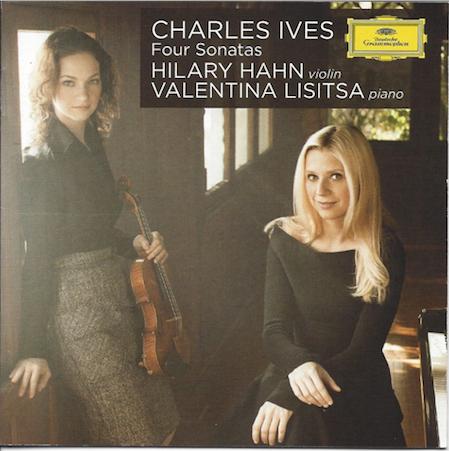


After a couple of listens to the album I'm surprised to find that these pieces are very fine and interesting music. Ives himself seemed to think they were back-pedaling, going too soft on the audience (not sure why this is a vice, though), and in his Memos he called them:
"weak-minded, retrogressive"
and described the First Sonata as:
"in part a kind slump backward, though in some places it is quite the opposite"
Ives, perhaps merely in self-defence against the small-minded conservatism he constantly encountered from musicians in his early years, tended to be tough-minded to a fault.

There is no question that Ives was a visionary pioneer, to the extent that, to this day, his music is perhaps less well understood than it might be. So let's have a look at it and see if we can achieve a few scraps of understanding. Here is the first page of the First Sonata:


You can certainly see why Hilary Hahn, in her notes to the album says.
When we got our hands on the sheet music, we attempted to read through it. That effort quickly stalled. Ives's music may sound at times transparent, but his notation turned out to be tremendously complex, filled with exacting markings for accents, articulations, disjointed dynamics, rhythmic intricacies, and changes of tempo.
You need to understand that these performers, Hilary Hahn and Valentina Lisitsa, are of a level of accomplishment that there are probably not many pieces in the repertoire that they can't simply read off at sight! But this music, even over a hundred years after its composition, is still very hard to read and understand. But, interestingly enough, it is not so hard to listen to! In fact, let's have a listen to this sonata:


The first page is about the first 50 seconds in the recording. What do we notice? Let's just take the first fourteen measures, ending just before the piano solo in the third measure of the last line. The piano begins with a brief phrase that seems to start in F minor, but quickly slides away from that. The notation is a bit perplexing because we have A flats and naturals at the same time, plus we have D# and E# and then D# and C# over an odd chord of E flat, B flat (then B natural) and F#. He is constantly beginning one kind of gesture (as in the first measure) that turns into an entirely unexpected one. The music is neither tonal nor atonal, but hovers between. I am very tempted to start re-spelling half these notes to try and make sense of them. But That Would Be Wrong! Let's look at the melodic lines and see what they reveal. The piano opens with


The phrase divides into two gestures, both opening with an ascending fifth (F to C answered by C to G) and the second one descends D# C# A G. It might almost be heard as a phrase in F ending on the dominant--except that the chord below is something else entirely: E B flat, C#! The next melody in the piano is this (in two sections):


Midway through the violin enters with a phrase that begins with a backwards version of the piano's first phrase:

Click to enlarge
Why does this sound familiar? The piano opened with rising 5th, falling major third: the first three notes of the violin phrase are falling minor third, rising fourth. It is a kind of obscure "family resemblance". This continues with the falling semitone, minor third, which echoes the rising whole tone, whole tone of the piano phrase. Yes, these are not the same intervals. Hey, I said "family resemblance". I mention this because we hear the violin phrase as being a kind of answer to or commentary on the piano phrase (while the piano is introducing another commentary itself). In an odd little gesture towards closure, both violin and piano end this phrase on a C#! The piano then has a tiny little phrase that also seems to echo something from before, then the violin has a new phrase. Incidentally, the piano had a turn with two whole tones (C B flat C D) and now the violin, in longer notes, has a bit of an echo of that: C D (B natural) E. That whole tone turn returns in the piano and both instruments continue with a new phrase that, without copying them exactly, again suggests the material from before. There is also another strong reference to the tonal practices of the past because the violin exactly reproduces the opening rising fifth of the piano (F# to C#) as if it were going to be a canon at the octave. But this does not continue. As I said, the music constantly hovers between tonal gestures and the repudiation of them by continuing in an unexpected direction. This last phrase, even though it began by outlining an F# chord, ends on a G minor minor seventh chord, which almost suggest the dominant of the dominant (if we are in F). Even though this is not really tonal music, it keeps hinting at tonal structures.

So that is a very brief and perfunctory analysis of the first page (50 seconds worth) of the First Sonata! You can see why I don't do many analyses here! Even a very cursory analysis of the first movement would take the whole day. But, it is my view that just a brief look at the bones of a piece gives you a good handle on how to listen to it. So let's go back and listen to the whole piece and see where it takes us.


Sunday, June 8, 2014

The Problematic Mr. Ives

I haven't written a lot about Charles Ives here and it has often been unsympathetic. I often find his music off-putting. But after reading an extremely interesting review, by pianist Jeremy Denk, of a new biography of Ives, I may want to give him another chance. Mr. Denk writes:
Another of the essential Ives problems, an important manifestation of his doubt, is his simultaneous affection for music of unashamed consonance—like hymns or Stephen Foster ballads, which are almost too easy to understand—and music of bewildering dissonance. (His dirty secret was that he loved to write beautiful things.) He did not hide this divided loyalty, which would be disqualifying for most composers in search of a voice. In the 114 Songs, self-published as testament, these extremes are side by side: his gorgeous student setting of “Feldeinsamkeit” in normative D-flat major nestles against pages of tone clusters, savage piles of unresolved notes.
And again:
Humor has a complicated place in the value system of classical music, and for many Ives’s broad wit is a failing. But his slapstick pastiches and his most affecting testaments share a common urge: to recreate the messiness of human experience. It’s true enough to say that Ives wrote music about music, but truer to say that Ives wrote about music-making—social events, church services, parties—any kind of event in which music is a conduit for communal epiphany, release, or outpouring. One famous example is the last movement of the Second Orchestral Set, where Ives remembers an accidental catharsis: shortly after the sinking of the Lusitania in 1915, crowds on a train platform joining along with a hurdy-gurdy to sing “In the Sweet Bye and Bye.” The moment when everyone arrives together singing the tune is thrilling, but even more moving is the aftermath, the trailing-off, the hurdy-gurdy continuing to play, winding down slowly but surely—Ives devotes a great deal of love to the unclean finish.
This is a pretty good argument for Ives' music and for listening to it in a different way. One piece that Mr. Denk particularly recommends is "The Revival", the last movement of the Violin Sonata No. 2. Let's have a listen:


Well, that is certainly an interesting, unique and expressive piece. I may have to change my mind about Ives rather thoroughly! It is probably the case that I just don't know very much of his music.

Monday, March 10, 2014

Vulgarity in Music

I was at a string quartet concert last night. On the whole an excellent concert with an interesting range of contemporary music. I'm not going to name the quartet as this won't be a review of the performance. I do want to talk about a phenomenon I noticed that is of aesthetic interest. We often talk about music using metaphors because that is usually the best way to communicate without using a lot of technical terms: "Then follows a passage in the relative minor that pivots on the Neapolitan sixth chord to C major." This does not mean much unless you have taken a few courses in harmony. So we fall back on metaphor, which can often be very clear and informative.

One frequent source of metaphors about music is the likening of a program to a menu with an entree, first course, main course and dessert. One that is not very often used, but that I would like to embark on here is likening musical performance to social intercourse and in particular, the etiquette of social interaction. Don't you find some music charming and engaging and other music boorish and clumsy? Have you ever felt a piece of music was bullying the listener? Or another one drawing the listener in?

The string quartet program last night gave a couple of interesting examples. The program ended with the String Quartet No. 1 by Charles Ives. There followed an encore, an arrangement for string quartet of one of the variations from the Goldberg Variations by Bach--no. 13, as a matter of fact. The utterly different approach of the two pieces in juxtaposition made me think of musical etiquette.

Musical interactions can be governed by social etiquette as much as any other kinds of human interactions. For example, if one of the players has a fermata, the others have to wait for him. This is a bit like allowing someone to proceed through a door ahead of you. We even have specific musical terms that are often written in the score. "Colla parte" for example, means for the accompanist to follow whatever the soloist is doing. The art of musical accompaniment in general is the art of following, in tempo and dynamic and phrasing, what another instrument is doing. In a string quartet you see the members observing one another closely for attacks, cut-offs and phrasing. So this is all perfectly normal.

What I want to suggest is that sometimes I feel that there is an unspoken aesthetic of music that is akin to a kind of etiquette that could govern or at least suggest relations between the music and the listener, the composer and the audience. For example, is it good and proper to pound away at the audience with the same idea over and over and over again? Usually not, though there are some significant aesthetic exceptions: the minimalist school of composers did this and they had a very specific intention.

Last night's concert, which featured a quartet by Philip Glass, demonstrated to me something interesting. You might recall from my posts on the Schoenberg Violin Concerto that one of the problems I saw for that music was the extreme rhythmic dislocation. Composers today have far much more of a "groove" in their music and it is likely due to the influence of those two "minimalists" Steve Reich and Philip Glass who reminded us over and over and over that pulse is an important part of music.

So, often what one might expect ordinary musical etiquette to forbid, such as going on and on with the same pulse for a long time, is frequently permitted by an important aesthetic need. This is so often the case that the idea of an etiquette of music is a strange concept for us. But, I would like to argue, sometimes it seems like the right metaphor.

Going back to that concert, the quartet by Charles Ives, especially in juxtaposition with the music by Bach, seemed to me boorish and vulgar. Yes, I know, that's a bit extreme, but I call them the way I hear them. Ives may be a bit of a sacred cow, and there are some lovely pieces by him such as the Three Places in New England, but often his music seems to me to be, as I say, boorish and vulgar. What is vulgarity in music? Things mashed together with little care for the overall effect, going on and on, hammering on an idea, no matter how ugly. Writing with no respect for the performers and the audience, focusing only on one's own musical obsessions. Hey, that sounds exactly like Charles Ives! In fact, one of the performers, in announcing the piece, said something similar, but mentioned it as if it were a good thing!

So let's do some listening and see if you can see what I mean. Here is the last movement of the String Quartet No. 1 by Charles Ives:


Ugh. I suppose you can call that "triumphant" and "happy", but to me it is just an ugly mishmash. I get the same feeling from that as of being trapped in a corner at a cocktail party by a boorish and ignorant person who insists on telling me his half-baked views on everything while poking me in the chest with his finger. It is a wonder to me that a string quartet can play this music with a straight face who also might be playing quartets by Haydn or Beethoven. Don't they see the difference? Or does the ideology of modernism completely justify this? I suppose it used to.

Let's juxtapose that Goldberg Variation, no. 13, so as to get the effect of the concert:


Those two pieces side by side surely reveal something?

Let's end with some better music by Charles Ives. Here is "The Housatonic at Stockbridge", the last of his Three Places in New England:


Monday, May 14, 2012

The Universe of Music

To me, the world of music is a vast universe of sound with nebulas, galaxies, solar systems, planets and comets. The Balinese monkey chant is a small musical world of its own, geographically close to but musically far from, the world of the Javanese gamelan. The blues of Robert Johnson and its flow, as a river, into the music of the Rolling Stones and Eric Clapton, is another world. The galaxy that is the string quartet, devised by Joseph Haydn, throws out spiral arms in Beethoven, Brahms, Janacek, Bartok and Shostakovich.

No need to continue the metaphor: the universe of music is too vast to comprehend. Occasionally someone tries to hint at this vastness. One such was Charles Ives in the sketches for his Universe Symphony. Here is a brilliant account of the piece. It is hard to think of anything to compare it to. Perhaps Mysterium, an unfinished project of Scriabin that dates from roughly the same period, the second decade of the 20th century. Another comparison might be to Dante's Divine Comedy, a work of art that spans the whole universe of human understanding.

I'm fairly comfortable with most composers and a lot of pop music. I have a fair idea of what is going on in the music and the aesthetic value of it. But there are composers that I have not even yet attempted to come to terms with and Charles Ives is one of these. Scriabin, too, possibly. I just don't know what I think about Ives' music. But I am certainly going to have a very serious look at it. In the meantime, here is the first section of his Universe Symphony realized by Michael Stern and performed by the Rundfunk Sinfonieorchester Saarbrücken under his direction.


A couple of days ago another version of the piece was performed in New York by the Nashville Symphony. Here is news clip with the music director discussing how it was put together.


Five conductors? Makes sense. But poor Stockhausen! Outclassed by Ives decades before he wrote his Gruppen for three orchestras and three conductors!