The list of really great pieces for the classical guitar is surprisingly short. Mind you, not everyone would agree with this assessment. But it seems clear to me that there are only a few really substantial pieces. We could try to list them: the Concierto de Aranjuez would qualify and for solo guitar, the Nocturnal of Britten, the Invocation and Dance also by Rodrigo, the Variations and Fugue on Folias de España by Ponce and then we are likely into the transcriptions: the Chaconne of Bach, a few works by Albéniz and Granados, some by Scarlatti and that's about it. Of course arguments could be made for a few others, perhaps something by Sor or Giuliani, but that's about it. A shockingly brief list for such an important instrument.
Perhaps the most brilliant thing Andrés Segovia did for the guitar repertoire was transcribe the Chaconne of Bach. Instantly we had a piece that not only worked surprisingly well on the instrument, but it was also an addition of tremendous stature. One could argue that it is the greatest piece written in the whole Baroque era (though of course that would start a whole host of arguments!).
Perhaps the stupidest thing I did in my career was to put off learning the Chaconne. It was really a mixture of poor judgement and sheer laziness. I could never quite bring myself to learn the Segovia transcription as it didn't quite conform to my taste as far as interpretive choices. And I was too lazy to do my own version from scratch--there are a lot of notes in the Chaconne! I was also unsure that I was going to bring something worthwhile to the piece. That was pretty stupid as I could not NOT do otherwise than play it my own way. Anyway, I let decades go by without learning the piece, instead performing cello suites and lute suites by Bach.
But now I am rectifying all this and I'm well into doing my own transcription (which is mostly just lightening up Segovia's and rethinking the slurs and ornaments) and working on memorizing it. Some of the thirty-second note passages are surprisingly hard to keep straight!
Working on this piece every morning has the lovely benefit of putting Bach in your head all morning, something I heartily recommend.
There were three pieces that convinced me to convert from steel string and electric guitar to classical guitar: the Chaconne, the Concierto de Aranjuez and Asturias by Albéniz. The latter two I often played in my career, the Chaconne was the only one missing. So now I am finally getting around to it. I think I have just enough technique left to be able to play it, so it will make a nice envoi to my performing career. About a year from now I should have it all memorized.
So I guess the first question is, what is a chaconne? As usual, the Wikipedia article is not a bad place to start:
The chaconne has been understood by some nineteenth and early twentieth-century theorists to be a set of variations on a harmonic progression, as opposed to a set of variations on a melodic bass pattern (to which is assigned the term passacaglia),[7] while other theorists of the same period make the distinction the other way around.[8] In actual usage in music history, the term "chaconne" has not been so clearly distinguished from passacaglia as regards the way the given piece of music is constructed, and "modern attempts to arrive at a clear distinction are arbitrary and historically unfounded."[9] In fact, the two genres were sometimes combined in a single composition, as in the Cento partite sopra passacagli, from Toccate d’intavolatura di cimbalo et organo, partite di diverse arie ... (1637), by Girolamo Frescobaldi, and the first suite of Les Nations (1726) as well as in the Pièces de Violes (1728) by François Couperin.[10]
Frescobaldi, who was probably the first composer to treat the chaconne and passacaglia comparatively, usually (but not always) sets the former in major key, with two compound triple-beat groups per variation, giving his chaconne a more propulsive forward motion than his passacaglia, which usually has four simple triple-beat groups per variation.[11] Both are usually in triple meter, begin on the second beat of the bar, and have a theme of four measures (or a close multiple thereof). (In more recent times the chaconne, like the passacaglia, need not be in 3 4 time; see, for instance, Francesco Tristano Schlimé's Chaconne/Ground Bass, where every section is built on seven-beats patterns).
By way of contrast, Richard Taruskin in the Oxford History of Western Music describes the ciaccona in his discussion like this:
The ciaccona was a fast and furious dance in syncopated triple meter, which in the sixteenth century has been imported into Spanish and Italian courtly circles from the New World ... Monteverdi published his setting of Ottavio Rinuccini's imitation of Petrarch's famous sonnet Zefiro torna in the form of a "ciacona." [op. cit. vol. 2, p. 37]
Here is how that looks in score:
Click to enlarge
Pretty simple harmonic structure: I V vi I6 V repeat. The C could be either IV or just a passing note. The metric layout is interesting: 6/4 with stresses on 2 and 5 in the second measure. This is from Scherzi musicali of 1632. There is a chaconne by Louis Couperin from a manuscript dated to around 1660:
Click to enlarge
This is an eight-measure theme, but the second four measures are the same as the first. Interesting, the syncopation (stress on the second beat) only happens in the third complete measure. This is also a structural downbeat as it is the first appearance of the dominant on a beat. The key is G minor and the harmonies are III (the upbeat is an interesting ambiguity as on the face it is simply a d minor chord, but the downbeat reveals that it should be heard as a III6/5), VI (and up to this point we could be in E flat), iv, V7 (first confirmation of key) i, V (4-3 suspension) i. And the downward scale connecting the cadence with the repeat shows how the d minor/B flat harmony integrates with the rest. Rhythmically this replaces the downbeat beginning of the Monteverdi, with an upbeat.
Here is a "Chaconne Légère" from the Troisieme Concert Royale by François Couperin from 1714:
Click to enlarge
Again, an eight-measure theme and the harmonies in a minor are i, iv, III, V (the arrival of V is delayed with a syncopation) i VI, V i V i. The harmonic rhythm accelerates throughout. Here is an example from Telemann:
Click to enlarge
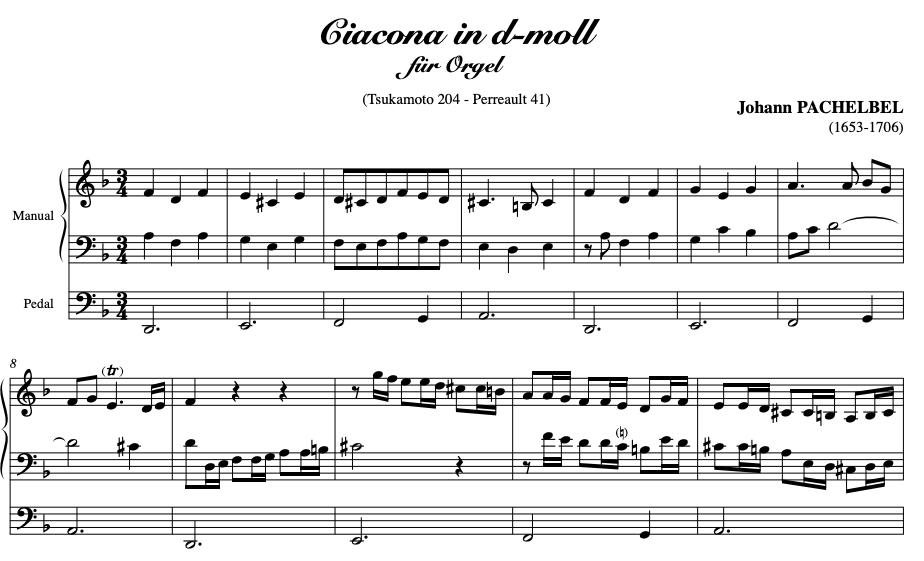
For the first time we see the theme beginning on the second beat of a 3/4 measure and the tempo seems slower. The chaconne was not a huge favorite of German composers, but here is another example from Pachelbel:
Click to enlarge
Rhythmically rather humdrum as one would expect from Pachelbel. No upbeat, eight-measure theme and the harmonies are i, viiº6, i6, ii6, V, i, ii, i6-iv, V, i.
What started as a fairly zippy dance-like brief harmonic ground has evolved into an eight-measure theme in two halves sometimes with syncopation. It also, at least with German composers, seems to have slowed down. The name "ciacona" was often used and does not seem to have been an indication of whether the composer is following the earlier, syncopated and quicker Italian model or the later French model. In general the genre seems to have slowed down. Here is the Bach theme:
Click to enlarge
Eight measures divided into two halves, each ending with a cadence on the tonic. Here are Bach's harmonies: i, ii4/2, V6/5, i, VI, iv, i6/4, V i, ii4/2, V6/5, i, VI, ii6/5, V, i. The only difference between the two halves is the iv chord replaced by the ii6/5. This is a harmonically very rich theme which Bach actually simplifies, harmonically, in some variations. This goes rather against the usual tendency with sets of variations which is to follow a simple theme with more elaborate variations.
Bach also sets up a fundamental harmonic syncopation throughout that stresses the second beat. In the third and fourth complete measures he even creates a hemiola by making the two measures of 3/4 into one measure of 3/2. All this sets the listener up for a substantial piece.
I think that what is actually happening here is that Bach, that great synthesist, is uniting the chaconne genre with the sarabande. If I replaced these harmonies with other ones, but retained the rhythmic structure, I think I could persuade you that you were listening to the first section of a sarabande. For comparison, here is the Sarabande from the same partita:
Click to enlarge
The main difference seems to be that while the second beat is stressed in both, the Chaconne begins on the second beat. In any case, the theme to the Chaconne just feels a bit sarabande-like to me!
Here is a performance on violin by Sigiswald Kuijken:
Of course it doesn't feel much like a sarabande at that tempo.
I put up the John Williams recording a while back. When it came out it seemed to me to be a really valid approach to the piece. It trimmed away the excess additions of the Segovia transcription and had a crisper rhythmic approach and even added a few ornaments here and there. But listening to it now I have to admit that about halfway through, when he gets to the restatement of the original harmonies just before the major section (right around the 6:23 mark), I started to chuckle. Yes, it seemed so incongruous to me that after so much of the piece without a shred of a trace of an ornament, suddenly he decides to add quite a few.
John Williams is a very great guitarist and he is the performer whose wonderful recording of all the "lute" music of Bach made it truly part of the repertoire. But frankly, while a technical marvel and a very solid interpreter, when it comes to the Chaconne he is not very creative. If you are going to adopt Baroque performance practice then you should do it in a comprehensive way, not adding it like whipped cream and a cherry on top. That reminds me a bit of the old guitarists' interpretive standby: anytime you have a passage that is repeated you either do it ponticello or tasto for contrast. This is one of the Segovia quirks that has mercifully disappeared from most interpretations. But slapping in ornaments in one tiny section is not very much more profound.
Don't get me wrong, Segovia was a great artist and a great player of Bach, but he was certainly not a model of Baroque performance practice. John Williams represented a considerable advance in the guitar world's understanding of Bach. But listening to a selection of other performances on guitar, about the best that one can expect, it seems, is a technically solid if rather dull delivery. Here are a couple of examples by John Feeley and Ben Verdery.
So even early on I found myself attracted to performances on the Baroque lute instead of the guitar. Here is a fairly early one by Hopkinson Smith and right from the first chord we encounter a different sensibility.
The most recent Baroque lute version is by Thomas Dunford and he takes us a step further with looser rhythms and some interesting arpeggiations.
One of the most interesting things about the Chaconne is how it tends to reveal the musical personality of the performer--it is a kind of test of your character as an artist. Some of the most interesting performances are found on the harpsichord. Here is an early one by Gustav Leonhardt:
What I really like about this version is the free use of ornaments. In the opening theme, for example, he does mordents on the two A melodic notes that begin each half of the theme. I like this because when I was working on the piece the other day and thinking about how to begin it I came up with two ideas: first, to fill in the third in the first chord, adding an E between the D and F. Then adding a mordent on the next A. This was, I hasten to say, before I listened to the Leonhardt!
But for a really zingy performance let's listen to the very recent one by Jean Rondeau. From the video it looks like he recorded it in his garage:
UPDATE: Just to bring it full circle, the most creative interpreter of Baroque music on guitar seems to be Leo Brouwer. Before he injured his index finger, cutting short his performing career he did an interesting version of the Chaconne:
And guess who he studied Baroque performance practice with in Amsterdam back in the late 1960s? Yep, Gustav Leonhardt.
When I first discovered classical music back around 1970, it seemed like everything was for orchestra, piano, or violin. I was very happy to discover, after a while, that there was actually such a thing as classical guitar and it even had a repertoire. Most of that repertoire was by composers who were, shall we say, "lesser known"? But there was one big exception: J. S. Bach and I delighted in listening to some wonderful performances by Christopher Parkening, Andrés Segovia and, later on, John Williams.
Now of course Bach did not actually write for the classical guitar which did not even exist in his time. Nor did he write for the Baroque guitar, which did. But Bach's music has a universal quality and much of it survives very well when translated to different instruments. Though Bach did know and play on pianos, his keyboard music is for harpsichord, clavichord and organ, though that has not stopped generations of pianists from playing it, and playing it superbly well.
The one guitar piece that made a huge impact on me was the Chaconne in D minor, the last movement of the Partita in D minor for solo violin. It was this piece in particular that inspired me to devoting much of my life to learning the classical guitar. Two other pieces were also influential: Leyenda by Albéniz and the Concierto de Aranjuez by Rodrigo. These two, plus a host of other repertoire, I did, in time, learn and perform on numerous occasions. But something about the Chaconne stymied me.
It was one of the first pieces I tried to learn as I got a photocopy of Segovia's brilliant transcription for guitar. In fact, very early on I memorized the first page. But I realized that I was years away from having the necessary technique so I shelved it. I did learn a lot of other music by Bach, the First Lute Suite, the Fourth Lute Suite, the First Cello Suite and so on, but not the Chaconne. I took it up to deliver a presentation on it in a performance practices class in university, but I never got around to learning it.
Why not? At the time it just felt like I did not have something new and original to say about the piece. I tended to avoid pieces that seemed to me to be over-performed unless I had something to say. But in retrospect I realize that it was that very Segovia transcription that was standing in my way. It was too beefy and too romantic and added too much to the piece. The great strength of the Chaconne is its enormous aesthetic power delivered through such slender means. Then I heard John Williams masterful recording of it where he trimmed down the Segovia transcription to its pure essentials and I thought, ok, good, Williams has the final word, no need for me to learn the piece.
Well, that was truly wrong-headed of me! The truth is that of the great masterpieces of the classical music world, the list that includes the Brandenburg Concertos and Mass in B minor of Bach, the symphonies of Beethoven, Mozart and Haydn, the string quartets and piano sonatas of Beethoven, and so on, the only piece that is undeniably on that list and that you can credibly play on guitar is, yes, the Chaconne.
So I am finally learning it--not to perform as I am retired from public concerts, but purely because it is there: 256 measures in D (minor and major) for violin unaccompanied, very playable on guitar. A set of variations on an eight measure theme. If we set aside Bach's own Goldberg Variations, the greatest set of variations ever written in the Baroque era--or any era, arguably. And delivered with such modest means: four strings and a bow.
I am going to do some other posts on the piece. I am already planning one on the genius of the variation technique. In the meantime here is the John Williams performance: