This is the Caspian String Quartet:

THE MUSIC SALON: classical music, popular culture, philosophy and anything else that catches my fancy...
Showing posts with label Béla Bartók. Show all posts
Showing posts with label Béla Bartók. Show all posts
Tuesday, February 11, 2025


Tuesday, December 21, 2021
Bartók: Bluebeard's Castle
If you were like me a couple of weeks ago, you might have had a look at/listen to Bluebeard's Castle by Bartók and said, what is this about? This is, after all, a pretty weird piece. I listened to it a couple of times while working through a whole box of Bartók and honestly, I couldn't make any sense of the music. So I decided to have another look at it and found a couple of filmed versions with subtitles so I could actually, you know, know what was going on. Listening to it sung in German or Hungarian without translated subtitles is not going to get you very far.
Bluebeard's Castle is a kind of expressionist fairy tale with the typical structure of a fixed number of stages or challenges. There are only two singing roles: Duke Bluebeard and Judith his new wife. He brings her to his dark castle. Bluebeard's castle has seven locked doors, behind them are:
- Torture chamber with bloody walls
- Armory with blood-stained weapons
- Treasury with gold and gemstones
- Garden with beautiful flowers
- A rocky abyss, view of the domain
- Pool of white still water of tears
- Bluebeard's three previous wives, as living effigies
The work, composed in 1911, has been called "one of the great early twentieth century operas" (Abbate, Carolyn; Parker, Roger. A History of Opera (p. 447). Penguin Books Ltd. Kindle Edition) and it might be compared to Schoenberg's Erwartung, composed just two years earlier, in 1909, as another example of psychological expressionism. The Bartók work is carefully structured, beginning in F#, moving to C in the middle when the castle is bathed in light and returning to F# and darkness at the end. Each door unveils its own unique orchestration, brass fanfares for the armory, harp arpeggios and flute trills for the garden and so on.
A lot of, to my mind, odd interpretations have grown up around the work. Some have even thought that Judith is the villain, invading the private world of Bluebeard and forcing him to give up his secrets. In a recent staging, Judith is a police detective who frees the three previous wives and kills the perpetrator. A more balanced view might see this as a primarily symbolic work that delves into the problems and challenges of man/woman relationships. Or maybe it is just a critique of serial divorce!
The most unique feature of the opera is the seven doors with their seven varying contents. These are obviously aspects of Duke Bluebeard's personality that are step by step revealed to his new bride. The torture chamber might be seen as the cruel facet, the armory the assertive, the treasury the acquisitive, the garden the aesthetic and so on. A thorough examination of the work would look at the details of how Bartók characterizes each aspect. The final door shows the previous wives as the dawn, midday and evening of what, one's relationships? Then Judith is installed as the night and darkness falls. I see this as a rich field for interpretive investigation.
However you see it, it is certainly a powerful work and the unique structure makes the narrative work. Here is a 1988 performance with English subtitles that was broadcast on the BBC. For some reason Blogger doesn't want to embed, so just follow the link:
Sunday, June 6, 2021
Bartók: Music for S, P & C, first movement
 |
| Béla Bartók (1881 - 1945) |
When I was taking the graduate seminar 20th Century Theory and Analysis we spent some time with Bartók and I recall the professor recoiling in horror when I suggested that the first movement of Bartók's Music for Strings, Percussion and Celesta (composed in 1936) was a fugue. Now of course he was right in that it is not a traditional or conventional fugue, but rather a piece written following Bartók's own unique system of melody and harmony (not to mention rhythm). But I was also right in that it presents all the traditional gestures of a fugue and the listener is meant to hear it in that sense, but with Bartók's re-envisioning and revitalizing of the conventional form. So what I am going to do is show how this movement is a fugue, with all the characteristic elements of a fugue including subjects, inversions of subjects, stretto, episodes and so on. And I am going to show how this all fits into Bartók's harmonic and melodic system.
Incidentally, the introductory note in the score on the structure of the first movement states quite clearly that it is a "fairly strictly executed form of a fugue." What the theory professor was demonstrating was his adherence to the modernist narrative of 20th century music and its avant-garde rejection of musical tradition. Bartók, being one of the founders of 20th century modernism in music, should not be tied to musical traditions such as the fugue in his view. Bartók was certainly a musical progressive, but his musical language has deep roots both in folk musics and past musical traditions.
Fugue from Another Planet
I choose this subtitle because what Bartók has done is give us what is identifiable, in whole and in parts, as a fugue in the Bachian sense, but at the same time he has managed to make it sound utterly unlike the sound of a Bach fugue. Let's look at how he accomplishes this. Here is the subject as first presented and it begins on A:
 |
| Click to enlarge |
And here is the answer beginning on E (I'm not showing the entire answer so as to save space) which appears at the fifth, just as it should in a fugue:
 |
| Click to enlarge |
Then there is an entry in the cellos on D (bass clef and again, I am not showing all the subject):

There follows an entry in the violins on B, an episode and then another entry in the violins on F# (treble clef):

I mentioned inversion and stretto as two other traditional fugal devices that Bartók uses. Here is an example. The first segment of the subject is inverted and layered on top of itself through all the strings from top to bottom:

Stated like that, this seems rather like a traditional fugue. But let's take a look at that subject. Apart from that C# it looks a lot like A Phrygian. But notice that the subject spans the space between A and E-flat in its first two segments. One of the main characteristics of Bartók's approach to pitch, both melodic and harmonic, is to create symmetries where traditional harmony uses asymmetries. The overall layout of this first movement displays different kinds of symmetries. First, this A to E-flat movement is the main structural feature of the movement: it begins on A and the climax is on E flat:

Of course, the main structural pitches in traditional harmony are the tonic, subdominant and dominant, which asymmetrically divide the octave. Using the tritone above A, the E-flat, symmetrically divides the octave in half. At the very end is a little coda that is a kind of summary of the overall structure (treble clef):

Antokoletz' fascinating book on Bartók includes this example that shows two other kinds of symmetries in this movement:
 |
| Click to enlarge |
Here he shows two other ways Bartók structures the movement. Beginning on the initial A, the upper staff shows how he creates entries of the subject each a perfect fifth higher than the last: A, E, B, F#, C#, G# and finally E flat (enharmonic of D#). Interwoven with that is a movement down by perfect fifths: A, D, G, C, F, B-flat and finally E-flat. Two interlocking symmetries both arriving at E-flat!
Summary
The Music for Strings, Percussion and Celesta is a major classic of 20th century music. To my knowledge it was the first piece written using the "Music for ..." type of title that has been used by innumerable composers ever since. The composition owes its genealogy to both the sonata da chiesa of the Baroque in its slow-fast-slow-fast movement structure and to the 18th century Viennese symphony in its purely instrumental four movement layout ending with a quick dance-like movement. It is as close as Bartók got to writing a symphony, but he wanted to underline his status as a musical innovator so he chose a neutral title (and one that many other composers have found useful). Another major innovation is the division of the orchestra into two "choirs" or groups separated in space in order to make use of the very old 17th techniques of the Gabrielis in San Marco in Venice where the different instrumental groups answered and echoed one another--a technique that had fallen completely into disuse by the early 20th century.
Now let's have a listen to one of the greatest pieces of 20th century music. First the RIAS Symphony Orchestra conducted by Ferenc Fricsay with the score.
Monday, May 31, 2021
Sonata for Two Pianos and Percussion
I just ran across this very nice performance of a unique piece by Bartók, the Sonata for Two Pianos and Percussion. What is so unusual about this performance is that everyone is playing from memory, something you rarely see in chamber music, especially of this sort!
What is interesting about this piece is that he takes the idea of a sonata for piano and expands it to two pianos and then hugely expands the timbral range by using percussion to extend the sounds of the pianos.
Bartók and Folk Music
The rich traditions of folk and peasant music found in Eastern Europe were a lifelong preoccupation of Bartók. He was greatly aided in this project by the use of the Edison phonograph, which recorded on wax cylinders. Here is a photo of him recording Slovak folksongs. Bartók is fourth from the left:

Bartók's first expedition to collect Hungarian folksongs was in collaboration with Zoltan Kodály and in December 1906 they published a collection of twenty arranged for voice and piano. Here is an excerpt:
Bartók later wrote about the influence of this music in his autobiography:
The outcome of these studies was of decisive influence upon my work, because it freed me from the tyrannical rule of the major and minor keys. The greater part of the collected treasure, and the more valuable part, was in old ecclesiastical or old Greek modes, or based on more primitive (pentatonic) scales, and the melodies were full of most free and varied rhythmical phrases and changes of tempi... [quoted in Antokoletz, The Music of Béla Bartók, p. 26]
Another example: six Romanian Folk Dances arranged for violin and piano:
Of course, Bartók both transformed these basic materials and combined them with many other elements such as the church modes on various pitch levels, expanding modes by ordering them into perfect fifth progressions, and using whole tone scales and polymodal chromaticism. We can find examples of these in his 14 Bagatelles of 1908 where he absorbs the folksong influence into original compositions:
Sunday, May 30, 2021
Introduction to Béla Bartók
My love and appreciation for specific composers tends to wax and wane, always in a bit of a flux. This is partly because I am constantly renegotiating my relationship with music. Over the years I have been entirely captivated by composers that I am less enthusiastic about now: Steve Reich is an example. A contrary example is Mozart who I used to think was too "precious" but now I simply adore. Some composers I am perennially taken with like, of course, J. S. Bach, Beethoven, Haydn, Shostakovich and Stravinsky (though the latter has gone up and down a bit in my estimation). I guess that, for me, the story never comes to an end: there are always new strengths and weaknesses to be discovered. Not in Bach, of course, but in most others!
For much of the time that I have been posting this blog I have not been a huge fan of Béla Bartók, finding his music often too gloomy and dark. This probably came from listening to so much Steve Reich who is often, let's admit it, pretty upbeat. But I find myself leaning more and more toward Bartók recently and I recognize that I haven't given him a fair shake on the Music Salon. Years and years ago I did a post titled The Case of Bartók where the praise was rather half-hearted. Let me try and make up for that by doing several posts on Bartók and revealing what is really remarkable about his music.
But first let's have just a taste of his musical style. This is his well-known Allegro barbaro, composed in 1911 when he was thirty years old:
Why does Bartók's music have such a different flavour from other European music of the time? It partly has to do with the place of Hungary in European history. The Magyars are a people originating in Central Asia that only arrived in Europe late in the 9th century, among the last of the great migrations occurring from the end of the Roman Empire to the emergence of Western Europe from the Dark Ages. They were, therefore, considered by their neighbors to be somewhat "barbaric" in their language and customs. Hungarian is not related to other European languages but is a member of the Ugric language family associated with peoples in Western Siberia.
As we can hear in the piano piece, Hungarian music can have a fiery passion that is at odds with the more calm music of Central Europe. Bartók himself was fascinated with the folk music of Hungary and from his early thirties he devoted considerable amounts of time to the study and collection of folk music not only from Hungary but from Rumania, Bulgaria and even as far as Turkey. He discovered rhythmic and harmonic resources very different from the education in Western European theory he received from the Budapest Academy of Music.
Not to get too bogged down in details, but elements such as modal folksong, harmony based on fourths and irregular meters like 7/4 and 11/8 from Bulgarian folk dance soon found a place in his music. He often created settings for folk songs that combined modal melody with chromatically contrasting accompaniments.
Bartók studied piano with a student of Franz Liszt and was a virtuoso player. He wrote three formidably challenging piano concertos that synthesized a number of influences. Here is the Piano Concerto No. 1 in a spectacular performance with Yuja Wang as soloist and Esa-Pekka Salonen conducting the Swedish Radio Orchestra. One of the most bad-ass piano concertos you are ever likely to encounter!
Sunday, August 21, 2016
Parker Quartet at the Festival
A couple of weeks ago I put up a post on the Violin Sonata No. 1 by Charles Ives because the chamber music festival here was featuring a concert of all four of the violin sonatas by Ives by Jeremy Denk and Stefan Jackiw. Alas, Mr. Denk had to cancel which was rather disappointing as he was, in my opinion, the main draw of the festival. On short notice, the festival managed to book the Parker Quartet for the two evenings Jeremy Denk would have played. I missed the first one, but went with a friend to the one last night. There were only two pieces on the program: in the first half the Bartók Quartet No. 1 and in the second half, the Schubert Quartet No. 15 in G major.
I don't think I have ever heard the quartet before, but they are very fine players, highly skilled technically, with superb ensemble and a high degree of expressive intensity. There is a good-quality clip of them playing the third and last movement of the Bartók on YouTube:
There does not seem to be a clip of the Parker Quartet playing the Schubert on YouTube, but here is a fine performance by the Emerson Quartet:
Even at this fairly early stage of their career, the Parker Quartet seem to have established themselves at the highest ranks in the string quartet world. They are superbly accomplished and don't seem to fall prey to the latest fashions, meaning that they don't bore us with long talky introductions and they don't pander to us by playing tangos for encores. They even play Shostakovich, one of my favorite quartet composers. Here is a performance of the Quartet No. 9 at the Library of Congress three years ago. Notice that they have changed the seating since this concert. The viola is now on the far right.
I don't think I have ever heard the quartet before, but they are very fine players, highly skilled technically, with superb ensemble and a high degree of expressive intensity. There is a good-quality clip of them playing the third and last movement of the Bartók on YouTube:
There does not seem to be a clip of the Parker Quartet playing the Schubert on YouTube, but here is a fine performance by the Emerson Quartet:
Even at this fairly early stage of their career, the Parker Quartet seem to have established themselves at the highest ranks in the string quartet world. They are superbly accomplished and don't seem to fall prey to the latest fashions, meaning that they don't bore us with long talky introductions and they don't pander to us by playing tangos for encores. They even play Shostakovich, one of my favorite quartet composers. Here is a performance of the Quartet No. 9 at the Library of Congress three years ago. Notice that they have changed the seating since this concert. The viola is now on the far right.
Tuesday, June 30, 2015
Concerto Guide: Bartók, Piano Concerto No. 1 (1926)
Béla Bartók is one of the most important composers of the first half of the 20th century and, along with Liszt, one of the two most important Hungarian composers. What does "important" mean, in this context? The prevailing ideology (or "practice" if you want a neutral term) during the first half of the 20th century was modernism, which largely meant innovation in the basic materials and structures of music: melody, harmony and rhythm. Bartók is important because he wrote music that was innovative, but also that was influential on other composers and, most importantly, that resonated with audiences strongly enough that it became widely performed. All this adds up to "important".


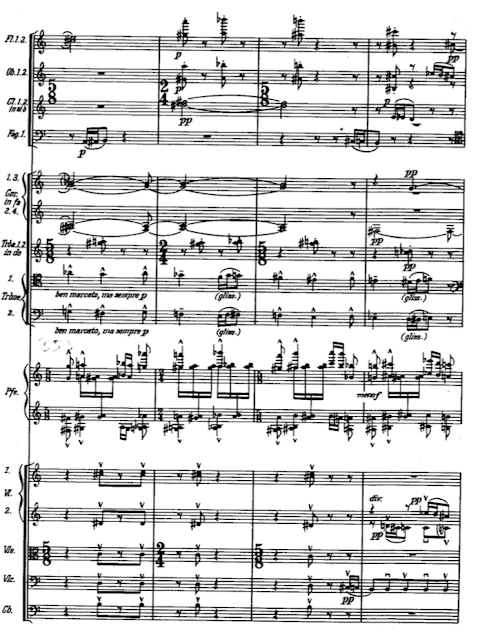
Now for some details. Bartók was innovative and original in a number of ways. He developed new notational practices such as extending a beam over a barline to indicate a rhythmic grouping. Here the beams for the piano part extend over the barline between the 3/4 and 2/4 measures to show how the phrase should be grouped:
 |
| Example from the Piano Concerto No. 1, first movement |
Another innovation was, in a context of frequent changes of meter, to write the time signatures very large and centered on each group of instruments. That looks like this:
 |
| Click to enlarge |
Previously the time signature would only appear on each individual stave; showing them like this makes them much more visible for the conductor (this is only done in the score, obviously).
Bartók also used a lot of very unconventional key signatures in his Mikrokosmos for piano, but we don't see that in this piece, where there are no key signatures. The first movement begins with low Bs in tympani and piano and ends with a big chord of E, B and F#, so not in C major!
The Wikipedia article on this piece, while giving some historical information, is not too revealing about the music itself. Without doing a lot of research to see if there is any kind of consensus on this, the first movement appears to me to be in sonata-allegro form. It is hard for anyone writing a piano concerto to completely ignore the Mozart concertos.
The piece begins, unusually enough, with the piano and tympani on a B pedal accompanying the orchestra that presents fragments of a theme. The piano then presents it more fully:


Notice the repeated note motif, the shifting time signature and the scale passages with chromatic interpolations. Later there is an important anapest motif in the winds. In this example, in dialogue with the piano, note the beams crossing over the barlines:
 |
| Click to enlarge |
(An anapest, taken from prosody terminology, is a rhythmic figure with two short notes followed by a longer one.)
To end sections, Bartók uses this vamping figure instead of a conventional cadence:

This new theme appears, related to the anapest motif:

Then, in a different tempo, we have this theme, presented in the piano:


These themes are then given a development and here is a fairly typical page:

As you can see, this concerto is pretty challenging for everyone: the pianist, the orchestra and the conductor.
After this, I hear something resembling a recapitulation and then the first movement ends with an abbreviated version of that cadence figure, using the same notes.
Bartók's method seems to be to use the broad structural outlines of classical forms, but to fill them with entirely different material: much more dissonant and metrically complex. His music has an intense expressivity that is very compelling, which probably accounts for a lot of his enduring popularity.
Now let's listen to the whole piece. This is the French pianist Jean-Efflam Bavouzet with the London Philharmonic Orchestra conducted by Vladimir Jurowski:
Tuesday, June 9, 2015
Concerto Guide: Bartók, Violin Concerto No. 1, op. post.
Continuing our journey through the concerto in the 20th century, the next one of interest, chronologically, is the Violin Concerto No. 1 of Béla Bartók, which was completed in 1908. It was inspired by an intense romantic attachment Bartók had formed to Stefi Geyer, a gifted violinist who later taught at the Zurich Conservatory.
Alas, this was a doomed romance as Ms. Geyer was not interested, neither in Bartók, nor in Othmar Schoenk who also wrote a concerto for her! She refused the dedication and the concerto was never performed during either of their lifetimes and not premiered until 1958.
It is a powerful work, despite its early provenance: Bartók was only 27 at the time of composition. It is in the form of a rhapsody: two movements, slow then fast. It begins with the violin alone:

Soon joined by the first violin section:

It is in the wandering chromatic melodic style that perhaps had, even this early, taken some inspiration from the folk music of the Carpathian Basin that attracted Bartók's interest later on as a scholar of folk music. One of the ways Bartók developed to structure music was to use tonal relationships to relate the large sections while the surface melodic patterns are organized in other ways. We will get into this more as we look at other concertos by Bartók. Perhaps the biggest influence at the moment of this composition, apart from the ineffable mystique of Stefi Geyer, was that of Debussy which we can also see in the Fourteen Bagatelles, also from 1908.
Without further ado, let's have a listen to the two-movement Violin Concerto No. 1 of Bartók. This is José Maria Blumenschein, Violin with Jukka-Pekka Saraste conducting the Youth orchestra of NRW:
 |
| Stefi Geyer |
It is a powerful work, despite its early provenance: Bartók was only 27 at the time of composition. It is in the form of a rhapsody: two movements, slow then fast. It begins with the violin alone:

Soon joined by the first violin section:

It is in the wandering chromatic melodic style that perhaps had, even this early, taken some inspiration from the folk music of the Carpathian Basin that attracted Bartók's interest later on as a scholar of folk music. One of the ways Bartók developed to structure music was to use tonal relationships to relate the large sections while the surface melodic patterns are organized in other ways. We will get into this more as we look at other concertos by Bartók. Perhaps the biggest influence at the moment of this composition, apart from the ineffable mystique of Stefi Geyer, was that of Debussy which we can also see in the Fourteen Bagatelles, also from 1908.
Without further ado, let's have a listen to the two-movement Violin Concerto No. 1 of Bartók. This is José Maria Blumenschein, Violin with Jukka-Pekka Saraste conducting the Youth orchestra of NRW:
Thursday, April 11, 2013
Bartók: Music for Strings, Percussion and Celesta
Bartók's Music for Strings, Percussion and Celesta is remarkable in several ways. Written in 1936 for the Basel Chamber Orchestra, it was the first piece, to my knowledge, to use the title form "Music for ..." Since then, of course, this has become a popular construction used by, among others, Steve Reich for such pieces as Music for 18 Musicians and Music for Large Ensemble. As times and musical forms change, there is an on-going need to find new titles. The Music for Strings, Percussion and Celesta might have been called a "symphony" or "sonata da chiesa" at a different time in music history as its four movement layout (slow-fast-slow-fast) could suit either of those forms. But by 1936 the use of the word 'symphony' for most progressive composers was considered hopelessly out of date.
Another way in which the piece is original and innovative is in the instrumentation: pieces for strings, percussion and celesta are rare: I think this is the only one! Bartók creates a unique soundscape with these resources. Another distinctive characteristic of the piece is its division of the strings into two equal groups on opposite sides of the stage with the percussion in between. Bartók specifies this in the frontispiece to the score--again, an early example of a practice that has become more common. The reason he does this is so he can have the two groups echoing one another, an effect common, for example, in 17th century music from Venice where they made use of the layout of one of the churches with its separate choir stalls.
Other significant elements to the piece are the use of a fugal texture for the first movement (which mirrors itself in the second half--for another example see the Third Symphony of Gorecki), the "night music" textures of the third movement and the dance-like character of the second and fourth movements.
Here is the opening theme of the fugue:

It is treated rather exhaustively in fugal style with an exposition of full entries, stretto, fragments of the theme developed, a climax at the most remote point: E flat, a tritone away from the 'home' note of A. After this point Bartók reverses course with the theme in inversion and returns to the beginning. At the very end the structure of the whole movement is presented in microcosm as the violins move from A out to E flat in contrary motion and then return:

The basic pitch content of the piece, which you could summarize like this:

alternates semitones and minor thirds. The inspiration for this may have been various kinds of modal chromaticism found in folk musics of eastern Europe. Modal chromaticism refers to the use of, for example, both B flat and B natural in the above example and C sharp and C natural. Western European music, for which the staff notation was developed, virtually never uses scales in which both chromatically inflected and noninflected notes are used.
I won't go on and analyze the other movements except to point out that an expanded version of the theme from the first movement returns in the last movement to give the overall form a cyclic quality. By "expanded version" I mean that the intervals are all made into wider ones. Here is that version:

I will say that this is one of Bartók's most powerful pieces. Each movement projects a unique atmosphere and mood and the piece as a whole is extraordinarily successful. Let's listen:
This is counted as being a good example of 'progressivism' in 20th century music, but you could equally look at it as an example of a composer looking both back in music history and outside the mainstream of European music for inspiration. Just look at the elements that are historic: fugue form, slow-fast-slow-fast layout of the movements and antiphonal groups. The pitch content is the most 'progressive' element along with the way the percussion is used.
Another way in which the piece is original and innovative is in the instrumentation: pieces for strings, percussion and celesta are rare: I think this is the only one! Bartók creates a unique soundscape with these resources. Another distinctive characteristic of the piece is its division of the strings into two equal groups on opposite sides of the stage with the percussion in between. Bartók specifies this in the frontispiece to the score--again, an early example of a practice that has become more common. The reason he does this is so he can have the two groups echoing one another, an effect common, for example, in 17th century music from Venice where they made use of the layout of one of the churches with its separate choir stalls.
Other significant elements to the piece are the use of a fugal texture for the first movement (which mirrors itself in the second half--for another example see the Third Symphony of Gorecki), the "night music" textures of the third movement and the dance-like character of the second and fourth movements.
Here is the opening theme of the fugue:
It is treated rather exhaustively in fugal style with an exposition of full entries, stretto, fragments of the theme developed, a climax at the most remote point: E flat, a tritone away from the 'home' note of A. After this point Bartók reverses course with the theme in inversion and returns to the beginning. At the very end the structure of the whole movement is presented in microcosm as the violins move from A out to E flat in contrary motion and then return:

The basic pitch content of the piece, which you could summarize like this:

alternates semitones and minor thirds. The inspiration for this may have been various kinds of modal chromaticism found in folk musics of eastern Europe. Modal chromaticism refers to the use of, for example, both B flat and B natural in the above example and C sharp and C natural. Western European music, for which the staff notation was developed, virtually never uses scales in which both chromatically inflected and noninflected notes are used.
I won't go on and analyze the other movements except to point out that an expanded version of the theme from the first movement returns in the last movement to give the overall form a cyclic quality. By "expanded version" I mean that the intervals are all made into wider ones. Here is that version:

I will say that this is one of Bartók's most powerful pieces. Each movement projects a unique atmosphere and mood and the piece as a whole is extraordinarily successful. Let's listen:
This is counted as being a good example of 'progressivism' in 20th century music, but you could equally look at it as an example of a composer looking both back in music history and outside the mainstream of European music for inspiration. Just look at the elements that are historic: fugue form, slow-fast-slow-fast layout of the movements and antiphonal groups. The pitch content is the most 'progressive' element along with the way the percussion is used.
Tuesday, April 9, 2013
Margaret Thatcher's Favorite Composer
It is somewhat surprising to find that Béla Bartók was perhaps Margaret Thatcher's favorite composer. She had rather the reputation of not being very fond of culture, but apparently she frequently attended opera performances and went to summer music festivals in Germany and Austria. Norman Lebrecht has more. She was quite fond of Bartók, especially when conducted by Georg Solti. Let's listen to some:
That is really a remarkable piece. I have been of two minds about Bartók in recent years, but that reminds me how much I used to love his music. I think it might be a worthwhile project to have a closer look at the
That is really a remarkable piece. I have been of two minds about Bartók in recent years, but that reminds me how much I used to love his music. I think it might be a worthwhile project to have a closer look at the
Subscribe to:
Posts (Atom)