I'm introducing this post with a famous example from Wittgenstein of the difference between seeing and seeing-as that has some interesting applications in music. When you look at the above picture you see a simple line-drawing. But you can see it as two different animals, a rabbit or a duck. There is a difference between seeing and seeing-as.
There are musical applications because we can both hear and hear as. Take theory class for example: the professor might play two chords and ask "which one do you hear as the tonic?" And what about this progression? Composers can, with context, make it obvious what chord is the tonic and what the dominant. But they can also make it ambiguous and in the case of a modulation from one key to another, we may only hear something as a tonic in retrospect.
Music adds the interesting element of temporal context to the hearing-as aspect. Wittgenstein uses that term "aspect" to describe, say, the two different interpretations of the drawing. In one aspect it is a duck and the other a rabbit. In popular music sometimes there is an ambiguity between tonic and dominant--or is it sub-dominant? If your usual context is Classical style, then a pop song might sound like it is ending on the wrong chord.
But the hearing-as issue extends far beyond simple harmonic function. For example, a passage may be played and heard as introductory when near the beginning of a piece, like this from the Bach Chaconne.
But might have a quite different expressive effect when heard several minutes later in the piece where its function now is to recall the opening and prepare for a modulation to the parallel major:
This example is close to the duck/rabbit one as the two passages are, at first, identical. But we can expand the concept quite a bit. The Chaconne is a splendid example of organic unity in music. The whole piece, roughly fifteen minutes in length, is based almost entirely on this eight measure theme:
Click to enlarge
A chaconne, at this point in music history, usually consists of a set of variations over a short harmonic progression, often in the form of a repeating bass line. Due to the length of this piece, while there are many instances of the same bass line, Bach often departs from it. The basic harmonic progression persists, however. But each variation brings out difference nuances or aspects of the theme. For example, the example above is the whole of the eight measure theme. Notice that it starts on the second beat and ends on the first. The progression is i, iv, V6/5, I, VI, iv, i6/4, V6, i with a slightly different and more conclusive cadence in the second half.
When we hear it at the beginning it has an introductory feel but with two what we might call sub-texts: there is just a hint of the French overture (especially if you add some ornaments as I do) and a hint of the sarabande, which emphasizes the second beat, as this theme does. That French overture feel continues with a couple of variations emphasizing a dotted-note figure:
But there are lots of sub-texts or aspects in play. For example, a bit later Bach alludes to a typical element in fugue texture by inserting a multi-voice stretto, most unusual in a piece for solo violin:
I am using examples from my transcription for guitar, but apart from some added bass notes it is identical with the violin original. Later on there are allusions to dance:
And in this passage I hear an extreme expression that has the feeling of a lament, communicated through chromaticism and texture:
Then, modulating to D major, this passage sounds to me like a deeply meditative chorale:
Bach uses variation form and technique to reveal different possible aspects of the basic harmonic progression, ones referencing different musical styles and genres as well as different kinds of emotional expression. I'll stop here, because I am still learning the piece and haven't thought about later sections.
What I do when I play the piece is look beyond the notes to see the different aspects that they reveal. In that sense I am interpreting the piece according to different aspects. Of course, someone else could see entirely different aspects.
Here is a performance of the piece by Jean Rondeau on harpsichord:
"It is not possible to step into the same river twice" --Heraclitus
Why? Because πάντα ρει, "panta rei," "everything flows." We might not think everything flows, but we certainly think that some things flow, rivers, for example. Oh, and music. Yes, music definitely flows which makes the idea of musical structure a very peculiar one. Music is like a river in that it flows through time, always changing (and even if it is not changing, your perception of it is changing). If you can't step into the same river twice (different time, different water) then you perhaps cannot hear the same piece twice. You certainly can't play it exactly the same twice, not can you listen to it the same twice. As an example, Six Pianos by Steve Reich:
Sure, that's an articulated flow, but the flow of the river can be articulated as well, with wavelets. It's still a flow. And how do you structure a flow? In time, with beats, or a pulse. Is that a structure? Maybe not. In the case of the river, the water is given a structure, shaped by gravity and the river bed. But in itself, it has no structure, it just flows. Like music. Sure, we talk a lot about musical structure: measures, meter, phrase, dance rhythms, harmonic structure, harmonic rhythm. But this is only talking about how the flow is articulated. Does it have a structure? I'm assuming you have been listening to the Steve Reich piece. Have you heard the structure yet? What was it?
When people try to show the structure of a piece of music, they sometimes resort to schematics like ABA or very elaborate sketches like this:
Click to enlarge
With a great deal of listening and study you can, somehow, "visualize," perhaps, this structure. But really any schema you can put on paper is just a wildly distant metaphor. You have to go listen to the piece. Then you are hearing the "structure" which is really just the articulated flow. Music structure is not spatial, it is temporal.
If you listen to a lot of different kinds of music you might notice that there are two fundamental elements. This is on an abstract level, not a concrete one. The two elements are syntax and semantics, both words coming from ancient Greek. So do the words melody, harmony and rhythm, by the way!
Syntax is the way things are put together. In language it is the way sentences are constructed and the subject of grammar. Semantics is the meaning of the words and sentences. In music this distinction is often referred to as form vs content, but I want to get away a bit from that historical approach.
I see composers as falling into roughly three groups: the syntax composers, the semantics composers and the ones who manage to balance them both. For example, a composer like Steve Reich, in his earlier works, was a purely syntactical composer. Drumming is about nothing more than rhythm, downbeat, hemiola and phasing which is just the incremental shifting of rhythmic patterns. There is literally NO semantic content. Early Philip Glass is similar, for example his Music in 12 Parts has no extra-musical content but is just about patterns and pitches. But we also have earlier examples. Bach's Art of Fugue is a purely syntactical piece as is his Well-Tempered Clavier and the two and three-part inventions.
The program music of the 19th century starting with Hector Berlioz' Symphonie fantastique was an attempt to focus on the content rather than the form, color rather than contour in visual art terms. French composers, starting in the 17th century, made rather a specialty of making pieces about their extra-musical content. Of course, once you integrate referentiality into a piece of music then that becomes part of the music. There are innumerable examples from the French clavecinistes in which they fill conventional forms like the rondeau with all sorts of referential content. The tombeau, for example, is nothing but an allemande with special reference to the death of someone.
Then there are composers who manage a real synthesis of form and content. Bach is a great example of this as well in his cantatas, passions, masses and so on. Haydn is another good example. In many of his symphonies and string quartets, which are primarily syntactical forms, i.e. "pure" music, he infuses referential content. Some examples: the "Farewell" Symphony, the "Rider" String Quartet and so on. In Beethoven there have been many efforts to uncover or elaborate on referentiality in the symphonies and piano sonatas, some of them encouraged by Beethoven himself. The association of the Symphony No. 3 with Napoleon and the nicknames attached to some piano sonatas like the "Tempest" or "Hammerklavier" are other examples. But in all of these works, the syntax is equally involved, it is not a question of merely dumping content into a conventional form. That is why I refer to these works as syntheses.
Mind you, there are lots of examples of pieces that have such an evocative atmosphere that they have acquired a nickname that is not related to anything the composer did. The "Moonlight" Sonata of Beethoven had no associations with moonlight in Beethoven's mind.
These categories survive in the music of the present day, Caroline Shaw, for example, uses a lot of traditional musical syntax in constructing new pieces with often ambiguous titles: Boris Kerner for cello and percussion, for example, uses a very traditional harmonic and melodic syntax combined with contrasting percussion. Become Ocean by John Luther Adams is the opposite in that the referential atmosphere predominates and it is difficult to discern any traditional syntax.
There is a kind of progression from the mind of the composer to the mind of the ultimate listener. The composer often thinks in terms of syntax because that has a lot to do with how the music is written. The listener however takes the opposite approach and asks themselves "what does this music mean to me?"
Interestingly, jazz also seems to have these two fundamental elements. There are lots of referential pieces that draw on popular song forms like Louis Armstrong's "What a Wonderful World" and many other examples, but there are more purely syntactical pieces like "So What" by Miles Davis or "Giant Steps" by John Coltrane. In popular music, however, the purely syntactical seems not to exist outside rare examples like Deep Purple's Concerto for Group and Orchestra.
Here is the Tombeau sur la mort de M. Comte de Logy by Sylvius Leopold Weiss played by lutenist Edin Karamazov.
I was playing Bach this morning, as I usually do, and was struck, as I have been countless times before, with the rich creativity of Bach's imagination. Using the most fundamental aspects of the common practice system, tonality, he weaves a constantly developing texture. Scales, arpeggios, cadences, modulations, turns and simple rhythmic structures are all he needs. Take the piece I was learning this morning, the prelude to the 3rd Cello Suite:
[The original key on cello is C major so that opening phrase falls two octaves to the lowest note. The piece has usually been transposed up a major sixth to A major, and at that pitch the temptation is to add some bass lines. There is an arrangement by John Duarte often played by Segovia and others. A couple of decades ago, Pepe Romero released a lovely recording of this piece, but in D major. If you tune the 6th string to D you can play everything exactly as it is on the cello and there is no need to add a bass line.]
She plays it a bit fast, to my mind, but that's ok. Just listen to how simple, basic, fundamental and at the same time creative, Bach is in this prelude. And he wrote hundreds of preludes, each one original and brilliantly creative. Another example is Domenico Scarlatti who wrote five hundred and fifty-five sonatas for harpsichord, all in binary form and using these same basic structural materials. Not to mention the hundreds of concertos by Antonio Vivaldi.
My point is that composers were able to use and re-use and use again the basic materials of common practice tonality without running out of ideas. This is an old story, of course. My favorite hilarious example is that of the music theorist who, sometime in the 16th century, complained that every single contrapuntal idea had been exhausted and no more originality was possible. And two hundred years later we have Bach, the greatest contrapuntalist of all.
But then in the early 20th the most progressive composers began to think that this whole system was exhausted. The primary figures were Claude Debussy, Arnold Schoenberg and Igor Stravinsky who each developed ways of ordering music that avoided the common practice structures. Fair enough! But I think we can see in this a subtext: perhaps the structures of tonality were not so exhausted after all? Composers like Jean Sibelius continued to use them for decades and they returned with the so-called "minimalists" in the 1970s.
I think that what was going on here was not so much or not only a theoretical breakthrough, but a civilizational breakdown of morale. Composers couldn't or didn't continue to compose within these structures because they felt the subterranean cataclysm that was about to engulf European civilization. Schoenberg's first forays into atonality date from 1908, just six years before the outbreak of World War I. His Pierrot Lunaire dates form 1912 and Stravinsky's masterpiece The Rite of Spring was premiered in 1913, the year before the war began.
Are these works tokens or harbingers of a civilizational breakdown and not just aesthetic experimentation? If you were looking for a topic for a research-heavy doctoral dissertation, that would be a good one.
Here is another piece from around this time, the Six Little Pieces op. 19 of Schoenberg:
The University of North Texas College of Music will investigate a faculty-run academic journal responsible for showcasing critical responses to a claim that music theory is white supremacist. A group of graduate students in the Division of Music History, Theory, and Ethnomusicology at the UNT College of Music released a statement recently, condemning the Journal of Schenkerian Studies (JSS), a publication run by faculty in the MHTE department.
A group of faculty members are also supporting the complaint:
We, the undersigned faculty members of the University of North Texas Division of Music History, Theory, and Ethnomusicology, stand in solidarity with our graduate students in their letter of condemnation of the Journal of Schenkerian Studies.
Heinrich Schenker was a Jew, born in Austria, who died in 1935 so did not suffer greatly under the anti-semitism of the Nazis who only came to power in 1933. Still, this kind of criticism is notice that all culture stemming from white people is a target in this environment. The interesting question is will there be significant resistance, when will it take place and from where will it come? Because I can't quite believe that this is all going to take place without question.
Leave your thoughts in the comments.
For an envoi, one of Schenker's musical examples, the Piano Sonata op. 109 by Beethoven. This is Sviatoslav Richter in a 1991 performance:
Yes, I know I said I was going to do more educational posts for a wider readership, and I will. On Sunday I will put up another post on listening. But I will also continue to post on things that interest me as a composer.
Music theory is an often-puzzling topic for me as I suspect it is for many composers. I am reminded of a Shostakovich anecdote. He was sitting down to breakfast with a friend and commented that the cook making the eggs in the kitchen was like a musicologist (or music theorist) in that he worked with the eggs and prepared them to eat, but it is we that actually enjoy them. Some composers also have a significant role as theorists and Schoenberg comes first to mind. But most composers, when they speak of theory at all, do so rather cryptically. For them it is what Glenn Gould once called a "centipedal" question. The centipede was standing by the road one day when someone came along and said "I have often wondered, since you have so very many legs, which one do you actually start with when you walk?" This question was so troubling for the centipede that he didn't know how to answer it and thinking about it he froze by the side of the road, unable to move.
Music theory comes in many varieties: the kind of Roman numeral harmonic analysis we learn in first year theory, but also the kind of rudimentary counterpoint one learns using the "species" method. Then there is structural analysis or form functional analysis. There is also the kind of specialized analysis that is associated with the identifying of rows in serial music. Schenkerian analysis has become very popular as have some varieties of what is called "psychological" analysis. Analysis depends on some kind of underlying theory. For example, the Roman numeral harmonic analysis depends on a highly developed method of labeling chords according to their role in harmonic progressions and according to their inversion. The theory of chord inversion originates with Jean-Philippe Rameau in his treatise of 1722. It is elaborated by the harmonic practice of J. S. Bach in his chorale harmonizations and has been refined over the centuries since.
Modern compositions such as the Rite of Spring by Stravinsky which is based on the use of Russian folksong and the octatonic scale did not receive a real theoretical explanation, or partial explanation at least!, until the 1960s. In general the practices of composers like Haydn and Mozart were only partially understood for a long time. Rules of thumb under the term: "sonata-allegro form" were applied, but the truth is that for every so-called theoretical "rule" there were more exceptions than anything else. I think that we are still struggling a bit with some pieces by Beethoven and Chopin.
At the end of the day, music theory, while certainly useful and interesting, is of only modest value to the ordinary listener and not much more to the composer. I can safely say that while I have read a great deal of what Schoenberg has to say about composition, I don't find that it has the slightest influence on what I write.
What you do as a composer when you sit down to write something is look for inspiration--but no, it doesn't actually work that way. What you do is wait and hope for something to come along, some idea that will give you an opening. It can come from any source, but for me it often comes from imagining some kind of musical idea. Once one comes along that seems promising I start writing. It is not an intellectual process however. I just write stuff and if it seems the right stuff I keep it, but often it is not right and I throw it away. Schoenberg once said to a student, pointing to the eraser end of a pencil that this end was more important than the other end, that you write with. I often sketch on paper because music software can be so limiting.
When I am writing I stumble across things that I really like and I try to figure out what make that particular combination of notes so pleasing so I can do it again or develop it in some way. This is a kind of theorizing I suppose, but the difference with conventional music theory is that this is very local and specific while music theory in general tries to be general and universal.
Ok, let's listen to something. This is the Missa Salve Regina by Tomas Luis de Victoria.
Reading Marcel Proust's giant landscape of a novel makes me muse about musical structure. A lot of structure in music comes from the dance and from song, which means that the structure is more akin to poetry than prose. We don't use iambic pentameter much, but we sure use 4/4 and eight and sixteen measure phrases a lot. At least that was the norm in 18th century music. In the 19th century music got more "prosy" with more irregular phrases and wandering themes.
Proust's Remembrance of Things Past is one digression after another, one parenthetical thought modifying another parenthetical thought inside a giant digression--and by "giant" digression I am thinking of one that went on for some two hundred pages. A single sentence can contain digressions so vast that you have to search back to find the verb, or even the subject noun! But while extreme, this kind of parenthetical approach to the novel is not unique: I can think of one other case. That would be The Life and Opinions of Tristram Shandy, Gentlemanby Laurence Sterne, published in 1767. That too is characterized by digressions within digressions so extreme that while the book begins discussing the birth of Tristram Shandy (who is also the narrator), the digressions are so extreme that we don't actually reach said birth until volume three. Proust's approach is very different, but the time structure is so complex because of the regressions and digressions that you never quite know where you are: "In Search of Lost Time" indeed, as the original title in French literally translates.
The composer whose music this reminds me of, sort of, is Allan Pettersson whose great shaggy dog symphonies similarly seem to keep winding around themselves. Of course a digression in language is a semantic phenomenon, something not possible in instrumental music, but still, there is something of a similar feel possible in music. The most magical moments in Proust are when the original topic suddenly reappears and you realize that you are just coming out of a digression. A similar effect occurs in Pettersson when one of his monolithic boulders of a theme reappears after a long stretch of other material. Here, have a listen to his Symphony No. 7. This is a 2017 recording with Daniel Harding conducting the Swedish Radio Symphony Orchestra.
These two concepts are often confused, I suspect. We learn about tonality and dissonance in theory class, but we don't think much about how they are related or if they are related. Dissonance is a fairly easy concept, but one that is historically inflected. What is considered to be dissonant varies over time. A long time ago, thirds were considered too dissonant to use in a final cadence. In common practice harmony, almost any interval can be used, as long as it is resolved correctly. In a V7 - I cadence, the dominant chord contains the very dissonant tritone, but with the leading tone resolving up and the seventh resolving down, all is well.
In 20th century music a lot of dissonances were explored including clusters of semitones and even microtones.
Tonality is harder to define, but it usually involves the concept of "functionality." I gave the example of a V7 - I cadence. This is an example of functionality. A cadence really defines tonality. The function of a cadence is to define the key, the tonal center. The function of a leading tone is to lead to the tonic. The function of a seventh is to create a dissonance that is resolved into the tonic chord. Every note and every harmony has a role and function in common practice harmony. Schoenberg even thought about his twelve-tone system as being a huge extension of tonality.
Dissonance has a function within tonality, in fact, tonality depends on the use of dissonance.
But here is the thing, we sometimes think that what led to the obsolescence of tonal music was the over-use of dissonance, but you can have music that is not functionally tonal that also does not use a lot of dissonance. So-called "modal" music is an example. Modes, typically lacking leading tones, have a lower level of dissonance than tonal music. You could have musical structures that simply avoid both tonality and dissonance. For example:
Click to enlarge
That is the opening of Petroushka by Stravinsky and while what is going on there is not nearly as simple as it looks, one thing for sure, it is neither dissonant nor tonal. What we have is an oscillation between two harmonies with a melody above that that suggests a different harmony. One of the things that weakens the notion of a tonal center is the rhythmic structure. Fundamentally, in order to define a key in common practice tonality, you have to have some kind of dominant resolving to some kind of tonic and it needs to go from an upbeat to a downbeat. Pieter van den Toorn describes what is going on here as "oscillating simultaneities." The fact that they are a whole-tone apart means we don't really hear either as a "tonic" and that is despite the leap of a fourth from A to D that would often signal a dominant-tonic relationship. Look at that cello melody: we do get a C# but it is not heard as a leading tone because it is in a metrically weak position and because it leads away, not towards the D. Everything is "up in the air" which what makes this opening so exciting.
I have, above all, repeatedly pointed out the purpose of all forms: a layout which guarantees comprehensibility. I have then shown what are the conditions that go with comprehensibility; how it is a question of the kind of listener one is writing for (and, in so doing, defined the difference between light and serious music...); how there is always a manifest relationship between an idea's difficulty and the way it is presented, so that an idea which is hard to grasp demands a slower and broader presentation than does one which is easy to grasp; the role played here by tempo, so that when the notes move quickly, things must unfold more slowly. How, for example, when the harmonies are hard to grasp, the tension must be lower in other directions--and other things of the same kind. Obviously one cannot formulate this kind of consideration of material without psychology, since the material is destined to affect the psyche and only comes into consideration at all through this function.
--Arnold Schoenberg, Style and Idea: Selected Writings, p. 316.
I'm not sure anyone else has expressed these things with the same degree of clarity.
Bartók knew something about form. Here is his Piano Concerto No. 3 with Martha Argerich:
UPDATE: While we are on Bartók piano concertos, this is a pretty interesting performance of number 3. The soloist is Jean-Efflam Bavouzet with the London Philharmonic Orchestra, Vladimir Jurowski, conductor. Notice how the conductor cues the hard-working pianist as well as the orchestra. Also, they have moved the percussion from being in the back to being in front, level with the solist. Good performance.
UPDATE: Sorry, I meant to write that the clip by Jean-Efflam Bavouzet is the Concerto No. 1 by Bartòk, not no. 3. Apologies!
I just noticed a rather odd and surprising overlap between Stravinsky and Schoenberg. In the latter's analysis/discussion of his Four Songs with Orchestra, op. 22 [reprinted in Perspectives on Schoenberg and Stravinsky] he points out numerous instances of the use of a particular little set of intervals: the minor second and minor third, in various configurations and sometimes expanded to a major second and major third in various configurations. Now notice something about the first set, the minor second and minor third. Depending on how you organize them, with the minor second within the minor third, for example, as Schoenberg often presents them, if you extend that over the octave you get, that's right, the octatonic scale, which was used extensively by Stravinsky (he got it from Rimsky-Korsakov).
I don't want to imply any influence here, but I do want to note that the octatonic scale is a symmetrical way of dividing up the octave, as opposed to the major and minor scales of common practice harmony, which are asymmetric ways of dividing up the octave. Composers like Bela Bartók were also exploring symmetrical alternatives, in his case it was often the tritone.
Unsurprisingly, I am not the first to notice this. Taruskin offers extensive quotes from Russian modernist critic Vyacheslav Karatïgin on the Rite of Spring and mentions that:
Like Myaskovky, Karatïgin professes to see a deep kinship between Stravinsky and Schoenberg--prompted in his case, no doubt, by the enthusiastic letter he had received from the Russian composer about the German. [Tarusin, Stravinsky and the Russian Traditions, p. 1029]
Stravinsky heard Schoenberg's Pierrot Lunaire in Berlin on 8 December, 1912 and that was the occasion for the letter to Karatïgin where he says:
I saw from your lines that you truly love and understand Schoenberg--that truly remarkable artist of our time. Therefore I thought you might be interested to learn about his very latest composition, in which the whole extraordinary essence of his creative genius is most intensely concentrated [i. e. Pierrot Lunaire]. [quoted in Taruskin, op. cit. p. 824]
Another commentator on connections between Schoenberg and Stravinsky was theorist Allen Forte who said in his 1978 study of The Rite that:
...in The Rite of Spring Stravinsky employed extensively for the first time the new harmonies that first emerged in the works of Schoenberg and Webern around 1907-08 [quoted in Taruskin, op. cit. p. 1022]
In later years both Schoenberg and Stravinsky said a lot of critical, even derogatory things, about one another, which illustrates more the fact that they were career rivals.
For an envoi let's hear some of Pierrot Lunaire, one of the most unusual pieces in Schoenberg's output:
Tension and resolution is one of the basic technical devices of music and therefore one of the basic problems of composition. Over the long development of tonality and even before, in the period of modal harmony, the basic means of structuring music in a way that was both expressive and perceivable by the listener was to use dissonance and consonance to create tension and resolution. The basic arc was always to move from a state of stability or rest to one of energy and tension, then to return to the state of rest. This was done through micro and macro use of consonance and dissonance. By the 18th and 19th centuries this had been developed to a tremendous extent and the so-called "common practice" system of harmony had sophisticated and subtle resources to structure the flow of music.
Unfortunately, these resources are scarcely available to us anymore. The harmonic progressions of tonality, unless quoted or used ironically tend to sound trite and trivial. So our options are either to give up the techniques of tension and resolution entirely or to find new ways of incorporating them. Traditionally the tensions and resolutions were based on degrees of harmonic dissonance but the possibility of using other parameters such as rhythm or dynamics or timbre or texture was always lurking in the background.
I am a fan of the music of Steve Reich and, to a lesser extent, Philip Glass, but their music, while energetic and compelling, does have an underlying problem. On the macro level, it is relatively static but compensates for this with a built-in tension on the micro level. What do I mean? Take for an example the piece "Octet" by Steve Reich. It is a dynamic, energetic piece:
But the level of energy and tension scarcely varies throughout the piece. It starts with a high level of tension (5/4 time signature, syncopated rhythms and a stretto between piano 1 and 2) and while it adds and subtracts different components (bass clarinets, flute solo), the basic texture keeps this same level of energy throughout. It starts and ends with roughly the same level of tension. The piece works because of the sheer ingenuity of the ideas, but it does not use the technique of tension and resolution because it avoids anything resembling a resolution. This is generally the case with most of his music.
A lot of the composers in the high modernism phase avoided the issue entirely. The "moment form" of Stockhausen, for example, by definition avoids any kind of long-range, structural organization, therefore cannot use tension and resolution. Each "moment" is as structurally important as every other. Other composers use complex methods of structuring that leave the listener unsure of any kind of direction in terms of tension and resolution. The level of dissonance, for example, remains high throughout. This is usually the problem with serial compositions that build in a specific level of dissonance. Composers like John Cage who use chance procedures avoid tension and resolution as well.
One way of structuring music is to have a relatively low level of tension throughout. This seems quite popular these days and extends from the mellow stylings of "New Age" music right up to the environmentally sensitive textures of John Luther Adams whose "Become Ocean" won a Pulitzer Prize for basically being cosmic and ominous. Blogger doesn't want to embed, so just follow the link:
The problem is that it is cosmic and ominous throughout, again, basically static except for crescendos and decrescendos.
I don't find that any of these procedures work for me, so I have been trying to find other ones that do. After all, if you have some materials, whatever they are, you can surely arrange them to create large-scale tensions and resolutions. The area of rhythm, despite a lot of focus, still has great potential. Steve Reich's early piece "Drumming" did use some fascinating devices on both the micro and macro levels to create structure. For example, the technique of "phasing" where a particular rhythmic pattern slides past a mirror of itself, creates tension and resolution on the micro level while the filling in of the metric structure over time creates a medium level of tension and resolution. On the level of the whole piece he creates direction through instrumentation. An opening section with just small drums is followed by sections for marimbas, glockenspiels and finally all instruments together.
I have developed some other ways of using rhythm to create structure and they seem to be working quite well. I am hoping to make a recording soon of my new piece "Dark Dream" so I can show them to you. Suffice it to say, for now, that if you set up a very high-tension, oppositional texture earlier in the piece, you can resolve this by transforming it into a rhythmic unison.
I want to introduce this post by recounting one of Zeno's paradoxes. Zeno of Elea (c. 490 BC to c. 430 BC) was a pre-Socratic Greek philosopher who is known for his paradoxes, described by Bertrand Russell as "immeasurably subtle and profound" which, as you will see in a moment, is a rather subtle pun. Wikipedia relates the paradox of Achilles and the tortoise as follows:
In the paradox of Achilles and the tortoise, Achilles is in a footrace with the tortoise. Achilles allows the tortoise a head start of 100 meters, for example. If we suppose that each racer starts running at some constant speed (one very fast and one very slow), then after some finite time, Achilles will have run 100 meters, bringing him to the tortoise's starting point. During this time, the tortoise has run a much shorter distance, say, 10 meters. It will then take Achilles some further time to run that distance, by which time the tortoise will have advanced farther; and then more time still to reach this third point, while the tortoise moves ahead. Thus, whenever Achilles arrives somewhere the tortoise has been, he still has some distance to go before he can even reach the tortoise.
See the linked Wikipedia article for some of the solutions to the problem. This paradox is designed to show that motion is an illusion. We know the argument because it was preserved in Aristotle's Physics where he offers solutions:
Aristotle (384 BC−322 BC) remarked that as the distance decreases, the time needed to cover those distances also decreases, so that the time needed also becomes increasingly small.[20][21] Aristotle also distinguished "things infinite in respect of divisibility" (such as a unit of space that can be mentally divided into ever smaller units while remaining spatially the same) from things (or distances) that are infinite in extension ("with respect to their extremities").[22] Aristotle's objection to the arrow paradox was that "Time is not composed of indivisible nows any more than any other magnitude is composed of indivisibles."[23] (Footnotes from Wikipedia)
There are two ways of looking at time: either as a series of discrete points, or as Aristotle says, "indivisible nows," or as a smooth continuum without discrete points. The basic assumption lying behind most music and musical notation is that time is a series of discrete points which are represented as pulses or beats. The whole notion of a time signature is based on the idea of discrete beats. All music software that I know of is based on the idea of recurring pulses or discrete beats.
But alongside this concept of time, which seems to provide the interior skeleton, as it were, of music, is the idea of smooth continua. We see this other concept of time in the use of rubato, accelerando, ritardando and even in the idea of "grace" notes that fall outside of the discrete pulses. All these elements go against the Procrustean bed of the discrete beat.
My new piece for violin and guitar, titled "Dark Dream" makes use of the contrast between the two notions of time: time as a series of pulses and time as a smooth continuum. One basic motif and the most important structural element is a two second figure that moves smoothly between repeated notes slower than eighths to ones faster than sixteenths and back again and at the same time a dynamic range between ppp and mf is also traversed. Both of these are smooth continua. They take up a regular amount of time, which they have to do because the two instruments are expressing the motif against one another most of the time. That is, as one instrument speeds up and gets louder, the other is slowing down and getting softer, so they are constantly circling one another. Only at the end do they articulate the motif together. But within this regular amount of time, there are no discrete pulses.
The rest of the piece uses regular pulses. So the basic contrast built into the structure of the music is between music of pulses and music of smooth transitions. Some other music I know of that does something similar is the early "phase" music of Steve Reich, though there the realization is quite different. In pieces like "Piano Phase" Reich has one instrument play a repeating pattern in a fixed pulse while the other instrument, playing the same pattern, slightly accelerates so as to move one unit ahead. This is repeated several times until the two instruments are in unison again. What I am doing is having certain sections of the piece using only smooth continua while others use a set pulse. Yes, there are other pieces that do this, of course! But they do it in various ways that are, to my knowledge, a bit different than I do and the contrasting sections are perhaps not contrasting in the same conscious way.
Let me illustrate what I am talking about with the first page of the score of "Dark Dream:"
The "feathered" beams indicate a smooth accelerando and ritardando and this is combined with a smooth crescendo and decrescendo. In the third and fourth systems we see another kind of smooth transition with the glissandi between two fixed pitches.
There are certainly other composers that have explored these kinds of possibilities! So I don't want to claim that kind of unique innovation. But I hope that I am at least exploring some interesting possibilities in this piece. I am planning a recording of it, so I hope to be able to post that at some point so you can hear for yourselves.
Meter (or "metre" if you are British, Canadian or other subjects of the Queen) is one of those fascinating musical topics that are not quite as easy to understand as might seem. The Wikipedia article on music meter is a particularly excellent one with some cool visual/audio aids. They talk about the origins of musical meter in poetry which is undoubtedly true, but not much on the minds of musicians.
From teaching music for a few decades I came up with some simple ways of describing it and, of course, we always had lots of examples before us in the lessons. Simply put, we have different ways of talking about time in music. There is duration, which is the length of time it takes to play a piece of music. Then there is beat, the recurring pulse that is typical of a lot of, though not all, music. Then there is rhythm, which is the pattern of long and short notes that comprise the surface of the music. Finally, there is meter, which is the way the beats are grouped. This is particularly evident in dance music where the waltz, for example, is grouped in threes while the polka is grouped in twos. The grouping is signaled by a stress on the first beat of the group, the downbeat, which is prepared with an upbeat. This obviously relates to the movement of the dancer's feet or weight. In music notation these groups are shown as measures divided off by barlines. At the beginning of the piece or movement the meter is also indicated with a time signature:
Here I have shown three different meters in succession, ending with the first again. These are all simple meters though the 5/4 one could call asymmetrical because it typically divides up into two beats plus three beats. We also find meters of seven beats, often divided 2+2+3 or 2+3+2. An example is the Precipitato from the Piano Sonata No. 7 by Prokofiev where he shows the subdivision at the beginning:
Click to enlarge
All these meters have a duple subdivision of the beat, but it is also possible to have a triple subdivision which results in what we call compound meters. In these the beat is not a regular note, but a dotted note, which adds half the value to the note. Here are some examples.
As you can see, as well as the time signature, the groupings are indicated with the beams. All the groups of three eighth notes are beamed together.
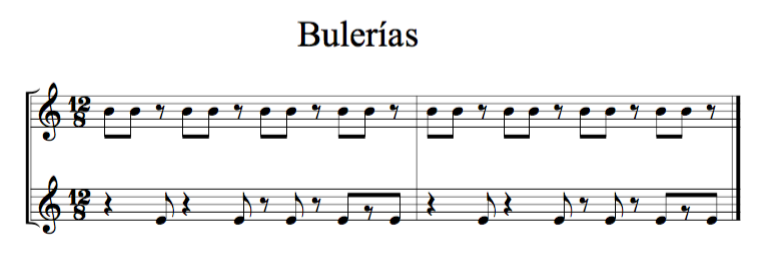
Polymeter comes in a couple of different forms and there are some excellent examples at the Wikipedia article. Poly- just means "many" though typically in music we would have just two different meters at once. For example, you could have three beats against four beats where the beats match up, but the downbeats would only coincide every twelve beats. Wikipedia has examples of this and other possibilities such as 5/4 and 4/4 together. Those examples are with two meters having the same note values. I have mentioned before that an interesting example of polymeter is found in Flamenco music in the Bulerías where 3/8 is superimposed on 3/4 and then 6/8. When I created the example below I couldn't figure out how to show that in the music software so I put it all in 12/8! Let me see if I can explain. The top is easy: it just consists of 3/8 all the way. But the bottom is actually a measure of 6/8, a measure of 3/4, a measure of 6/8 and another measure of 3/4. What makes it confusing is that in Flamenco music they don't start the measure with the downbeat, instead it comes at the end!
Now on to hypermeter which Wikipedia, following the theorists that discuss it, describes as the idea of beats being grouped to form measures but on a larger level. Here, measures are grouped to form hypermeasures. For example, in a quick 3/4 we might hear each measure as a single beat with four of them going together to form a hypermeasure. We run into this in Beethoven scherzos, for example. I just googled "hypermeter in Beethoven" looking for an example for you and the fourth hit that came up was a post I did a while back on the Symphony No. 9. Just go there for the example which shows a movement ending with four measures of rests to complete the hypermeter! Sorry, I didn't say where I got that example from and now I can't remember. Pretty sure it was a Beethoven movement, though.
That would be a good way to end this post: the Scherzo from the Symphony No. 9 by Beethoven. This is Daniel Barenboim conducting the West-Eastern Divan Orchestra:
This is where the rubber meets the road: now we have to really come to grips with the structure of Stravinsky's music which is what Taruskin takes up in the next chapter: "Chernomor to Kashchey: Harmonic Sorcery." He pulls no punches here, the chapter is heavily larded with musical examples. Incidentally, this is how you can tell a book intended for musicians from those intended for the general public: any form of musical notation is absolutely prohibited in the latter. Even a book that appears to be for a specialized musical audience, like the Cambridge Handbook on the Rite of Spring, does not have an overabundance of musical examples, though certainly the essential ones. But the Taruskin volume is chock full of extensive musical examples (not to mention footnotes).
He begins the chapter with Rimsky-Korsakov's comment, after an evening in which Stravinsky and Rimsky-Korsakov's wife, Nadezhda, had played through the Schubert late C-major symphony in a piano four-hands arrangement. He said that before Schubert certain "bold and unexpected" modulations simply did not exist. For Rimsky-Korsakov, Schubert was the father of modern music. What kind of modulations was he referring to?
I want to just back up a bit and fill in a bit of background here. Music in the Western world, for a long time, was based on the individual melodic line. Most music in most places is still structured in this way. But in Western music going back eight or nine hundred years, the practice of combining independent melodic lines became the standard practice. In order that they blend in a pleasing way and not clash, certain methods or rules were adopted. This is where the idea of consonance and dissonance came from. Some notes clash, are dissonant, while others blend, are consonant. A good piece of music actually uses both these phenomena so as not to be bland and boring. But there were pretty strict rules for how dissonances were to be handled or resolved.
As we move into the 15th century, harmony begins to develop a life of its own as composers like DuFay developed techniques like fauxbourdon to harmonise melodic lines. (I know I am getting into esoteric knowledge when Blogger starts underlining words in red, even though I know they are spelled correctly!) Roughly from 1600, harmony became more and more structurally prominent and the idea of functionality came to the fore. Functional harmony was the common practice from around 1600 to around 1900, though just how it functioned changed enormously. Taruskin points out in passing that a good book on the use of harmony in the 19th century still has to be written!
The first stage of functional harmony focused on the idea of a tonic and a dominant. Pieces of music basically began in the tonic, the harmony built on the first note of the scale, or tonic. Then the music moved to the dominant harmony, that built on the fifth note of the scale. A couple of other chords or harmonies were used built on the fourth note of the scale, the subdominant (which prepared or led up to the dominant) and the sixth note of the scale (which was used to stand in for the tonic in a deceptive cadence), the submediant. Pop music to this very day rarely uses any harmonies other than these basic ones, though jazz certainly does. Closure is achieved by simply returning to the tonic after the dominant. This harmonic movement, from dominant to tonic, is called a cadence and all tonal music ends with one.
The tonic/dominant relationship was so powerful that it was soon extended in various ways. One was by using secondary dominants, that is, any harmony or chord can be preceded by its dominant. The whole harmonic space can also be organized by the circle of fifths:
As you move up by fifths, each key adds a sharp, while as you move down by fifths, each key adds a flat. This enabled modulation, the movement from one key to another, to be handled in a clear and organized way. A great deal of music, especially in the Baroque and Classical periods, is filled with harmonic sequences, which are passages that move through different harmonies in a specific pattern. The most common are ones that descend or ascend by fifths. Here is a good page on that. Sequences were used as a kind harmonic engine to drive the music forward.
By the time we get to Schubert and the early Romantic period, composers were looking for something different. Rather than driving forward, they wanted to pause, reflect and give the music an inwardness. What Schubert did was to exploit and normalize the use of sequences that moved by thirds rather than fifths: these are called mediant progressions. As Taruskin notes, third relations operate in Schubert on every structural level. Here is a harmonic reduction of a forty-bar passage from the Finale to the C-major symphony that provides an example. The chords marked "x" are flat submediants that have no functional role in harmonic structure up to this point. They alternate brusquely with the tonic and only work because of the common pitch, C, that unites them:
The flat submediant, a major third below the tonic, A flat major in the key of C, was the Romantic harmony par excellence and its use is largely credited to Schubert. That other harmony you see, the F# diminished chord, also has a mediant origin, it is two minor thirds above the tonic. Both these chords contain a C natural, which links them to the tonic.
This might be enough harmonic theory for one post, so let's listen to that Schubert symphony. This is the "Great" Symphony in C major (so-called because there is another, shorter, symphony by Schubert also in C major) with the Vienna Philharmonic conducted by John Eliot Gardiner:
Incidentally, in the first movement Schubert inserts a complete circle of major thirds within a circle of fifths!
You may be astonished to hear this, but the term I have chosen for the title of this post is of my creation/invention. At least, if we can believe Google. The only similar uses they turn up have to do with image textures, not musical ones. So let me define my term!
Metric textures are a category of musical devices and practices having to do with rhythm, specifically meter, in music. Let's just review some basic terms. In music we talk about time in various ways. The timing of a piece of music refers to its duration in minutes and seconds: "what is the timing of the first track on the disc?" Pulse refers to the repeating beat underlying the music, akin to the pulse created by our heartbeat. Meter refers to how the pulses are grouped. This is indicated in a musical score by the time signature which in simple meters usually consists of two numbers: the upper one tells us how many pulses make up the metric group and the lower one what rhythmic value counts as a pulse. A typical example is the ubiquitous 4/4 time signature indicating four beats or pulses in each metric group with each beat a quarter note. There is another kind of time signature used for compound meters where there are two levels of grouping. In these meters the sub-group is usually three notes instead of the usual two, making the larger group a dotted note. Examples of these are 6/8 and 12/4. In musical scores the metric groups are normally divided off with barlines.
Rhythm refers to the pattern of short and long notes that we hear as the surface of the music. For example, each pulse or beat can be divided up into shorter notes that create subdivisions. The varying of these subdivisions is the rhythm of the piece.
There are certain music techniques that use layers of different meters to create interesting rhythmic effects. One of these is called hemiola and was a favorite way for Baroque composers to clinch an important structural cadence. It depends on re-grouping the meter. A typical example would be to turn the recurring dotted quarter pulse of a piece in 6/8 temporarily into 3/4 by rewriting the rhythm to group the patterns into quarter notes instead of dotted quarters. This changes the basic pulse. In flamenco a similar technique is used to create a polyrhythm or polymeter where we hear the two groupings simultaneously instead of sequentially. This is used in the flamenco palo known as bulerías. It is a bit tricky to show in notation, but it can look like this:
Or follow the link to the Wikipedia article. On one level, a measure of 6/8 is followed by a measure of 3/4, but on the other level a quick 3/8 continues throughout. Here is how bulerías sounds like in performance. What you hear are various slices of the metric texture, which is always present in the background, but not in the foreground.
This idea, of combining two different metric groupings, is an example of a metric texture. It is found in flamenco music, in African drumming and is the technique used in a lot of music by Steve Reich. Layering different meters creates a kind of sustained tension that enables him to write quite long pieces that seem to hover, almost without change, for long stretches. It is the built-in tension of the metric texture that makes the music exciting to listen to in the absence of the usual harmonic and melodic devices that music has traditionally used.
The first kind of metric texture used by Steve Reich came about through experimenting with tape loops. If you run the same tape loop at slightly different speeds, you get some interesting results as we can hear in the early tape pieces like Come Out from 1966:
As this technique, called "phasing" by Steve Reich, involves infinitesimal changes, it resembles a kind of metric calculus! Reich soon discovered that it could be adapted to use in compositions for live performance and Piano Phase is a simple example:
This is performed by two pianists both playing this pattern at the beginning together. Then one pianist slightly speeds up until he is one sixteenth-note ahead, at which point the two pianos synchronize their sixteenths. Then this process is repeated. What happens is a metric texture is created through minute tempo changes. Here is what that sounds like:
In another post I will look at some other examples of metric textures in Steve Reich.
Every now and then I manage to tear myself away from the Internet long enough to actually read something. No, what we do on the Internet is not so much "reading" as ripping off bleeding chunks and gobbling them down in between skimming lightly over the surface. Actual reading is more contemplative and less hurried.
So right now I am reading a collection of essays by one of the most learnéd and wise writers of the 20th century, Jacques Barzun, titled "The Culture We Deserve". The very first essay, "Culture High and Dry" poses some challenges that are worth considering.
As a long-time professional musician there are certain things that I don't have a lot of patience with and these include things like sloppy amateurism and incompetence generally. Barzun points out that a lot of so-called "professionalism" is really specialization, the dividing up of knowledge into smaller and smaller packets. The accompanying methodology is that of analysis. Now I know the shortcomings of analysis, but still, my training tends to lead me to default to analysis whenever I want to understand something about music or another art form.
I have been long aware of the problems with analysis, and I have talked about them on this blog. I think that they were underlined for me decades ago when I quit a musicology list-serve in disgust because they got caught up in an utterly pointless, but mean and nasty, discussion of the proper pronunciation of vowels in the names of regional Czech composers! I kid you not. A lot of analysis is simply a waste of time. One of the very few who does it well is Charles Rosen (along with Richard Taruskin and Joseph Kerman).
Barzun offers an alternative to analysis that he calls, after Pascal, "intuitive understanding." I need to present an extended quote to convey the idea:
But the same human mind that has created science by the analytical method can work out an entirely different way. The mathematician-philosopher Pascal pointed this out 350 years ago. He called the way of analysis the "geometrical bent." It deals with simple things like angles or straight lines or atoms or molecular pressure ... being well defined, they do not change when they are talked about and can thus be represented by numbers. The principles of mathematics and a few others then supply the rules for dealing with the permutations of these clear and simple unchangeables.
The other use, direction, or bent, Pascal called the esprit de finesse--we might call it "intuitive understanding." It goes about its business just the other way. It does not analyze, does not break things down into parts, but seizes upon the character of the whole altogether, by inspection. Since in this kind of survey there are no definable parts, there is nothing to count and there are no fixed principles to apply. The understanding derived from the experience is direct, and because it lacks definitions, principles, and numbers, this understanding is not readily conveyed to somebody else; it can only be suggested in words that offer analogies--by imagery. Hence no universal agreement is possible on these objects and their significance ... the things that make up culture are understood and remembered and enjoyed by mental finesse; they are for inspection as wholes, not for analysis and measurement; they lack definable, unchangeable parts. [Barzun, op. cit., pp 11-12]
Now before you all jump in and say, but of course music has definable parts, etc., let me just say that Barzun immediately goes on to discuss this objection in the next section. Please go ahead and read further on your own as I have quoted enough for my immediate purpose.
My first reaction to this was to heave a sigh of satisfaction because my most salient method in teaching music over a few decades was to use metaphor to reveal the musical character of passages and to suggest solutions to problems of interpretation. One other teacher who excelled in this was Oscar Ghiglia.
But another part of me thinks that in order to really come to grips with a piece of music, as either a player or a listener, you do have to adopt some technical vocabulary, for precision if nothing else. You do have to say things like, "you see that tonic chord in measure 42--that is really a point of arrival, isn't it?" For how else are you to talk about music? I wrote a scathing review of a book on the orchestral music of Shostakovich because it carefully avoided not only any actual musical notation but any use of technical terms whatsoever. The author ended up talking about "the jumpy theme" and the "long-note theme." The problem with this is that it lacks specificity (Shostakovich wrote a lot of jumpy themes). If I talk about a particular piece and quote passages from it in notation, there can be no doubt about which piece I am considering. But if all you do is use vague metaphors, then the only way we can be sure what piece you are talking about is if you tell us the title.
On the other hand, mere analysis gives us little more than a bloodless facsimile of the original. As Barzun notes:
...the material of modern scholarship is by now not even the work itself, but a curious kind of facsimile, an offprint made up for methodic purposes. What students get is this abstract duplicate and little else ... Any mental finesse that the graduate or undergraduate student might bring to the work lies dormant or is diverted to the minutiae of analytic methodism. [op. cit. p 16]
I think I escaped this particular fate by being a performer: every time I sat down in the practice room I was confronted with the whole finesseable aesthetic work, not a methodological construct.
I want to go to a performance to illustrate this. I played this piece, "Les Tendres Plaintes" by Rameau, for a Spanish-speaking friend the other day and, despite the best efforts of Google translate, was not able to come up with a Spanish translation of the title that my friend could make sense of. So I said, well, never mind, the piece itself is an illustration of what is meant by "tendres plaintes." And so it is. Really, I could talk about the form (rondeau), the harmony (D minor with episodes in A minor and F major), the ornamentation and so on and you would still not have the aesthetic experience. But here it is:
Every few months we have another article on the topic of "earworms", those catchy bits of melody that get stuck in your head. The latest is The Science Behind “Earworms”:
Don’t worry, there’s a reason why “Don’t Stop Believin'” gets stuck in your head for days every time you hear it. In fact, there are a couple of reasons. And they’re backed by science.
Songs that get trapped in your head for long periods of time, commonly called “earworms,” are the subject of a study by Durham University (in England) researcher Dr. Kelly Jakubowski, who recently published a paper on the subject in Psychology of Aesthetics, Creativity, and the Arts. Jakubowski and her team found that earworms have three distinct qualities that separate them from other songs: pace, melodic shape, and unique intervals.
All these articles have the same characteristics:
They claim to have the answer to some age-old and puzzling question
They take a scientific approach, and
They display a near-total ignorance of hundreds of years of music history and theory
Given those shortcomings, it is not surprising that the "answers" they come up with are shallow and, to any musician, unconvincing. Let's have some more from the researchers at Durham University:
Pacing, the team found, is crucial. Many commonly cited earworms have upbeat, danceable tempos, but are still slow enough to easily track. Most earworms follow the melodic preferences of Western pop music, which in turn follows many of the melodic contour patterns in nursery rhymes. “Twinkle, Twinkle, Little Star,” for instance, has a rising pitch in the first phrase that falls in the second, a common trait of earworms. (Maroon 5’s “Moves Like Jagger” was specifically called out by the study for this.)
But childlike simplicity and a peppy tempo aren’t enough to make an earworm. A true earworm changes its game up with at least one unusual interval structure, defined by the study as “unexpected leaps,” repeated notes, or any other idiosyncratic tick in the song’s composition that makes it memorable, in addition to catchy.
The basic problem with this kind of "research" is that it is nearly always a case of using the wrong set of tools. Science, at least this kind of science, is nothing more than statistics and surveys with a thin veneer of technical vocabulary. The vocabulary has been eliminated from the news story, but you can see it in the original paper here where an "earworm" is given the scientific moniker "involuntary musical imagery". The idea of sounds being misnamed "images" already makes me uneasy. Looking over the original paper to get a sense of how they approached the question musically, I see that again, it is purely a question of statistics:
First- order features are features that are calculated based on the intrinsic content of a melody itself, such as the average note duration, average interval size, or pitch range of the melody. Second-order features, also called corpus-based features, are features that compare a melody to a larger collection or corpus of melodies (generally comprised of music from the same genre or style as the melodies that are being analyzed, such as pop songs or folk songs). For instance, one example of a second-order feature might measure to what degree the average interval size within a particular melody is common or uncommon with respect to the distribution average interval sizes within a large corpus of comparable melodies.
This is inevitable if the tools used are scientific. In science, you can only examine those things that you can measure and you can only measure those things that you can assign numbers to. Now, of course, you can look at music entirely in terms of numbers: tempo is how many beats per minute, pitch is how many vibrations per second and so on. But those things are nothing but the externals and bear as much relation to a musical performance as a recipe does to the dish on the table. The musical expression as implied and encoded in the score and as evoked by the performer and as experienced by the listener is simply another order of reality from the notes on the page and the numbers that science can deduce from them.
Let me explain why. Really catchy earworms each have a memorable quality. This is why they, and not a thousand generic examples, are memorable. It is their individuality that makes them memorable. This individuality is precisely the quality that cannot be captured by any methodology based on statistics. To make another metaphor, imagine trying to identify Albert Einstein when he was a patent clerk by doing a statistical survey of patent clerks. That is the equivalent of trying to identify those qualities that make for an earworm by doing a statistical survey of catchy tunes. If you look at the quotes above you will see that each description begs the question (as in "assumes the conclusion"). A rising pitch in the first phrase that falls in the second, a "common trait in earworms" is found in thousands of melodies that are NOT earworms. This same critique applies to every single characteristic claimed as being indicative or characteristic of earworms: they are all characteristic of all popular melodies, nursery rhymes, Haydn string quartets, Bach minuets and, for all I know, Brazilian sambas (though I haven't done the research on the latter).
The question of what makes a particular piece of music "catchy" is unanswerable using scientific methodology. What is extremely odd is that the researchers, their subjects, the journalists reporting and nearly all of the readers fail to realize this!
In related news, science also has no answers for questions regarding aesthetic quality, ethics, theology and why I am having trouble organizing my latest composition.
Now for our envoi, and we deserve a good one today. Here is one of the most catchy compositions ever written, by Wolfgang Amadeus Mozart. It's a little divertimento that he referred to as "a little night music" in a letter to his father and so, ever since, it has been known as "Eine kleine Nachtmusik". It was composed in 1787. This performance is by Concerto Koln:
Don't blame me, I didn't name it! Boston.com had an article about something they called the "sensitive female chord progression": Striking a Chord. Here is how they describe it:
...what is the Sensitive Female Chord Progression, exactly? It's simple enough for the music theory-inclined: vi-IV-I-V. No good? Well, for a song in the key of A minor, it would be Am-F-C-G. Still confused? Here's an easy way to see if a song uses the chord progression: Just sing Osborne's lyrics, "What if God was one of us? Just a slob like one of us?" over the suspect four chords. If it fits, you've just spotted one in the wild. Once you're attuned to it, you'll hear it everywhere.
I have the feeling that the writer called up a musical friend to get the technical vocabulary--he almost got it right! The vi-IV-I-V is good, and that does stand for A minor, F major, G major and C major, but that's in the key of C major, not A minor. Here is how that looks and sounds:
Later in the article they quote one music teacher's take on it:
Jack Perricone, chair of Berklee College's songwriting department, thinks the mixture of chords gives the progression emotional heft. "It starts on a sense of maybe disquiet," he says. "In a sense, it's three-quarters major and one-quarter, but a very important quarter, being minor.
"And I think that has to do with credibility, what people experience in life. . . . I mean, that's not a bad mixture, one-quarter sadness or darkness and three-quarters light."
Now I'm imagining myself on the hiring panel at Berklee and we are interviewing candidates for the theory position. I ask every candidate "do minor chords mean sadness and major chords happiness?" And if they say yes, I say "next!" One thing is clear: the four-chord progression, whether it is this one or a similar one, is pretty much a cliché, which tends to support my belief that much popular music is industrialized formulas for evoking conventional emotional reactions.
If you want to be creative, try some three-chord progressions like I-VII-IV-I. That's the progression for the long coda to "Hey Jude":
Happy, sad? You got me, though the mood is more ecstatic than depressed. My theory is that music isn't really an expression of ordinary everyday emotions, but rather musical moods. Music is an "aesthetic object" not the acoustic equivalent of a pep squad or a therapy session. Here is another three-chord progression and I won't do a simple piano version because it wouldn't sound very good. The progression is VII-i-VII-VI or G major, A minor, G major, F major. As you have already guessed, that is the whole harmonic content of the song "All Along the Watchtower" by Bob Dylan:
That is, I believe, the original version from the album John Wesley Harding, but just the instrumental backing tracks. Dylan's people are pretty good at keeping his songs off YouTube. Anyway, happy? Sad? One third sad? Again, you got me. That song has a very particular and unique mood that I don't have any words for: driving forward with a certain amount of distance?
What all these progressions have in common is the avoidance of any clear cadential progression from V to I. That is pretty much what any of us do these days when writing tonal music. Perhaps we should call what we do "vague tonal music blended with modal music for extra vagueness."
Let's end with that great television performance of "Hey Jude" that is preceded by a little clip showing the Beatles could have been a pretty good tearoom gig band if they had wanted to:
UPDATE: There is a bit of a problem I neglected to mention. With a lot of these pop chord progressions, the tonality is rather ambiguous. For example, in the Dylan song, you could think of it as being in A minor and that is how it is usually conceived, but in the absence of any cadence a theorist might want to say that the tonality is not confirmed. Certainly if it were a piece from the Classical Era. You can't tell from the key signature, because since these songs are fundamentally the performances of them, the score has no authenticity other than being a transcription of a performance. I suppose that we tilt towards A minor rather than, say, G major, because the F major chord means we can't use F#s. In any case, we hear A minor as the tonic chord even without an actual cadence. I've been talking about A minor as that is always how I envisioned the song. But Bob Dylan actually plays it in C# minor with a capo so that the chord fingerings look like A minor. And Jimi Hendrix plays it with the guitar tuned down a semi-tone so that it comes out in C minor, but he plays it without a capo.