Showing posts with label 20th century music. Show all posts

Monday, September 25, 2017

A 20th Century Debate

My post from Saturday on the Ten Best Compositions of the 20th Century sparked some interesting comments. One of them made such outstanding points that I want to bring it, and my response, into a separate post. First you should go read the original post so you know what we are arguing about. Where the discussion got very interesting was with this comment from Anonymous (a regular commentator):
I find that list depressing. Mind you, the selection is perfectly reasonable. I would probably add Ligeti, remove Prokofiev or Ives. But it's scary to think how relatively weak these pieces are compared with a 19th c. equivalent. (Only the Rite stands out.) Wagner alone has produced greater music than all of your pieces combined.
I think the problem is the very concept of 20th c. music. It actually makes little sense historically. Twenty is just a nice round number but it's meaningless. Historically, the period you want to consider and compare would be called "modernity" and that's 1870-1950. You would then have a more coherent, and far stronger selection.
To which I responded:
Very good point about the arbitrariness of the century and yes, 1870 to 1950 is an era in itself. However, in recent years historians have been eschewing using terms like "Baroque" and "Romantic" in favor of labeling their studies simply the "19th Century" or the "20th Century." However I have to disagree about the 19th century. It is just personal taste, but I don't find much that I enjoy from the death of Schubert to Debussy. Shocking, I know, but I have never had much liking for the ponderous pomposity of 19th century music. Exceptions for Chopin, some Brahms... I find Wagner to be particularly unpleasant! But, as I say, just a personal view. I look at the list of 20th century music and think, "wow, what great stuff!"
Anonymous came back with a further comment:
In your list only Stravinsky might be seriously considered in the top 10 among all composers. Perhaps Bartok but that's already pushing it. 
Meanwhile, in the 19th c., you have Beethoven, Schubert, Debussy, Wagner who are all instant top-10 members. Next, people like Schumann, Brahms, Verdi, Chopin, Puccini are all knocking on the door. 
In other words, nearly half of the 10 greatest composers who ever lived can be associated with the 19th c. 
Another problem with your list is the sole inclusion of Reich. To me, he's the greatest American composer that ever lived. But his inclusion requires the consideration of Jazz musicians, for example, Miles Davis, Kenny Clarke, Thelonious Monk, and especially John Coltrane. So if you're going to have Reich, then you need to have Coltrane because they share so much -- and in just about all aspects (originality, range, influence), people like Miles Davis and John Coltrane leave, say, Ives or Messiaen in the dust.
The problem is this: until 1950, the best musical minds went into classical music. After that, this was no longer true. Also, too much of music composition moved into academia, from which great art has never emerged.
This was a very stimulating comment, so I responded with this:
Excellent comment!! I did say that this was just personal taste for me, so setting that aside and looking at it objectively, yes, there are a lot of great, that is to say, widely loved, composers from the 19th century. Let's take the New York Times list, put together by Anthony Tommasini as our benchmark. The list, in order, is Bach, Beethoven, Mozart, Schubert, Debussy, Stravinsky, Brahms, Verdi, Wagner and Bartók. We might quibble over some, but let's just take it as a reasonable attempt to list the greatest composers no longer living starting with Bach (pre-Bach composers were excluded).
Here are my quibbles: Beethoven and Schubert are composers born in the 18th century who had their greatest influence in the 19th century, but to my mind, they are not really 19th century composers. What Charles Rosen calls "The Romantic Generation" begins with a number of composers all born around 1810: Berlioz, Liszt, Schumann and Chopin. Those are the true 19th century composers. Beethoven and Schubert wrote music on a solid 18th century foundation. Debussy, while born in the 19th century (as were Stravinsky, Prokofiev and Sibelius, all composers we consider 20th century) is considered to be perhaps the founder of 20th century music. I know that it seems as if I have just promulgated a contradiction: why do I consider composers born in the late 18th century to be more 18th century and ones born in the late 19th century to be more 20th century? Yes, it seems odd! But I think that is due to the fact that the large tidal movements in the arts do not quite align with the zeros! In other words, the 18th century musical structures did in fact endure into the first part of the 19th century, while the 20th century concepts of structure began a bit before the turn of the century. This is all debatable, of course! But assuming that what I have proposed is plausible, that means that, on Tommasini's list, four of the ten are 18th century (Bach, Mozart, Beethoven and Schubert), three are 20th century (Debussy, Stravinsky and Bartók) and only three are 19th century (Brahms, Verdi and Wagner) and two of them are known only for opera.
Your other point is regarding Steve Reich. Yes, he does seem to both be an awkward fit with the other composers on the list, but at the same time, I agree, he is perhaps the greatest American composer. He is the only one on the list who came to prominence after 1950. But I think it is pretty clear that he is a "classical" composer. According to Reich's own way of classifying music, he is one of the guys who writes it down, that is to say, he creates a musical score which is then performed by specialist musicians. Jazz, while an influence on his style, is a very different genre with different methods. If we accept your criteria we would have to consider other influences: drumming from Ghana and gamelan from Bali. In a similar vein, we would have to bring in Ravi Shankar if we are talking about the music of Philip Glass.
But your last point is a very powerful one! I have experienced this with my own students: the most highly gifted tended to go into something else other than classical music! And yes again, academia does not produce great music, though I am not sure why. Composers are always bemoaning their poverty and difficulty of getting performances and general insignificance. Academia provides a nurturing environment with a steady paycheck, enthusiastic students, performance opportunities and prestige. So why don't academic composers write great music?
Here is the Tommasini list from the New York Times:


The question of why the environment of academia seems to stifle creativity is a good one, and one that I don't have an answer for.

On reflection, it seems that one of the most important events in music in the 19th century was the dominance of opera. I don't think any other century or era witnessed the over-reaching of one genre to this extent. The concerto was very important in the 18th century, but it did not dominate the way opera did in the 19th century. Just look, two out of the three 19th century composers were known ONLY for opera! And the century is rife with other composers who were nearly exclusively opera composers: Rossini (yes, born in the 18th century, but worked extensively in the 19th), Puccini, Massenet, Bellini, Gounod, Offenbach, Bizet, Rimsky-Korsakov. The only serious rivals to opera were the solo piano recital, invented by Liszt, and the symphony concert. These two genres were almost as important as opera, to music historians at least, if not the audiences of the day. Opera was the mass entertainment of the century as the cinema and team sports were of the 20th century.

It is spectacularly true that no 20th century composers were very successful with opera, with the exception of Alban Berg, who only wrote two (well, one and a bit). Overnight, it seems, composers moved into other genres.

Fascinating subject...

Let's have an envoi. How about some great 19th century music? Giuseppe Verdi's life precisely spans what I see as the "19th Century" which actually begins a bit into the century: 1813 - 1901. Aida is one of his greatest masterpieces. This is a San Francisco Opera production starring Luciano Pavarotti and Margaret Price:


Saturday, September 23, 2017

Ten Best Compositions of the 20th Century

Way back in the mid-1970s I was enrolled in an undergraduate course in music titled "20th Century Music" that was a survey course. Twenty years later I found myself in a similar course, "20th Century Theory and Analysis" (a doctoral seminar) taught by the same professor! At one point he remarked that every year he taught either course it got more difficult because the century got longer. When he started, he only had seventy or so years to teach, but now it was almost a hundred. Actually, I think it would be much easier now because the winds of time have started winnowing down the repertoire you have to cover. Back then you had to discuss Momente by Stockhausen and Le Marteau sans Maître by Boulez and something by Ligeti and Xenakis and Nono and Kagel. But now I think we can ignore that stuff as it seems to have sunk below the surface due to widespread audience rejection. The uncomfortable truth is that the audience does in fact have the final word. If no-one wants to hear your music, then musicians will sooner or later give up playing it.

One of the best ways to attract traffic on the internet seems to be by doing lists. Of course if you are doing lists of classical music you do limit your audience! Much better to do lists of the best cat videos or the stupidest things politicians said this week or best recipes for pasta sauces. Still, my list of the top ten pieces for classical guitar remains a perennial favorite, the most-viewed post on the blog. So here goes, my pick of the ten best compositions of the 20th century. I suspect you know what number one will be. In traditional internet style, we begin with number 10. The links will undoubtedly decay over time, but for now I will put in clips of each piece.

10. Charles Ives, Three Places in New England


9. Alban Berg, Wozzeck


8. Sergei Prokofiev, Piano Concerto No. 2


7. Olivier Messiaen, Turangalîla-Symphonie


6. Igor Stravinsky, Symphony of Psalms


5. Jean Sibelius, Symphony No. 5


4. Bela Bartók, Music for Strings, Percussion and Celesta


3. Dmitri Shostakovich, Symphony No. 5


2. Steve Reich, Music for 18 Musicians


1. Igor Stravinsky, The Rite of Spring


(I don't know why, but this clip insists on starting a few seconds in. Just put it back to the beginning!)

Enjoy! And explain to me how I'm all wrong in the comments. I wasn't too analytical with this. I just went with my gut for most of it. These are pieces that continue to fascinate me and that I always enjoy listening to. For some of them I could have swapped in others: instead of Wozzeck I could have listed the Schoenberg Violin Concerto. Instead of the Prokofiev Piano Concerto I could have listed the Sibelius Violin Concerto and so on. The only ones on the list that are really indispensable are The Rite, Steve Reich's Music, and the Turangalîla-Symphonie because they really don't have any equivalents! But I could have replaced the Shostakovich symphony with a couple of other pieces by him and the same with the Bartók. Anyway, these are my choices! If I had one more space I would have included the Symphony No. 3 by Gorecki or something by Arvo Pärt.

Just a final note: I do in fact think that The Rite of Spring by Stravinsky is the finest composition of the 20th century and there is a lot of evidence to back that up. But for the rest of the list, the order is somewhat arbitrary. If you want to say that the Sibelius symphony should come before the Bartók, then I won't argue. These pieces are in such different styles that they are rather incommensurable. Which is better, Wozzeck or the Symphony of Psalms? Or the Music for 18 Musicians? Tell me about it in the comments.

Tuesday, January 26, 2016

The Case of Morton Feldman

Morton Feldman (1926 - 1987)

Morton Feldman was associated with a group of experimental New York composers that included John Cage, Christian Wolfe and Earle Brown. Like the others, Feldman's compositions used the idea of indeterminacy, or making scores much less specific as to pitches, rhythms and so on. Around 1970 he gave up the use of radical indeterminacy and began to write music where the results were more clearly indicated. In 1973 he was appointed professor of composition at SUNY Buffalo where a Canadian composer friend of mine did a doctorate in composition under his direction. Prior to that he supported himself as a full-time employee at his family's textile business. The very last assignment I completed in a 20th century theory and analysis seminar was on Feldman's piece Rothko Chapel. Sadly, Morton Feldman died quite young, at age 61, from pancreatic cancer.

While John Cage seems to get most of the public attention, and Christian Wolfe and Earle Brown seem to have faded away entirely, I have the feeling that the most interesting composer in this group was Morton Feldman. Let's look at a couple of examples of his notation. This is a piece for orchestra from 1967:


A piano piece from 1952:


Later scores are more conventional with time signatures:


I can't find the score to Rothko Chapel online, but here is a photo of the interior of the chapel itself:


Rothko Chapel is a non-denominational chapel in Houston that is not only a place of worship or meditation, but also an important gallery of art. The interior contains fourteen paintings by Mark Rothko. The composition by Morton Feldman was inspired by and written to be performed in the chapel.

Let's have a listen to the piece, which was composed in 1971 for the very unusual ensemble of soprano, alto, choir, percussion, celesta and viola:


Like much of Feldman's music, the dynamics are often quite soft. In his later years he began writing very long pieces such as Violin and String Quartet (1985, around 2 hours), For Philip Guston (1984, around four hours) and, most extreme, the String Quartet II (1983, which is over six hours long without a break.)


Sunday, March 29, 2015

Thoughts on Boulez' list

There are a few interesting things about Pierre Boulez' list of 10 great compositions of the 20th century. Perhaps the most striking thing about it is not so much what it includes, a lot of justifiably famous 20th century pieces, but more what it excludes. First of all, let's have a look at when the pieces he selects were composed:

  1. Varèse, Ameriques: 1918-1921, revised 1927
  2. Berg, Three Pieces for Orchestra, op. 6, 1913-1915
  3. Stravinsky, Rite of Spring, 1913
  4. Bartók, Music for Strings, Percussion and Celesta, 1936
  5. Webern, Six Pieces for Orchestra, 1909-10, revised 1928
  6. Berio, Sinfonia, 1968-69
  7. Stockhausen, Gruppen, 1955-57
  8. Mahler, Symphony No. 6, 1903-04, revised 1906
  9. Schönberg, Erwartung, 1909
  10. Boulez, Répons, 1984
There are two enormous omissions, at least they seem enormous to me. The first is a surprising one: a composer who is not only one of the most influential of the century, but one who shares his nationality with Boulez: yes, of course, Claude Debussy. We might argue as to which piece to mention, perhapPrélude à l'après-midi d'un faune (even though it was composed in 1894), perhaps his late ballet Jeux. But I think few would disagree with how Wikipedia describes Debussy's influence:
Claude Debussy is widely regarded as one of the most influential composers of the 20th century. His innovative harmonies were influential to almost every major composer of the 20th century, particularly Maurice RavelIgor StravinskyOlivier MessiaenBéla BartókPierre BoulezHenri DutilleuxNed RoremGeorge Gershwin, and the minimalist music of Steve Reich and Philip Glass as well as the influential Japanese composer Toru Takemitsu. He also influenced many important figures in jazz, most notably Miles DavisDuke EllingtonBix BeiderbeckeGeorge ShearingThelonious MonkBill EvansJimmy GiuffreAntônio Carlos Jobim, and Herbie Hancock. He also had a profound impact on contemporary soundtrack composers such as John Williams, because Debussy's colourful and evocative style translated easily into an emotional language for use in motion picture scores.
So why would Boulez omit him? Perhaps because Debussy contradicts one of Boulez fundamental assumptions: that great music cannot at the same time be popular. This is a core assumption of 20th century modernism in music, at least up until the mid-century. But just looking at the list above shows that Debussy's influence was very, very broad. Why ever would Boulez include a piece by Mahler and not one by Debussy?

The other omission is more subtle: notice how, with just a couple of exceptions, the list avoids any mention of music written after the mid-century. Note the inclusion of Boulez' own Répons, which is the newest piece on the list! Setting aside that, there are only two pieces written after 1950, Gruppen by Stockhausen which is just barely after 1950, and the Sinfonia by Berio. Boulez includes his Pantheon of great pieces, meaning the ones that were very important to him, but at the same time omitting perhaps the most important, Debussy, while avoiding any hint that the course of 20th century music has changed since the maximal complexity of the mid-century.

So we pose the question, what might we suggest are some great works from the second half of the century, as Boulez has not troubled himself with that? Some names that seem to be important are John Cage, Steve Reich, Philip Glass, John Adams, Thomas Adès and Esa-Pekka Salonen. These figures are likely anathema to Boulez because they repudiate some of his fundamental beliefs about music: that you cannot write great music and be popular, that music, in order to be taken seriously has to always strive for the maximum complexity and that tonality is dead.

I think my list of 10 great pieces of 20th century music would look something like this:

  1. Debussy, La Mer, 1903-05
  2. Sibelius, Symphony No. 4, 1910-11
  3. Schoenberg, Pierrot Lunaire, 1912
  4. Stravinsky, Rite of Spring, 1913
  5. Berg, Wozzeck, 1914-22
  6. Bartók,  Music for Strings, Percussion and Celesta, 1936
  7. Cage, 4'33, 1952
  8. Pettersson, Symphony No. 7, 1966-68
  9. Reich, Drumming, 1970-71
  10. John Adams, The Death of Klinghoffer, 1991
A lot of this list needs no special justification. You could argue for a different piece by Debussy and the only reason I did not cite the Prélude à l'après-midi d'un faune is that it was composed in 1894. There was another odd omission in Boulez' list, no opera or vocal works, and I have tried to correct that by including the obviously most important piece by Berg, Wozzeck, and Pierrot by Schoenberg. A couple of pieces might be surprising to readers of this blog: the silent piece by Cage and the very controversial opera by Adams which Taruskin accused of "moral blankness and opportunism", both of which might be true. But both these pieces, for different reasons, have had an important and wide influence so I thought they needed inclusion. As for the Pettersson, I honestly can't think of a more powerful work from the 1960s, a decade really dominated by the Beatles. And I continue to believe that the most radical work of the century has to be Drumming by Steve Reich, whether you like it or not. It pared music down to its absolute essence and rebuilt it--you don't get more radical than that.

I would very much have liked to include something by Shostakovich, either the Symphony No. 5 from 1937--perhaps it could share billing with the Bartók--or the String Quartet No. 8 from 1960. Certainly, if I were to follow my own taste I would drop the Cage in favor of the quartet. But I think that my list leans as far as possible in the direction of historical importance while also considering aesthetic importance.

Hmm, what to pick as a musical envoi? I suppose the most unfamiliar piece on the list is the symphony by Allan Pettersson, so let's hear that. Here is Sergiu Comissiona conducting the Swedish Radio Symphony Orchestra:


Saturday, March 28, 2015

Boulez on the 10 greatest works of the 20th century

This week was the 90th birthday of one of the central figures in 20th century music after World War II. Born in 1925, Pierre Boulez has been one of the great conductors of the last several decades and a composer of great influence. For Soundcheck he recently provided a list of the ten works that he thinks are the most significant in 20th century music. This, along with his comments, is well worth taking a look at. Here is the article. If you accept the basic assumption, that the most important criteria is technical novelty, doing something as differently as possible from what has been done before, then there is not much to argue with in this list.

The thing is, that while I am in complete agreement with a lot of the pieces, I don't think that every piece, in order to be great, has to be so difficult, both for the performers and listeners, all the time. I think that aesthetic greatness has more criteria: expressive intensity, humanity, breadth of expression and so on. Nearly all of Boulez' choices, including his music, are harmonically dissonant, dynamically extreme, rhythmically jagged and with pointillist texture. I don't think all great music must be like that, even in the 20th century. But that being said, yes, these ten works are classics of 20th century music.

I think I will make up my own list so we can argue about it. Some pieces I would consider including would be something by Steve Reich, something by Sibelius (if Boulez can include Mahler, I think I can include Sibelius), and something by Shostakovich.

But there is no arguing about this piece, which would easily make my list as it did Boulez'. Here is Boulez conducting the Music for Strings, Percussion and Celesta of Bela Bartók played by the Vienna Philharmonic in a live concert in 2007:


Saturday, January 24, 2015

Harold Shapero, American Composer

A couple of weeks ago I read an intriguing article in the Wall Street Journal about a neglected American composer, Harold Shapero. He passed away in May 2013 (born in 1920), never having achieved the recognition that quite a few people thought he should have. These people included composer Aaron Copland, conductor Leonard Bernstein (who conducted the premiere of Shapero's Symphony for Classical Orchestra, written in 1947), conductor André Previn who recorded the same symphony in 1988 (not in 1986 as stated in the article) and now Terry Teachout in the Wall Street Journal. Let's let him set the scene:
The American composer Harold Shapero, who died two years ago at the age of 93, is a prime example of the perpetually rediscovered artist. He was extravagantly admired by his contemporaries, foremost among them Aaron Copland, who praised his “phenomenal ear” and “wonderfully spontaneous musical gift.” Bernstein gave the premiere of his Symphony for Classical Orchestra in 1948, then recorded it to thrilling effect five years later. Alas, the winds of favor blew elsewhere, and soon Shapero was devoting most of his energies to teaching instead of writing music of his own.
In 1986, André Previn and the Los Angeles Philharmonic made a second recording of the Symphony for Classical Orchestra. That put Shapero back in the news—but only for a brief time. Thirteen years later, Anthony Tommasini, the chief classical music critic of the New York Times, published a profile of Shapero in which he wrote about the symphony with the utmost enthusiasm. “How can a major work, introduced so auspiciously, get lost for more than three decades, then come back and get lost again?” he asked. But that didn’t work, either, and Shapero retreated once more into an obscurity so profound that I didn’t learn of his death in 2013 until weeks after the fact.
The Wikipedia article provides more information, critical comments and a list of works. All this got me interested enough to acquire the CD of the Previn recording of Shapero's magnum opus the Symphony for Classical Orchestra. I am surprised to find myself disagreeing with this long list of famous musicians, but this is not very good music! Which does explain how a composer like Shapero, who really had every advantage you could possibly imagine, still managed to sink into complete obscurity. He studied with everyone you can think of: Nicholas Slonimsky, Ernest Krenek, Walter Piston (he entered Harvard at age 18 to study with him), Paul Hindemith and Nadia Boulanger. He became friends with Leonard Bernstein and associated with Igor Stravinsky. He was awarded all sorts of fellowships (Naumberg, Paine) and prizes (the Prix de Rome and George Gershwin Memorial Contest). Indeed, it is hard to think of any way in which he was disadvantaged. Despite all this and the admiration of composers like Aaron Copland and Leonard Bernstein, he never became celebrated by the musical public. The reason is simple: he is not a very good composer.

It is very interesting to listen to his music, though. Not because it is good, as it is not, but because of the ways in which it is not good. What I hear is a rather characterless music that bangs about in a robust way, but also in a dreary and undistinguished way. There are very, very few striking or memorable moments. There is an ongoing harmonic dullness. For an example, listen to the end of the last movement of the symphony where Shapero can find no other means to end the piece except by bashing away at the tonic in dreary quarter notes until we get very tired! You may think of this as being modeled after Beethoven if you like, but it is like Beethoven with 100% of the magic removed. There are hints of Stravinsky, especially in the Scherzo that occasionally sounds a bit like the Octet. But a very uninspired echo of the Octet. Rhythmically there is just nothing interesting going on. Most of most of the movements tend to sound alike. The slow movement is not very slow and, except for the beginning and end, sounds very much like the first and last movements.

It always seems as if something interesting is about to happen--but it never does. To me there is no mystery in why Shapero remained an obscurity despite periodic efforts by influential people to promote his music. He was a composer that just lacked charm and originality. Probably most aspiring composers in most places at most times are just this dull and uninspired. Great musical genius is extremely rare. The mystery to me is, why did so many better musicians have so many nice things to say about Shapero? Why did Aaron Copland praise his “phenomenal ear” and “wonderfully spontaneous musical gift”?

I would like to put up a clip of the Symphony for Classical Orchestra so you can judge for yourself, but, alas, it is not available on YouTube. Instead, have a listen to his Piano Sonata No. 3 written a couple of years before the symphony:


To me that sounds like an awkward blend of Haydn and Stravinsky. But it is also a lot more charming than the symphony. If you can find a copy of that and listen to it, I would welcome some comments!

For the sake of comparison, let's listen to another symphony, also in neo-classical style, written around roughly the same time. Here is the Symphony No. 9 of Dmitri Shostakovich, composed in 1945, conducted by Bernstein:


As an example of a very distinctive moment, I direct your attention to the hilarious dialogue between the trombone and piccolo around the one minute mark.

Saturday, June 1, 2013

Reflections on the Rite

A few days ago I put up a short post commemorating the 100th anniversary of the premiere of the Rite of Spring, certainly one of the most important pieces of 20th century music. I would like to delve into the piece some more for several reasons. The most important is that while I have been listening to the piece for a very long time--I first purchased Pierre Boulez' 1969 recording sometime in 1970 or 71 and got to know it fairly well--I did not study it with the score, neither on my own, nor as part of a course. Oddly enough, even though later on I took a pretty exhaustive course called "20th Century Theory and Analysis" and even did a graduate seminar on Stravinsky, we never sat down and did some close reading of the score. I'm not sure why, exactly, but maybe we can come up with some reasons.

There are of course analyses of the Rite, though perhaps not as many as you would think! Stravinsky, in this piece, did not come up with some brilliant new theoretical framework for musical composition the way Schoenberg or Webern or Bartók or Stockhausen did in various pieces. So what did he do and why is this piece so successful?

I think the reasons go contrary to the overarching narrative of 20th century music that we have been taught in so many books: that the 20th century was above all a time of experimentation and technical progress. Yes, it was a time for new ideas: atonality, for new sounds such as the exotic ones Debussy heard at the Paris Universal Exposition in 1889 from a Javanese gamelan orchestra. There are undeniable truths there, of course, but they are not the only truths. While 20th century music did make many innovations, that is not the only narrative.

For 100 years we have been talking about how radically new the Rite was, how the dissonance, the jagged rhythms and the ferocious timbres are what makes it important. But what if that is only a half-truth? What if what makes the Rite a powerful piece of music, greatly admired 100 years later, are different things? After all if it is only the radically new, the dissonance, the jagged rhythms that make the Rite important, then why is it that there are a hundred other pieces, just as radically new, just as dissonant, with rhythms just as jagged that we do not admire, or admire a great deal less?

As every historian knows, you can look at historical events in two ways: in terms of their break with the past or in terms of their continuity with the past. For 100 years we have been looking at the Rite--and all modern music--solely in terms of the radical newness. In doing so, we have been taking our cue from the composers themselves who have been using manifestoes to essentially market their music. Each composer presents themselves as radically new and different as a marketing tool! How much they build on the past is conveniently hidden. And no composer practiced this more successfully than Stravinsky.

We have already seen in the mammoth two volumes by Richard Taruskin, Stravinsky and the Russian Traditions how Stravinsky made use of Russian folk song and other traditions in his music--and fervently denied it! I think we can take a fresh look at the Rite and see some other echoes of previous music.

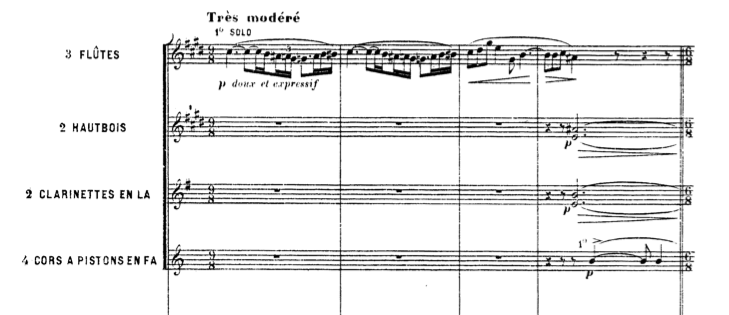
One of the most important influences seems to be Claude Debussy. Let me choose a couple examples of his music and show how they are reflected in the Rite. One of Debussy's most influential and characteristic pieces is thPrélude à l'après-midi d'un faune, composed in 1894. Here is how it begins:

Click to enlarge

Let's listen to the first couple of minutes:


Solo wind, soon accompanied by other instruments in a rhythmically and harmonically ambiguous context. That would also be a pretty good description of the beginning of the Rite:

Click to enlarge

Let's listen to that opening:


They almost start with the same note! C# vs C natural in the same octave. I have another example for you. Here is the beginning of another piece by Debussy, "Nuages" from the three Nocturnes for orchestra of 1899:

Click to enlarge

And here is a performance:


Now the opening of the second part of the Rite, "The Exalted Sacrifice":

Click to enlarge

And a performance:


Not so terribly different, are they?

Of course, the Rite of Spring has much that is quite different from Debussy, but there are certainly echoes of the earlier composer. No composer, not even Stravinsky, springs forth entirely new. Every piece of music builds to some extent on earlier music. Perhaps the most perniciously wrong part of the narrative of 20th century music is that the great revolutionary composers like Schoenberg and Stravinsky created entirely new musical languages. Of course, they did not. Their music is permeated with the gestures of the music of the past. For this reason it is possible for audiences to listen to the music with some degree of understanding and appreciation.

We do not admire the Rite of Spring today because it was written in an entirely new 'private' musical language, but rather because it found new ways of using many older musical ideas and gestures. Like Picasso's use of African masks to discover a deeper aesthetic level, the pounding rhythms of the Rite are not a new musical expression, but rather a very old one.

But I will explore the rhythms of the Rite in another post as this one is already quite long! Let's end with a complete performance of the Rite of Spring:


Friday, February 15, 2013

Anthony Genge: Streams I

Anthony Genge is a composer with some interesting influences. Here is his biography from his website:
Canadian composer and pianist Anthony (Tony) Genge was born in Vancouver, Canada, in 1952. He worked as a performer of jazz and rhythm and blues for a number of years before studying composition formally. Genge was a student of Morton Feldman between 1982 and 1985, completing a Ph.D. in composition at the State University of New York at Buffalo. He also studied composition with Bruce Mather at McGill University and Martin Bartlett and Rudolf Komorous at the University of Victoria. In 1979, he studied with the Japanese composer Jo Kondo in Tokyo. During this time he also visited several Pacific-Rim countries, studying their traditional music. By the 1990s, the style and influences in his music had become increasingly diverse, and since that time his music has been characterized by its distinctive harmonic language, elegant orchestration and postmodern mix of musical elements. Genge’s solo, chamber, and orchestral music, the first of which dates from the mid-1970s, has been performed and commissioned by leading soloists and ensembles throughout Canada, the United States, Europe and Japan, and his music has also been used for dance and film.

Currently, he divides his time between Antigonish, Nova Scotia
on the East Coast of Canada, where he is Professor of Music at
St. Francis Xavier University, and Victoria, B.C., on the Canadian
West Coast. In addition to his work as a composer, Genge
continues to perform and record as a jazz pianist and can be heard on his
critically acclaimed jazz trio recording Blues Walk.
Very interestingly, Tony's performing side, which is as a jazz pianist, and his composing side, don't seem to flow into one another. One influence that he does not mention is that of medieval music. In the piece I am going to put up, I think we can hear a bit of Machaut mingled with Asian influences. His piece Streams I, which dates from 1981, was originally intended for an established guitar trio. Alas, they were apparently unable to count the piece accurately. Some time later, Tony came to me and asked if I would undertake to record the piece for him, playing all three parts. This is fairly easy to do with multi-tracking.

I'm quite sure that the "streams" of the title are metaphoric, but I couldn't find any images of metaphorical streams so I put up several images of actual streams on Vancouver Island. They are preceded by a photo of Anthony Genge and followed by a couple of photos of me. This is a very unusual piece as it uses a lot of quarter-tones. One guitar has some strings tuned a quarter-tone away from the other guitars, which enables quarter-tone scales. Once you get used to the sound, I think it is a quite enjoyable piece, if a bit austere.


Thursday, February 14, 2013

Kurt Schwitters: Ursonate (1922 - 1932)

If I had a series called "Unusual Pieces of Music" -- I don't, yet -- this would undoubtedly be on it.


 Kurt Schwitters (1887 - 1948) was an artist and poet who worked in various genres and styles in the world of avant-garde art between the wars. This was a remarkably fertile time for experimentation in art. Schwitters worked in Dada, constructivism, installation art (he was one of the founders), collages and sound poetry. In the last area, he was influenced and inspired by the prior work of Raoul Hausmann (1886 - 1971). Here is a sample of Hausmann's "sound poetry". As the announcer says, this dates from 1918 and was recorded in 1946:


As poetry goes, this is very experimental, of course. But since the first time I heard it, in the early 1970s, was in a concert of avant-garde music, I have always thought of this stuff as 'music'. The Ursonate by Kurt Schwitters is a much more developed work. Here is the 'score'. This is a more popular piece than one might think. Kenneth Goldsmith has managed to collect links to nine different performances here. The one that I heard in performance was by Canadian composer Chris Butterfield. Here is an excerpt:


This is a substantial piece, over a half-hour long in most performances. If I had brought this to my composition teacher back in the 70s, I think I know what he might have said: that there are problems with the notation. Just writing down syllables gives the performer no clue as to the rhythms, tempi and pitches. What syllables should be rushed? Which held back? Which pitched higher? Which lower? And so on. It is a bit like the problem with Greek tragedy and epic. We know that these pieces of literature were also pieces of music, that is, they were accompanied by lyre and flutes. The chorus in a Greek tragedy sang their lines; Homer chanted the Iliad. But we have none of this music. Similarly with the Ursonate--what we know of the music as the 'composer' intended is just his single recording of it. Here is an excerpt:


Did he perform it differently at different times? We don't really know. In any case, it might be a benefit to have the 'score' so underdetermined. Performers can have considerable freedom to interpret and re-interpret. Even non-musician performers like poets and artists can perform it as they don't have to read musical notation.

Now what can we say about this musically? Like that novel by Anthony Burgess, it is an attempt to reproduce in literature something of the structures of musical compositions. That's kind of interesting in itself. Though, oddly, not something that would necessarily have any influence on composers. The influence is flowing entirely in the other direction! Chris Butterfield was interested in this piece because he was interested in all sorts of Dadaist literature and the absurd generally. He was doing settings of writings by Gertrude Stein at the time.

From time to time I will dig around in the 20th century in the belief that a lot of potentially interesting experiments were going on, some of which we might tap for compositions in this consolidation phase of music history.

Monday, February 4, 2013

John Cage: Third Construction (1941)

Readers of this blog know that I'm not usually a big fan of John Cage (1912 - 1992). Sometimes I cite him as an example of the questionably fashionable in 20th century avant-garde music. But the other day I heard a very interesting piece by John Cage that made me stop and listen to the whole thing.

In the years 1939 to 1942 Cage was working at the Cornish School of the Arts in Seattle, Washington and touring the West Coast with a percussion ensemble he and Lou Harrison had founded. He wrote a series of three pieces for percussion entitled First Construction, Second Construction and Third Construction. The third one, composed in 1941, has become a classic of the percussion repertoire. One site discusses it as follows:
John Cage's Third Construction, composed in 1941, follows a scheme similar to that the composer used in the First Construction (1939) and Second Construction (1940). Noting the effect of tonality upon traditional aspects of form (e.g. the central role of harmonic progression in a sonata-allegro or rondo movement), Cage sought to create an infrastructure that could similarly be applied to nonpitched percussion instruments. The result was what has been termed "micro/macrocosmic structure" -- that is, a structure in which the whole is reflected in the individual parts.
The First and Second Constructions were both built upon sixteen cycles of sixteen bars each. In the Third Construction, Cage employes a somewhat more elaborate scheme of twenty-four cycles of twenty-four bars each. Within this controlled structure Cage freely exercises other variables. While the length of sections is determined by the macro/micro principal, the rhythmic patterns within the structure create an intricate, multilayered web; Cage's singular timbral sense provides another source of variation and interest.
The four performers called for in the Third Construction play a large and varied battery of exotic instruments, including a teponaxtle (Aztec log drum), quijadas (jawbone rattle), lion's roar (a washtub with a small hole through which a rope is noisily pulled), and an assortment of cymbals, shakers, claves, tom-toms, and tin cans. By combining the endless possibilities of percussion colors and rhythms within a controlled, telescopic structure, Cage creates a work that is continually surprising yet holistically unified.
That certainly gives us some clues, but not quite enough to confirm what the ear hears: the piece seems to be constructed from rhythmic canons. One phrase seems to end with a distinctive triplet. But the structure is complex enough that it is unclear on a couple of listenings just how it is put together. There is a fascinating paper on early music by Cage by Jesse Guessford that discusses the structure of the First Construction and from it we learn that there are cycles, or 'circles' as Cage calls them, of rhythmic motifs rather than canons. The concept is perhaps Asian in origin. Here are some examples of rhythmic "circles" from the First Construction. The Third Construction uses the same kind of structures, but in larger patterns of 24 instead of 16 parts. UPDATE: For some reason, my example won't appear. It is on page 19 of the paper I linked to above, so you will have to go there. The example just shows short rhythmic patterns.

The notion of the 'circle' is just to indicate that if you have four motifs, 1234, you can repeat or retrograde the series, but you can't jump, say, from 2 to 4.

So Percussion are particularly accomplished performers of this music to the point that they perform it from memory! Here is a fascinating clip where they demonstrate a rehearsal technique: singing their parts instead of playing them:


There are three other clips in this series, but I will let you discover them on your own. I want to get right to a performance. It was this clip of So Percussion playing the Third Construction that caught my interest. Most percussion pieces are hard to listen to for very long. But this one kept my attention for the whole ten minutes. I even listened to other performances and was pleased to discover that there is a percussion group at McGill, my alma mater, that also does a fine job. The thing about this piece that interested me was the subtle range of timbres, the obvious structural unity and the delicacy of the sound. Here is So Percussion performing Cage's Third Construction:


Something almost unheard of is that So Percussion has done a number of other videos in which they discuss the piece in some detail. For example, here is the first player, Jason Trueting, discussing his part and the choice of instruments.


The Third Construction was written when Cage was a young man, in his late 20s. It is a period not closely studied by historians as it is his later works from his time in New York that attract more attention. In any case, I was delighted to discover this piece, a unique and worthwhile addition to the 20th century repertoire.

Wednesday, January 30, 2013

Schoenberg, Berg, Webern

I left things hanging a bit with my last post on Schoenberg. Let me see if I can wrap things up, provisionally at least. My exploration of classical music in the early days was partly guided by reading some library books and the purchase of recordings. One led to the other, of course. For some reason, the tiny municipal library I had access to had several books on 20th century music. In retrospect the interesting thing about these books was their relatively uniform view on the ideology of 20th century music. From these books I took for granted both who were the important figures (Schoenberg, Webern, Berg) and the context for understanding why: technical progress in new ways of writing music.

I accepted this paradigm for a long time and only much later did I really started to doubt it. I think the first inkling of a problem came in undergraduate music when I was in the listening library one day sampling some new music recordings. I happened to put on a disc of some Stockhausen for multiple orchestras (Carré or something) and followed it with Drumming by Steve Reich. The Reich was much more interesting and made a larger impact for me because it was not maximalizing dissonance and complexity! Well, according to the aesthetic parameters that I had learned regarding 20th century music, that was just wrong!

Technical progress in writing music is a very problematical concept as soon as you start to unpack it. For one thing it tends to place music in the same realm as science: research and development of new musical ideas. Milton Babbitt is the locus classicus for this viewpoint; another prominent practitioner is Pierre Boulez. Let's listen to some Babbitt. Here is his Composition for Four Instruments from 1948:


How are you supposed to listen to that? Are you supposed to hear the structure? Do you have to listen with the score? Should you study the score first? What kind of aesthetic experience could you have? Also, I have to point out that, there are a distressingly large number of pieces in this genre that all sound the same to me: the disjointed, fragmentary rhythms, the wide leaps in the melody, the huge changes in dynamics, the chopped off phrases--it all adds up to the same aesthetic effect. For me.

This is music that seems to be focussed only on the process of creating it. The syntax of it. The aesthetic effect is somewhat secondary. But it wasn't always so. If we go back to Schoenberg, Berg and Webern, two of the three always seemed to have also have a semantic or content side as well. In his early works such as Verklärte Nacht or Pierrot Lunaire or even the Six Little Piano Pieces, op 19, Schoenberg has a great deal of 'content'. Later on, he seems to have less and less, though there are exceptions such as his unfinished opera Moses und Aron. Some of his content seems to be related to issues surrounding his Jewish identity and the rise of anti-semitism in Nazi Germany. In other words, extra-musical events.

Schoenberg's student Alban Berg seems to have even more leaned towards the 'content' aspect and away from the structural aspect. His Lyric Suite for string quartet, long thought to be simply abstract music, turned out to have a rather detailed secret program referring to an affair between Berg and Hanna Fuchs-Robettin. Here is the first movement to give you a sense of the music:


While written using 12-tone procedures, that music certainly has an expressive 'content' in the sense I am using the word. Berg, as the author of two successful operas, Wozzeck and Lulu, has a strong sense of theater in his music. This has not ever been discussed to my knowledge, but his Violin Concerto contains instructions to the orchestra to perform certain actions onstage--again, the result is a kind of theatre. Mind you, I have not noticed any orchestras actually enacting these instructions! But they are there.

Anton Webern went in quite the opposite direction: he has the least 'content' of the three and his music seems to be the most concerned solely with the technical aspects of composition. It is hard to imagine a 'secret program' in any of Webern's pieces! Here is his String Quartet, Op 28:


I think you can hear how that is going to lead directly to Babbitt and Boulez. After the war the choice was made in places where composition was being taught, like Darmstadt, to follow the example of Webern and not the example of Berg. We might speculate that with the just past horrors of the war, the last thing anyone wanted was aesthetic content! On the other hand, this didn't seem to stop people like Shostakovich from writing content-full music after the war. But in Western Europe and North America, the ideology of music composition was to take Webern as a model and stress the syntax of music while ignoring the semantic. Even though this model has begun to break down there are still places that turn out composition students who seem to follow it.

If I might inflict on you a metaphorical way to distinguish Schoenberg from his students I could compare Schoenberg himself to a hearty dish like wienerschnitzel which would make Alban Berg a Sachertorte and Anton Webern, well, schnapps!

Thursday, January 24, 2013

Schoenberg and Pierrot Lunaire

I was talking about Schoenberg with a friend yesterday and mentioned that a) he is a very important figure historically and b) that his music has often been known to drive away audiences. My friend clearly had difficulty reconciling these two things! The reason is that the role of music in society in the early 21st century is radically different than it was at the beginning of the 20th century. What with all the fuss over the 100th anniversary of the Rite of Spring this year, I'm almost surprised that more mention has not been made of this. "Almost" surprised because it is pretty clear that we live in a time that has little historical awareness.

The 'a' and 'b' of Schoenberg are difficult to reconcile for us because we can't really imagine someone being musically important who doesn't sell a lot of records. This has largely been the standard since the Beatles. I love their music, most of it, but I recognize that they were instrumental in shaping the changed musical world we live in where popularity is the most important criteria for the evaluation of musical quality. If you don't have a 'hit', your aesthetic worth is seriously in question. Stravinsky knew this and made sure to have some 'hits' including the Rite of Spring. But Schoenberg was coming out of a quite different aesthetic tradition. Born in Vienna, he felt the great weight of the Viennese tradition in music. He carried on his back, his entire career, the burden of Haydn, Mozart, Beethoven and before them, Bach.

For these figures, music was an important aspect of society. It expressed important things about humanity and God and the nature of reality. All through the 19th century this was heightened by philosophers and thinkers like Arthur Schopenhauer. Music became the highest of the arts, most able to express the deepest inner feelings of humanity. As the century wore on, enormous, world-encompassing musical compositions like Wagner's operas and Mahler's symphonies were written to embody the profound significance of music.

In my last post I excerpted two pieces by Schoenberg in which he more or less extends this tradition. But he was fated to be one of those to break decisively with the past. Instead of more gigantic orchestral works, he was going to go on a different direction and this was signaled by choosing smaller instrumental forces and by writing music that no longer had a clear tonality.

Perhaps the most unusual piece Schoenberg wrote was his setting of 21 poems by Albert Giraud for singer and small instrumental group (piano, flute/piccolo, clarinet/bass clarinet, violin/viola and cello) called Pierrot Lunaire, completed in 1912. Pierrot is often described as a melodrama, a recitation with musical accompaniment, as the voice uses an odd sort of half-sung, half-spoken style called sprechstimme. The instrumental group is ironically and intentionally modeled on a cabaret orchestra. Some of the devices of modernism used to separate itself from the idealistic, naturalistic romantic tradition were irony, pastiche, detachment and incongruity--Pierrot has these in spades!

Here is the English translation of the text of the poem used for the first piece:

The wine that through the eyes is drunk,
at night the moon pours down in torrents,
until a spring-flood overflows
the silent far horizon.

Desires, shuddering and sweet,
are swimming through the flood unnumbered!
The wine that through the eyes is drunk,
at night the moon pours down in torrents.

The poet, whom devotion drives,
grows tipsy on the sacred liquor,
to heaven turning his enraptured gaze
and reeling, sucks and slurps
the wine that through the eyes is drunk.

Each song uses a different instrumentation. For the first one, apart from the voice, there is flute, violin, cello and piano. Now let's listen:


That little piano ostinato figure that we hear at the beginning is the material that ties the whole piece together. This figure outlines a whole-tone scale which is completed by the violin. This is not tonal music, but rather atonal music. But that certainly does not mean unstructured music! Indeed not. Part of Schoenberg's burden was to find a way of writing music that would live up to the high standards of coherence set by his predecessors, Bach and Beethoven. At this stage, still searching for a method, he would write music from pure intuition then struggle mightily to analyze how it was put together!

There is a kind of unique eeriness to the music of Schoenberg and his circle from this time that I savor. It slides around with ambiguous murkiness, giving one chills as each new strange facet is revealed. For this kind of music, the best approach is to listen several times until you start to feel familiar with the music. It has a density that takes time to absorb. Here is all of the first group of seven songs of Pierrot with the score. Have a listen.