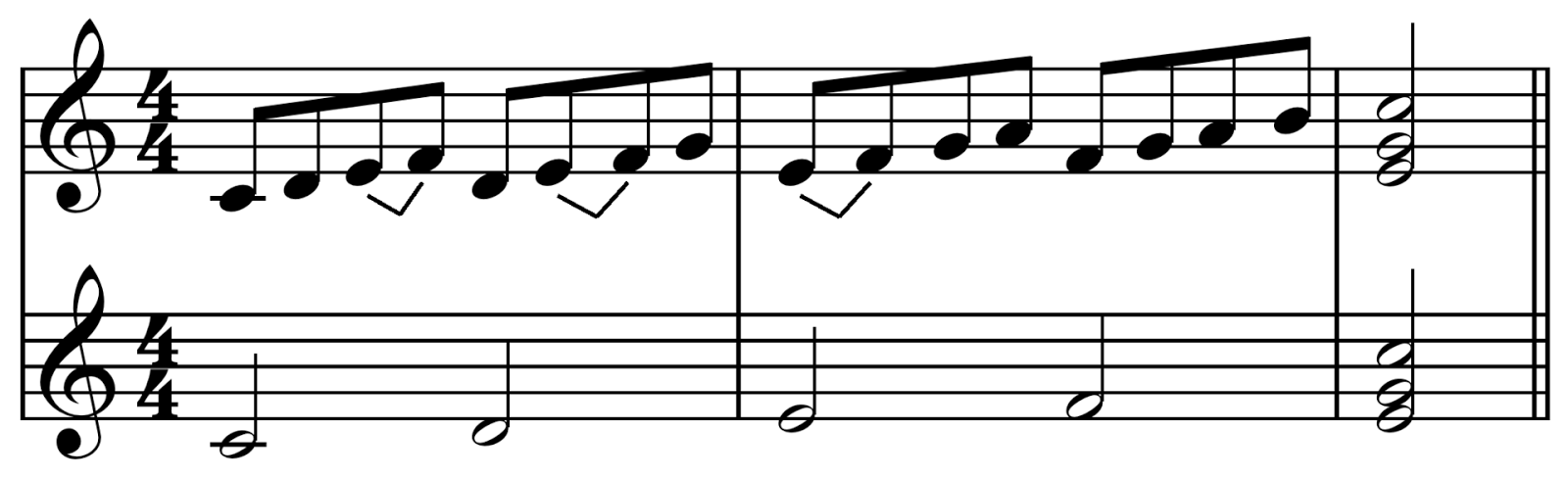
However, I have managed to find a two-piano reduction of the Piano Concerto no. 2 in F major by Shostakovich. He didn't rate this work terribly highly himself. As Laurel Fay notes in her biography of Shostakovich:
A week after its completion on 5 February 1957, Shostakovich pooh-poohed it in a letter to Denisov as a work with no redeeming artistic merits. What he did not say was that the concerto ... had been written as a vehicle for his son Maxim, then in his final year of study at the Central Music School.She goes on to tell us that Maxim premiered the piece on his 19th birthday in May 1957.
Critics were greatly taken with the concerto's charming simplicity, carefree spirit, and lyrical warmth.Say what? That doesn't sound much like Shostakovich whose music is usually better described as being dark, tortured, sardonic and depressive. But it is undeniable that the Second Piano Concerto is a very cheerful work--and why wouldn't it be? Shostakovich was obviously delighted with his son's achievement in music and delighted in writing a suitably exuberant work for him. It is interesting that the only other piano concerto by Shostakovich, which I posted about here, is also a very cheerful work, one that he wrote for himself when he was a young man of 27. These two light-hearted piano concertos contrast considerably with the ones for cello and violin, which are much more substantial, and darker, works. I don't have the scores, but if I come across them, I would certainly post something on them.
But back to the piano concerto. Here is the opening theme, which we hear a portion of in the orchestra before it is stated fully in the piano:


Which is a perfectly normal theme in F major that might have been written by Haydn except for the fact that it goes astray, wandering into D flat for a measure or so before closing in F. This little divergence turns an 8 measure period into 10 measures. Rhythmically it is a bit odd as well. I suppose that it would be easy to call this neo-classical though by this point, that phase was long over. There are no substantial contrasts in the movement; the second theme is not so different from the first, if rhythmically smoother:


This theme as well has a tendency to wander into D flat major. There is another theme in D minor:

All these themes have a bit of a family resemblance. A modulation to, well call it C major (or G major, or some mode or other) as the one-flat key signature disappears, signals an energetic development section:


In which the piano double-octaves its way in a slightly nutty fashion while the orchestra states the opening theme. This development gets more and more interesting as the crazed fairground mood becomes more intense. The orchestra comes to the fore after quite a lot of virtuoso piano writing with this hymn-like theme:


 |
| Click to enlarge |
Which is, of course, an augmented version of the D minor theme we heard before, now in major. This is followed by an extensive cadenza for the piano using the themes we have heard. Following this, inevitably, is the recapitulation with the orchestra recapitulating the themes while the piano offers ornamental decorations above.
All in all, there isn't much wrong with this piece. Sure, it's cheerful, but it was a happy occasion and even Shostakovich is allowed to write the occasional cheerful piece. It breaks no new ground, which is reason enough to condemn it if you are a card-carrying member of the avant-garde, but it is charming and listenable--just like a piano concerto by Mozart.
Let's have a listen. This is the composer himself playing the concerto with the Orchestre National de la Radiodiffusion Française, André Cluytens, conductor