I think that, many years later, George rather summed things up when he said that "the whole world decided to go mad--and blamed it on us!"

THE MUSIC SALON: classical music, popular culture, philosophy and anything else that catches my fancy...
Sunday, August 16, 2015
It was 50 years ago today
Fifty years ago, well, not today, but yesterday, the Beatles played the first mega-concert of the rock and roll era. They were booked into Shea Stadium in New York and sold out all 55,000 seats. Back in those days the amplification systems were primitive and couldn't compete with the screaming of all those fans so this concert went largely unheard. The Wall Street Journal has an article on the event.
I think that, many years later, George rather summed things up when he said that "the whole world decided to go mad--and blamed it on us!"
I think that, many years later, George rather summed things up when he said that "the whole world decided to go mad--and blamed it on us!"


Saturday, August 15, 2015
The Summer Listening List
The Wall Street Journal yesterday had an essay on the fading of the practice to undertake an ambitious list of reading over the summer--the kind of stuff you normally don't have time to get to the rest of the year.
But I think that setting yourself some goals to fruitfully use your leisure time is basically a Good Idea. Otherwise you could end up randomly surfing the Internet, watching cat videos or Russian dashboard cams or, shudder, watching television! So, to forestall those possibilities, let's come up with a summer listening list. Yeah, I know, summer is just about gone, but I just thought of this and whaddayagonna do?
The modest list for beginners:
These days, the summer-reading list seems to have gone the way of the perfect tan ... Schools and colleges still make available reading lists for students who are devoted, or anxious, enough to pack Lytton Strachey’s “Eminent Victorians”... in with their kayak paddles, but few people seem any longer to identify summer with catching up on the great books of the past or even on the must-reads of the present.Well, that's probably true. I can recall one summer I spent trying to complete reading Proust, "In Search of Lost Time", but I didn't quite manage it. The essay gives a bit of history of the summer reading list practice:
Perhaps the most representative instance of the dissemination of high culture to the average intelligent reader occurred in 1960, when the editor and critic Clifton Fadiman published his “Lifetime Reading Plan.” The monumental list began with the “Epic of Gilgamesh” and proceeded up through the novels of William Faulkner (it was updated in 1978 and 1986 and once more in 1998), each of its dozens of sections devoted to a single author and his or her work or works. It was the Platonic ideal (Frederick Copleston’s nine-volume “History of Philosophy,” summers of 1975-99, status: unfinished) of the summer reading list.I read much of the Copleston history as an undergraduate and got all the way up to Kant before I hit the Wall of Utter Incomprehension.
But I think that setting yourself some goals to fruitfully use your leisure time is basically a Good Idea. Otherwise you could end up randomly surfing the Internet, watching cat videos or Russian dashboard cams or, shudder, watching television! So, to forestall those possibilities, let's come up with a summer listening list. Yeah, I know, summer is just about gone, but I just thought of this and whaddayagonna do?
The modest list for beginners:
- The symphonies by Beethoven, available on 5 cds with Harnoncourt and the Chamber Orchestra of Europe
- The violin concertos of Bach, Hilary Hahn and the Los Angeles Chamber Orchestra
- Seven string quartets by Joseph Haydn, Emerson String Quartet: The Haydn Project (2 cds of Haydn plus a bonus cd of other composers from Mozart to Shostakovich)
That's pretty easy--you could probably get through those nine cds by the end of the month.
The medium list for intermediate listeners:
- The string quartets of Beethoven, available on 7 cds by the Alban Berg Quartet
- Bach, Mass in B minor on 2 cds with John Eliot Gardiner, Monteverdi Choir and the English Baroque Soloists
- The string quartets of Bartók with the Emerson Quartet
- The six "Haydn" quartets and the string quintets by Mozart with the Guarneri Quartet (terrific bargain, six cds for only twenty bucks)
The more challenging list for hard-core classical fanatics:
- The piano sonatas and piano concertos by Beethoven on 12 cds performed by Friedrich Gulda
- The complete symphonies by Haydn on 37 cds with Dennis Russell Davies conducting the Stuttgart Chamber Orchestra
- The complete concertos of Prokofiev on 3 cds with various artists on Decca
- The complete symphonies and tone poems of Sibelius on 7 cds with Neeme Jarvi and the Gothenburg Symphony Orchestra
- The complete string quartets of Shostakovich on 5 cds with the Emerson Quartet
That will keep you busy to Christmas, at least. Here is a little sample: Friedrich Gulda, piano with Horst Stein conducting the Vienna Philharmonic Orchestra in the Piano Concerto No. 4 by Beethoven:
Sequence
I'm still working my way through Beardsley's book on Aesthetics and just came across a passage where he is discussing forms common to the arts and mentions that while things like "color" have analogues in both visual arts and music (tone color in music and color tonality in painting) there are others that are found in music and not in the visual arts. His example is the theme and variations form. Yes, you can have regions in a painting that echo certain elements with variations, but the essence of the musical form rests on the existence of the theme as the central element of which the others are variations, and there is also a dramatic order or sequence to the variations. It is this ordering in sequence that is unique to music and not found in the visual arts, where the eye can wander as it wishes over the visual field.
There are three meanings of the word "sequence" in music, two of them specifically technical and one more general. The musical genre of the sequence is a chant or hymn, usually composed to couplets in Latin. The best-known example is the Christmas carol "Adeste Fideles", the English version is "Oh, Come All Ye Faithful". Here is an earlier example, "Veni Creator Spiritus":
UPDATE: I am informed by a commentator (who obviously knows more about Catholic liturgy than I do) that the example of sequence I want is actually Veni sancte Spiritus:
The second meaning of the term "sequence" comes from music theory and refers to a harmonic or melodic pattern repeated at different pitches. Here, from the Wikipedia article is a simple melodic sequence of a four-note scale segment repeated ascending one step each time:

There are also harmonic sequences that were developed in the 17th century and by Vivaldi's time had come to be used extensively. The effect for the listener is a bit like being on a Ferris wheel, with the feeling of rotating through space. Here is an example of the most common type, the descending fifths sequence, in which the bass line descends a fifth each time:

There are several other varieties of varying complexity and composers have displayed considerable ingenuity in their use. If you want examples, you will find them in nearly every quick movement from the Baroque and Classical eras. Rather than repeat myself, I will refer you to two posts I have put up on sequence previously here and here.
But those two uses aside, there is a general sense in which we can use the word "sequence" in talking about music. Like theater and dance, music is a "time-art" meaning that it takes place in time. Musical events are ordered in a dramatic sequence. Now in the 20th century many attempts were made to suppress or eliminate this aspect of music as part of the general modernist project of experimentation. Some composers, like John Cage, eliminated the dramatic sequence entirely by choosing notes by chance procedures so that no logical sequence was possible. He also wrote a piece consisting only of silence that achieves the same end. Other composers made pieces consisting of lengthy drones which also tend to downplay any sequential drama. Steve Reich and Philip Glass wrote pieces in which the events are so extended that the sensation is almost that there is no temporal progression--one feels trapped in a single moment. New Age meditation music seeks the same feeling.
But all these experiments, to my mind at least, really demonstrate that the unique strength and power of music is that very thing: the dramatic sequence. All attempts to avoid or eliminate it tend to be boring as music, fascinating though they may be from the point of view of metaphysics or meditation.
The great masters of dramatic impetus in music are found in the 18th and early 19th centuries. Before then, composers were still discovering how to assemble musical structures that drove forward, taking the listener on a kind of journey. As we move into the 19th century, the whole dynamic tends to slow down as something called the "romantic trance" is developed. But for that fairly brief time between 1700 and 1830, music achieved a remarkable ability to grab the listener, take them on a stimulating and multi-faceted journey and deposit them back home, fulfilled and amused. That's quite a feat, given that the mechanism is just a few compression waves in the air.
It is sequence that achieves it all. A sequence of short and long notes within an underlying pulse gives us rhythm. A sequence of different pitches building to a climax and tapering to a finish gives us the melodic phrase and the organization of harmony into a principal key and excursions into related harmonies, near or far, gives us the large structure. Master all of them and you can construct a piece of music.
Well, enough blather. Let's listen. Here is an interesting early example by C. P. E. Bach, who was the bridge between the somewhat more static structures of the Baroque, and the dynamism of the Classical style. Here is the Orchestra della Svizzera Italiana conducted by Ton Koopman playing the Symphony No.1 in D major, H.663 Wq.183 by C. P. E. Bach. And yes, there are some pretty good examples of the harmonic sequence here and there.
There are three meanings of the word "sequence" in music, two of them specifically technical and one more general. The musical genre of the sequence is a chant or hymn, usually composed to couplets in Latin. The best-known example is the Christmas carol "Adeste Fideles", the English version is "Oh, Come All Ye Faithful". Here is an earlier example, "Veni Creator Spiritus":
UPDATE: I am informed by a commentator (who obviously knows more about Catholic liturgy than I do) that the example of sequence I want is actually Veni sancte Spiritus:
The second meaning of the term "sequence" comes from music theory and refers to a harmonic or melodic pattern repeated at different pitches. Here, from the Wikipedia article is a simple melodic sequence of a four-note scale segment repeated ascending one step each time:
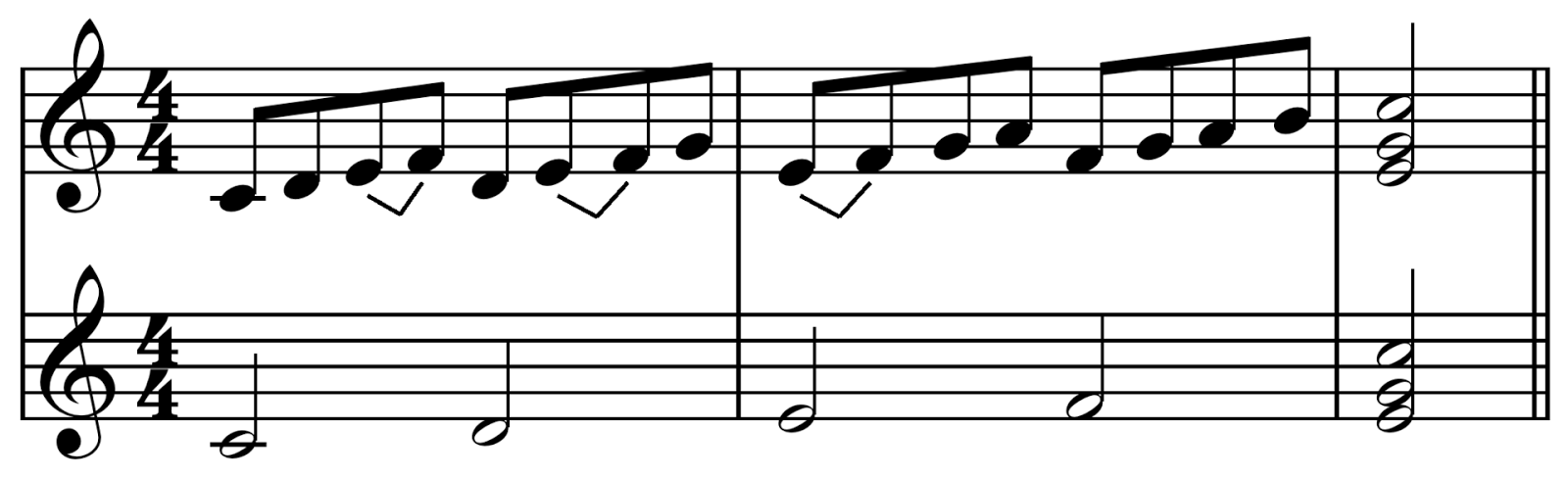
There are also harmonic sequences that were developed in the 17th century and by Vivaldi's time had come to be used extensively. The effect for the listener is a bit like being on a Ferris wheel, with the feeling of rotating through space. Here is an example of the most common type, the descending fifths sequence, in which the bass line descends a fifth each time:

There are several other varieties of varying complexity and composers have displayed considerable ingenuity in their use. If you want examples, you will find them in nearly every quick movement from the Baroque and Classical eras. Rather than repeat myself, I will refer you to two posts I have put up on sequence previously here and here.
But those two uses aside, there is a general sense in which we can use the word "sequence" in talking about music. Like theater and dance, music is a "time-art" meaning that it takes place in time. Musical events are ordered in a dramatic sequence. Now in the 20th century many attempts were made to suppress or eliminate this aspect of music as part of the general modernist project of experimentation. Some composers, like John Cage, eliminated the dramatic sequence entirely by choosing notes by chance procedures so that no logical sequence was possible. He also wrote a piece consisting only of silence that achieves the same end. Other composers made pieces consisting of lengthy drones which also tend to downplay any sequential drama. Steve Reich and Philip Glass wrote pieces in which the events are so extended that the sensation is almost that there is no temporal progression--one feels trapped in a single moment. New Age meditation music seeks the same feeling.
But all these experiments, to my mind at least, really demonstrate that the unique strength and power of music is that very thing: the dramatic sequence. All attempts to avoid or eliminate it tend to be boring as music, fascinating though they may be from the point of view of metaphysics or meditation.
The great masters of dramatic impetus in music are found in the 18th and early 19th centuries. Before then, composers were still discovering how to assemble musical structures that drove forward, taking the listener on a kind of journey. As we move into the 19th century, the whole dynamic tends to slow down as something called the "romantic trance" is developed. But for that fairly brief time between 1700 and 1830, music achieved a remarkable ability to grab the listener, take them on a stimulating and multi-faceted journey and deposit them back home, fulfilled and amused. That's quite a feat, given that the mechanism is just a few compression waves in the air.
It is sequence that achieves it all. A sequence of short and long notes within an underlying pulse gives us rhythm. A sequence of different pitches building to a climax and tapering to a finish gives us the melodic phrase and the organization of harmony into a principal key and excursions into related harmonies, near or far, gives us the large structure. Master all of them and you can construct a piece of music.
Well, enough blather. Let's listen. Here is an interesting early example by C. P. E. Bach, who was the bridge between the somewhat more static structures of the Baroque, and the dynamism of the Classical style. Here is the Orchestra della Svizzera Italiana conducted by Ton Koopman playing the Symphony No.1 in D major, H.663 Wq.183 by C. P. E. Bach. And yes, there are some pretty good examples of the harmonic sequence here and there.
Friday, August 14, 2015
Friday Miscellanea
I post this item simply to prove that I'm not the only curmudgeon in the world of music: even pop music has them! "Spin magazine founder: Today's music isn't any good."
“The commodification of music is so complete that artists these days create songs thinking they would make a good car commercial,” Guccione says. “And they’re more fixated on their social-media strategy than they are on their music.”Or as I have said: today's classical artists would love to sell out, but nobody's buying!
* * *
Something we have occasionally discussed is the digital music world and how well it handles classical music. Here is an article on managing classical music in iTunes 12 from Macworld.
* * *
I have a generally critical attitude towards a lot of the most characteristic art of post-war modernism. I'm not alone in this view as demonstrated by this rather thorough debunking of one of the leading post-modern artists of Britain, Tracey Emin, who managed to parley a lack of ability and a lot of cheek into a nice career in the modern art world:
When quality and accomplishment are no longer factors in who receives institutional support, it becomes a scramble for notice. It’s a matter of who can most offend the disdained others, make the most noise, kiss the most rings and/or asses; a game for those most willing to do whatever it takes to win the lottery of who the self-proclaimed gate keepers wave through to join the privileged circle. Emin, with her toilet stall quality doodles and screeds, is now a Royal Academy Professor of Drawing and on her way to knighthood. This is a clear demonstration that those in charge have lost all perspective of what is meaningful in art and life.The music world is, thankfully, rather different as, for most composers, traditional craft and aesthetics still govern a lot of what is done, at least in abstract instrumental composition. Music theater and opera are a different story.
* * *
This is an entirely unexpected and mildly amusing article about "The strange and surprising musical histories of the GOP presidential candidates."
Before heading off to UCLA law school, Carly Fiorina once toyed with the idea of becoming a concert pianist. She eventually landed at another keyboard, settling in tech and rising to become the CEO of Hewlett-Packard.
* * *
Over at the Guardian they have the Devil's Advocate interviewing András Schiff about his upcoming performance of the Goldberg Variations at the Royal Albert Hall. It's an amusing effort, but could have been a tad funnier:
TDA: Are you going to play all the repeats?AS: Yes.TDA: Why? It’s going to be terribly long and boring.AS: I beg to differ. Bach has specifically asked for the repeats, and this is a must. It is not a matter of choice. The structure is symmetrical, the Aria is in two halves, both 16 bars long, and each half is to be repeated. All the variations follow this pattern. The music is of such complexity that a second hearing is required; it gives the listener a second opportunity to hear the material again, and the player another chance to correct certain shortcomings. In tennis terms this is our “second service”.
* * *
Also at the Guardian is a longer piece by Ed Vulliamy that offers a rather frothy argument, stuffed with anecdote and light on analysis, to the effect that:
We should be sick and tired of the ubiquitous partition of “classical” from “pop”, in schedules and among audiences and fans; in some cases the bigotry – and ignorance of the other – is entirely mutual, and always tedious. After all, Jimi Hendrix cited Handel and Mahler among his major influences, while Dmitri Shostakovich – who outlived Hendrix by five years – loved (and composed) jazz and comic operetta. He even wrote a ballet about football.Ed reveals his basic assumptions with phrases like these:
Not much good art ever came from conservatives or conservatismHe is thoroughly convinced that the fundamental nature of art is to be revolutionary, political and shocking--and certainly some art has been. To his credit, he admits that sometimes producers go too far and that not all artistic "gambles" pay off.
* * *
This is a bit out there: a tenor has brain surgery and sings Schubert during the operation:
* * *
Via Slipped Disc we find this article on the disappearance of music critics in America:
Both guests estimate that there are currently about a dozen classical music critics at U.S. newspapers, down from about 65 only two decades ago.There's even a map, though I notice that they leave out Canada entirely. I wonder how many are left up North? Two or three in Montreal, one or two in Toronto, one in Vancouver? The piece at Slipped Disc has some entertaining comments.
* * *
At the New Yorker, Alex Ross weighs in on the opera scene in the new Tom Cruise thriller, Mission Impossible: Rogue Nation:
The tendency to associate classical music with murderous insanity is a curious neurosis of the American pop-cultural psyche. There is little evidence of such a predilection among real-life serial killers, who seem to prefer Black Sabbath, AC/DC, REO Speedwagon, and, of course, the Beatles.But, thankfully, the new movie goes against all those stereotypes. Read the whole article.
* * *
Over at Sinfini Music there is a surprisingly interesting article about piano performance then and now that delves into the subtleties of technique and interpretation:
Hough cites Friedman’s 1933 recording of Chopin’s Nocturne in E flat, No.2, Op.55, as an example. Fortunately, there’s little of the thin, scratchy brittleness common to old records. The instrument glows with a warm bass and a singing treble. More importantly, Friedman’s playing is tender, unhurried and lovingly detailed; you can trace the music’s multiple inner lines. Notes perfectly match the decay of preceding ones, so there’s little harshness or false accenting. The whole performance is so perfectly paced and proportioned, it feels like one, long breath. Yet: ‘This style of playing is no longer sought after,’ says Hough. ‘Audiences – and pianists – don’t know it’s there.’There are also some excellent clips by way of example. (I don't think, by the way, that the same might be said of guitarists. Early recordings of guitarists in the early 20th century like Andrés Segovia do not reveal wonderful subtleties so much as rhythmic waywardness.)
* * *
For our envoi today, let's listen to that 1933 recording of Ignaz Friedman:
Thursday, August 13, 2015
Ten Things You Need to Know About Classical Music

1. There are lots of Baroque pieces other than the Four Seasons by Vivaldi, other Adagios than the one by Albinoni (who didn't actually write it), other Canons than the one by Pachelbel and other symphonies than the ones by Beethoven and Mahler.
2. You don't actually have to read music to appreciate classical music, but it certainly doesn't hurt.
3. Yes, you can clap between movements, but, as you can tell from the somewhat strained smiles of the performers and the stony silence of those folks sitting beside you, maybe you should wait until the end of the piece?
4. The only reason that serious classical musicians dress in those boring formal clothes is so that they will not be mistaken for hip-hop artists.

5. No, conductors are not paid by the beat, nor by how deeply they bow, nor by how much they perspire, nor by how high they leap in the air. Well, except for Gustavo Dudamel...
6. Composers are paid about 1/10 of the fee to compose the music of what conductors are paid to conduct it.
7. No, Bach did not actually write anything for the Moog Synthesizer.
8. Classical music is not actually a tiny niche product, about 2% of total sales, in the music industry. Well, ok, it is, economically. But culturally, it is an enormous tradition stretching back over 1000 years, well before the Beatles' first LP.
9. No, trombones are not made to sit in the back of the orchestra just because they tend to play too loud. Well, that's not the only reason.
10. And finally, despite what you may hear, the concertmaster does not get to sit in front because he or she is the cutest violinist.
That drawing at the top is of Hector Berlioz conducting, so let's end with a piece by him. This is the Symphonie fantastique with the Orchestre Philharmonique de Radio France & Simon Bolivar Youth Orchestra conducted by Gustavo Dudamel:
Wednesday, August 12, 2015
Bad Music is a Lifestyle Choice
I was just going to stick the link in the upcoming Friday Miscellanea, but it deserves more attention. The Wall Street Journal the other day had an opinion piece titled "The Suicide of the Liberal Arts", that had some well-crafted observations about a subject we often talk about here: the problem of the increasing inability of ordinary listeners to appreciate classical music.
Aesthetic questions, as David Hume realized, are philosophically rather similar to moral questions and both are vulnerable to fashionable claims of relativism: everything you do is a lifestyle choice whether it is to murder the innocent or listen to bad music. One of the great aesthetic authorities on music, Duke Ellington, once said that there are only two kinds of music: good music and bad music. With the greatest possible irony, I note that the two words you are least likely to read in any music criticism these days are the words "good" and "bad". I honestly think that Alex Ross of the New Yorker would rather drive knitting needles into his ears than describe a piece of music as either good or bad!
Spengler's essay delves quite deep into the purposes of art and culture and ends with a challenge to some of my own views:
The appropriate work to act as envoi to this post is probably the opera by Mozart, Don Giovanni, that a lot of Spengler's discussion focuses on. This is the Chorus of De Nederlandse Opera & Royal Concertgebouw Orchestra, dir. Nikolaus Harnoncourt (1988):
Spengler at PJ Media writes an even better-crafted essay titled "A Thoughtless Age" reflecting on this one:When properly conceived and taught, the liberal arts do not by themselves make us “better people” or (God knows) more “human.” They don’t exist to make us more “liberal,” at least in the contemporary political sense. But the liberal arts can do something no less wonderful: They can open our eyes.They show us how to look at the world and the works of civilization in serious and important and even delightful ways. They hold out the possibility that we will know better the truth about many of the most important things. They are the vehicle that carries the amazing things that mankind has made—and the memory of the horrors that mankind has perpetrated—from one age to the next. They teach us how to marvel.
So much of the great classical literature deals with moral questions. I always think of Plato's great Socratic dialogue, the Euthyphro where Socrates, on the way to his own indictment runs into Euthyphro on the porch of the King Archon who is there to file the charge of murder against his own father. In questioning Euthyphro Socrates comes up with one of the greatest moral questions of all: do the gods (or God) condemn murder because it is wrong? Or is murder wrong because the gods condemn it?Western culture has become inaccessible to the general public because we have lost the ability to see the world through the eyes of those who created it. A generation ago, the literary critic Harold Bloom complained in The Western Canon that it no longer was possible to teach English literature to undergraduates because they lacked the cultural references to make sense of it: imagine reading Moby Dick without knowing who Ishmael and Ahab were in the Bible, or Joyce’s Ulysses without knowing that someone named Homer had written an epic about a certain Odysseus. (Outside the English realm, Bloom is guilty of the same sort of ignorance, but that is a different matter).There is a deeper problem, though: Why should we read works by long-dead authors with concerns entirely different than ours, and if we should, how can we do so?
Aesthetic questions, as David Hume realized, are philosophically rather similar to moral questions and both are vulnerable to fashionable claims of relativism: everything you do is a lifestyle choice whether it is to murder the innocent or listen to bad music. One of the great aesthetic authorities on music, Duke Ellington, once said that there are only two kinds of music: good music and bad music. With the greatest possible irony, I note that the two words you are least likely to read in any music criticism these days are the words "good" and "bad". I honestly think that Alex Ross of the New Yorker would rather drive knitting needles into his ears than describe a piece of music as either good or bad!
Spengler's essay delves quite deep into the purposes of art and culture and ends with a challenge to some of my own views:
To some extent, the conservative movement is to blame for the suicide of the liberal arts, through its embrace of Matthew Arnold and the cult of “culture” as a substitute for religion. Apart from the fact that Arnold was a dreadful poet, and said nothing that had not been said better three generations earlier by Friedrich Schiller, he has the whole thing backwards. The great works of high culture arose in the first place from the existential concerns of religion, and are incomprehensible without it. To propose culture as a substitute for religion is a contradiction in terms.I confess that, in my own life, music often acts as a substitute for religion. I make the claim that I just don't have a religious sense, but an aesthetic one instead. But perhaps this is balderdash and I just don't understand religion. For me the great works of music tend to be clustered in the 18th century, spilling over a bit into the 19th century and it is hard to see them as other than linked somehow to the great liberations of the Enlightenment. I wonder which of us has the right of it? Myself or Spengler?
The appropriate work to act as envoi to this post is probably the opera by Mozart, Don Giovanni, that a lot of Spengler's discussion focuses on. This is the Chorus of De Nederlandse Opera & Royal Concertgebouw Orchestra, dir. Nikolaus Harnoncourt (1988):
Tuesday, August 11, 2015
Concerto Guide: Schoenberg, Violin Concerto, op 36
One year after the Violin Concerto by Alban Berg, his erstwhile teacher, Arnold Schoenberg, wrote his one and only violin concerto in 1936. Schoenberg was living in Los Angeles by this point, forced to flee Nazi Germany due to his Jewish ancestry. He and Berg had been in frequent contact by mail, of course, though it is unlikely Schoenberg had heard Berg's concerto, or even seen the score. Berg passed away in December of 1935, soon after completing his concerto. The Violin Concerto by Schoenberg was premiered in December 1940 by Louis Krasner, the same violinist who commissioned and premiered the Berg concerto.
Instead of redoing my discussion of this piece, I am going to send you to a fairly lengthy post I did on it last year:
Instead of redoing my discussion of this piece, I am going to send you to a fairly lengthy post I did on it last year:
I have a feeling that this series will not be able to continue too much longer, simply because, due to copyright restrictions, I do not have easy access to the scores and without those, my comments would tend to the superficial. Some pieces I would like to cover are the Ebony Concerto by Stravinsky, the Violin Concerto No. 1 by Shostakovich, the Clarinet Concerto by Copland and so on. But I don't have access to those scores. So I might do a few posts just touching on a few concertos and leave it at that. I would like to comment on the concertos by Philip Glass, Esa-Pekka Salonen, Thomas Adès, for example, but without the scores, I can't delve too deeply. I might do a post on guitar concertos as I have played quite a few of them. But this lengthy series of posts is coming to an end, so if you have any suggestions as to a good theme for a new series, just leave them in the comments.
In the post I linked above, the clip is of Hilary Hahn playing the Schoenberg concerto, which is a really wonderful performance. Here is an interesting little clip where Arnold Schoenberg's grandson asks Hilary Hahn the same questions that his grandfather asked Louis Krasner when he was performing it.
Subscribe to:
Posts (Atom)