Here's what I'm listening to today: the Violin Concerto No. 1 by Sergei Prokofiev with Lisa Batiashvili and Iván Fischer and the Berlin Philharmonic. Prokofiev is one of the few 20th century composers who could write a really good melody, as we hear at the very beginning.

THE MUSIC SALON: classical music, popular culture, philosophy and anything else that catches my fancy...
Sunday, November 8, 2020


Friday, November 6, 2020
Ars Longa
I was just glancing in Paul Johnson's Art: A New History, a book I heartily recommend, when I ran across this quote from the long-lived Katsushika Hokusai (1760 - 1849 thereby spanning the lives of both Mozart and Chopin), perhaps the greatest Japanese artist:
Since the age of six I have had the habit of drawing the forms of objects. From about fifty I have published my drawings, but none was of much value until I was seventy. At the age of seventy-three, I began to get a slight grasp of the forms of birds, animals, insects and fish, and how grass and trees grow. When I am eighty my art may improve, by ninety it may be really worthwhile, and at a hundred divine. At a hundred and ten every dot and stroke will live.
Here is a landscape of Hokusai:
 |
| Click to enlarge |
Sadly, he only lived to be eighty-nine!
Friday Miscellanea
Well, that was quite a week, wasn't it? And I hear that there was some sort of election? No, not the British Columbia provincial election, that was a couple of weeks ago. But never mind, we have more important things to discuss starting with an interesting performance of Bach's Goldberg Variations as a ballet:
That's just a sample, but the pianist, Pavel Kolesnikov, has a new recording just released and reviewed in The Guardian:
Just when you think there are enough recordings of Bach’s Goldberg Variations, here comes one that makes the music sound fresh off the page. The pianist Pavel Kolesnikov says he had “shied away” from performing Bach until he was invited to collaborate with the dancer and choreographer Anne Teresa De Keersmaeker on the Goldbergs; the result, with De Keersmaeker dancing and Kolesnikov playing live, has been seen by a few lucky European audiences this year.
Recorded in the studio, Kolesnikov’s performance stands alone: there is certainly no sense of the equation being less than perfectly balanced. The theme sings softly and simply – and then the first variation bursts out, speaking clearly, the two melodic lines chasing each other down the keyboard like kittens. These contrasts of texture, between softness and defined edge, at first make it feel as if the music is going in and out of focus – but that’s not quite it, because every single note is set forth by Kolesnikov with crystal clarity. It might rather be that we are moving in and out of Kolesnikov’s head: some variations feel “public” and consciously articulated, while some unfold as if privately.
* * *
Over at Slipped Disc we are alerted to a new height (or bottom?) in artist marketing with this cover for a Scarlatti recording:

And it is fairly clear that the performance itself is not by a real pianist at all, but a MIDI file.
* * *
The Berlin Philharmonic did a rather unusual encore the other day, after the government announced a new ban on concerts. Here they are conducted by Kiril Petrenko in a performance of John Cage's 4'33 for any instrument or combination of instruments.
* * *
You can watch online performances of the Vienna Staatsoper at this link:
* * *
And on a completely different note, here is an essay on the role of "theory" in the teaching of the humanities: Who’s Afraid of Theory?
The Theory Wars, that is the administrative argument over which various strains of 20th-century continental European thought should play in the research and teaching of the humanities, has never exactly gone away, even while departments shutter and university work is farmed out to poorly-paid contingent faculty. Today you’re just as likely to see aspersions on the use of critical theory appear in fevered, paranoid Internet threads warning about “Cultural Marxism” as you are on the op-ed pages of the Wall Street Journal, even while at many schools literature requirements are being cut, so as to make the whole debate feel more like a Civil War reenactment than the Battle of Gettysburg. In another sense, however, and Butler’s partisans seem to have very much won the argument from the ‘80s and ‘90s—as sociologically inflected Theory-terms from “intersectionality” to “privilege” have migrated from Diacritics to Twitter (though often as critical malapropism)—ensuring that this war of attrition isn’t headed to armistice anytime soon.
Read the whole thing for an informative and sympathetic look at the history.
* * *
Bachtrack gives us Music vs. Covid-19: the state of play in Asia, America and Oceania. The whole thing is worth looking at. Here is a sample:
In Japan, where you are enjoined not to yell “Bravo”, people are making “Bravo cards” to be waved in the air instead; one orchestra is selling a “Bravo towel” in its foyer. And to understand Japanese rules on concert seating, look no further than the chequerboard-like pattern of “Ichimatsu-monyo”, a textile named after its most ardent fan, one of the great Kabuki actors of the 18th century.
Let's conclude with a note of optimism from Opera America’s Marc Scorca: “I believe that in the next years as we come out of this crisis, there will be a blend of a return to some of the old and incorporation of the new. That blend will be healthy for opera in the United States.”
* * *
And for sheer amusement value, here is an ad that has been popping up everywhere lately:
The biggest mistake guitar players make is that they try to LEARN their way to PLAYING the guitar...
… Thinking that if they just keep learning…
… If they just keep practicing…
… Eventually it will all connect.
And it WON’T!
It CAN’T!
Because it’s impossible to THINK your way to PLAYING well!
Legendary Guitarist Joe Pass famously said “You can’t think and play”
Because it doesn’t work that way! The two are opposites!
THINKING… is what causes all the PLAYING problems in the first place!
This is both hilariously wrong and somewhat true, all at the same time!
* * *
Let's have some music! Today's envoi is a complete performance of Donizetti's Anna Bolena at the Wiener Staatsoper in 2011:
Thursday, November 5, 2020
Baltimore American Musicological Society Conference
I have to give a trigger warning up front. Though we try to avoid politics in every respect except as it directly affects the music business and musicians, I am going to just wander into politics a bit in this post. I offer as an excuse that, as a Canadian, I do have quite a different perspective on American politics. Someone left a note on my desk yesterday about how every American, distraught over the election, will be alloted a "Canadian Emotional Support" person and I guess, in our office, that would be me! I have to say that Canadian election campaigns are much shorter, typically six weeks or so, and less emotionally fraught. I suspect that part of the reason is that we simply refuse to discuss the more difficult issues.
But let me back up a bit. Way back in 1996 or 97 I went to the American Musicological Society annual conference which that year was held in Baltimore. The high point for me was almost meeting Richard Taruskin who had a debate with my then-thesis advisor over neo-classicism and its connections with fascism. I don't even remember which sides they were on. Traveling to Baltimore and spending some time just wandering around the city was an unusual experience for me. I was not used to American cities as, apart from Toronto, they are quite different from Canadian cities. How is that you ask?
Let me offer up two bits of anecdotal evidence. I lived for quite a while in Victoria, the capital of British Columbia, and while I was there as an undergraduate music student, I used to usher at symphony concerts occasionally. The conductor of the orchestra then was Paul Freeman:
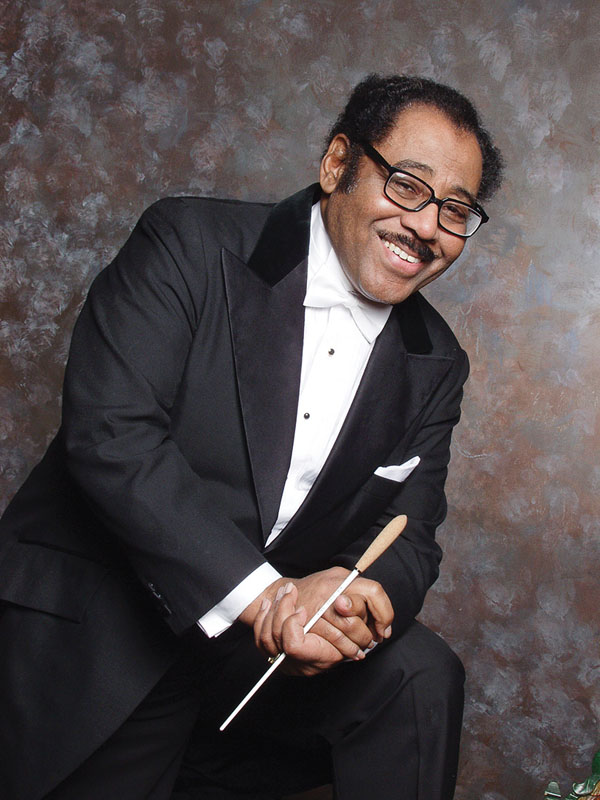
He is an American, born in Richmond, Virginia, and obviously black. As is his wife. I remember some of us ushers greeting his wife, who was usually sitting in row seven, saying "hi Mrs. Freeman." We had not been introduced, so how did we know that this black lady in row seven was Mrs. Freeman? Easy, in that whole 2,000 seat symphony hall there were precisely two (2), black people. The conductor and his wife. Back then many conductors in Canada, as with university professors, were imported from other countries. Not just the US, the previous conductor in Victoria was Lazlo Gati, from Hungary. I think we are finally hiring Canadian conductors now. I should mention, by way of context, that in the whole city there were probably fewer than ten black people. Victoria does have a very large population of people of Asian descent however.
Ok, back to Baltimore. At the conference there were about five hundred musicologists and graduate students in musicology from all over North American. In that whole herd there was one (1) black person, a young man in his thirties. I don't recall his specialty. As I wandered around the city I noticed something else odd: in every service job, all the employees, or nearly all, were black. The people behind the counter at the hotels, the people serving in restaurants and so on. Everywhere you went.
Now I draw no conclusions from this as I am an outsider and don't quite know what to think. In Canada, especially Quebec where I lived for over a decade, we have politicized language instead of skin color and with problematic results.
I will say this: there seem to be some profound problems in some cities in the US such as Baltimore, Detroit, and recently Portland OR, Seattle, and San Francisco. Mind you, I claim no Canadian superiority. Both Montreal and Vancouver have profound problems as well. Montreal, though few Canadians know about it and even fewer will admit it, has serious problems with corruption and the Mafia.
All I will say is that it might be time to try some new approaches to some old problems.
Some music? This is Paul Freeman conducting the Philharmonia Orchestra with Derek Han soloist in the Mozart Piano Concerto No. 21 in C major:
Sunday, November 1, 2020
Craft and Creation
I might have mentioned that I have taken up some new hobbies: fountain pens, sketching and journaling. That last one, "journaling" is a relatively new, though very popular, hobby. It used to be called, "keeping a journal" or "writing in a diary", though those are rather out of fashion. I did keep a journal decades ago when I was going through some emotional turmoil. That is not the case, now, I just wanted to do more non-digital things and writing in a journal with a fountain pen, as well as sketching, fulfills that need quite well. Writing haiku seems to have crept in as well.
Working with these new hobbies, which we might glorify by calling them new avenues of creative activity, has caused me to notice some interesting things. In all creative activities there is a balance or division between the craft of the activity and the creation in the activity. For example, I am a complete novice at sketching so nearly all the effort is devoted to simply learning the basics of the craft. Risking personal embarrassment, I will share a couple of still-life sketches:


Craft/Creation
Haiku: 10/90
Playing guitar: 70/30
Sketching: 90/10
Music composition: 30/70
Are these numbers surprising in any way? Not the sketching or the haiku, presumably. In playing guitar, after fifty years on the instrument, I find that I have to spend about half my time just trying to preserve and slightly improve my technique and a good part of the rest of the time, when I am playing pieces, is also devoted to technical issues. My creativity in interpreting music on the guitar was probably all worked out decades ago and now I am just trying to keep my hands in shape.
Music composition is an interesting division. I have been a musician over fifty years, as I said, and in that time I always did a little composition. But I have only composed in a serious way in the last ten or twelve years. So I still spend quite a bit of time on the craft, by which I mean basic organizational activities. In fact, it is pretty hard to tell where craft leaves off and creation begins in music composition. A big part of creativity these days consists in making discoveries in the area of what might be called "craft" or using craft in new or unusual ways. And, ironically, some of the most so-called "advanced" musical ideas, such as extended techniques, can often sound very dated these days because they were so overused in the 1970s, 80s, and 90s. Of course "over-used" is one of those phrases that is applied so subjectively that it doesn't tell us too much. It is largely a matter of aesthetic taste.
Speaking of "taste", is the having and deploying of aesthetic taste more craft or creation? I guess it could be either. And I would love to hear your thoughts on the matter.
For a suitable envoi, here is a piece for solo guitar I wrote a long time ago when I was still puzzling over the craft of composition. I was also puzzling over how to do a suitable video! This is "Chant" from my Suite No. 1 for guitar. In it I was simultaneously assimilating the influence of Gregorian Chant and Chopin.
Saturday, October 31, 2020
Saturday Haiku
Here are a couple more for you:
Today I heard
Dogs and cats through Auto-Tune
Singers sound the same!
* * *
One month in summer
Through the bedroom cupola:
Woken by the moon
I have been reading the notes to the Penguin haiku book and a remarkable number of them seem to be about either farting or masturbation. I don't recall that from when I first started reading haiku decades ago. I think they may have left those ones out. It is a bit like when I discovered, from reading an excellent book titled Shakespeare's Bawdy, that nearly everything the Nurse says in Romeo and Juliet is actually a dirty joke.
Some music? Perhaps a little Tōru Takemitsu. This is his Nostalghia for violin and orchestra.
Friday, October 30, 2020
Friday Miscellanea
We love well-crafted invective here at the Music Salon and Matthew Aucoin provides a rich harvest over at the New York Review of Books in a review of a collection of writings by Pierre Boulez:
Music Lessons, the translation of the lectures he gave at the Collège de France between 1976 and 1995, provides English-language readers with the fullest document yet of the mature Boulez’s musical thought: his approach to composition, his analysis of his predecessors’ work, and his attitudes toward many sectors of twentieth-century musical activity. It is an important publication, especially because I believe it casts doubt on the notion that Boulez grew wiser or more generous with age. This book embodies his every paradox: he is both discerning and myopic, clever and needlessly cruel, capable of moments of thrilling clarity as well as long stretches full of bland, arid tautologies. His contradictions are the contradictions of the late-twentieth-century European avant-garde; his narrowness became the narrowness of a generation. As his era recedes, it feels newly possible to take stock of both his strengths and his limitations.
* * *
The ways the woke progressives have of undermining the cultural values of Western Civilization are multitudinous and manifold. And they usually involve either distorting the meaning of familiar words, or of inventing new words to describe new crimes against orthodoxy. Here is a lovely example: Beethoven Has a First Name.
For a lot of intersecting reasons, music critics, academics, consumers, and performers in the mid-19th through early 20th centuries thought about music history as the story of a few great men producing great works of art. (Of course, this tactic is very common in how we tell our histories in many domains.) Tied up in the respect and ubiquity afforded to these men is the mononym, or a single word sufficing for a person’s whole name. These canonized demigods became so ensconced in elite musical society’s collective consciousness that only one word was needed to evoke their awesome specter. Mouthfuls of full names became truncated to terse sets of universally recognized syllables: Mozart. Beethoven. Bach.
This is so clever! And superficially plausible. But the fact that we refer to people like Beethoven, Mozart and Bach only by their last names is simply because they actually ARE great composers and, unfortunately, all male. Speaking of canonized demigods, is there any way that this policy could be applied to people like Cher, Drake, Madonna, Lady Gaga or Beyoncé who also suffer from mononyms?
* * *
I'm afraid that this is likely very true: Bail out our musicians or risk losing them for ever, say classical music stars.
Leading figures in classical music say many highly-trained orchestral musicians are giving up on music as they face homelessness and hunger this autumn. Speaking to the Observer this weekend, the internationally renowned conductor Sir Simon Rattle warned that an “exodus is happening right now”, while top English soloists the violinist Tasmin Little and the pianist Stephen Hough both spoke of despair and desperation among even successful performers.
As someone who left the music business as a performer a couple of decades ago, I think that the incentives to be a classical musician have been declining for a long time. The all-out erasure of music performance this year is just the last straw. No, I suspect that things will not return to the way they were--not for a long, long, long time.
* * *
In response to the vaulting infection rates in Europe BREAKING: GERMANY SHUTS ALL OPERA AND CONCERT HALLS FOR A MONTH.
“The federal and state governments want to get a grip on the drastically increasing corona infection figures with massive contact restrictions over the course of November — and this throughout Germany as early as next Monday, 2nd November. The goal: to be able to track infection chains again. At present, 75 percent of infections can no longer be traced, said Angela Merkel.
“There are further restrictions on contact. From Monday on, private meetings will only be permitted for members of one’s own household and one other household with a maximum of ten people. Tourist overnight stays within Germany are to be prohibited in November. According to this measure, trips only for non-touristic purposes such as business travel may be made.
“Events that serve entertainment purposes will be prohibited. Catering establishments are to close from November 2 for the rest of the month. The delivery and collection of food for consumption at home will be exempted from this rule, canteens will be allowed to remain open.
* * *
How did music evolve? Harvard study reveals a surprising theory. No, it’s not a sexual mating call.
The authors draw on extensive evidence to suggest two other likely roots for music: territorial signaling and infant care.
In warfare, rhythm and melody allow tribal groups to signal their strength, numbers, and coordination across far distances, to both allies and foes. This is not unlike how animals commonly use vocalizations to signal their territory or scare off others. “If we study music in traditional societies, we see it used consistently to form political alliances,” says Hagen. By this logic, military bands and marching bands are a late-stage adaptation of this dominance signaling: If the band can’t hold a beat, the football team probably can’t hold a ball.
In infant care, the researchers note that parents use sing-song language to communicate with their helpless infants. “The parent or caregiver needs a reliable way to signal to the infant that they are attending to them,” says coauthor Samuel Mehr, a psychologist and director of Harvard’s Music Lab. “But attention is a covert property of the mind. It’s hard to determine if someone is actually paying attention to you.”
To tell the truth, this seems a lot more plausible than other explanations.
* * *
With the very creative Esa-Pekka Salonen and Nico Muhly behind it, this sounds really interesting: The San Francisco Symphony Plunges Into a New World.
While recordings are nothing new, the vast majority of classical repertoire was not meant to be heard that way — or how it has been presented during the pandemic, inevitably with less visceral impact on a smartphone screen. With that in mind, the San Francisco Symphony commissioned Mr. Muhly to compose something specifically for a virtual medium. The result is “Throughline,” which has taken thousands of hours and endless patience to pull off and premieres Nov. 14 on the orchestra’s website and Bay Area public television.
The project is also an introduction to the eight collaborative partners Mr. Salonen announced when he was named to his new position in 2018, a group whose mission has been kept intentionally vague. “It’s an experiment,” he said. “I’m surrounding myself, at least mentally, with a bunch of talented and creative people.”
* * *
Let's have some music from Esa-Pekka Salonen. This is his piece Nyx, after the Greek goddess of the night:
Have we had an envoi from Dufay recently? We have not! Here is a very nice performance of "Se la face ay pale" by Cantica Symphonia:
Subscribe to:
Posts (Atom)