Sunday, August 14, 2011

The Case of Robert Schumann

Last night I attended the last concert in our chamber music festival, the Henschel Quartet playing Beethoven and Schumann. The Beethoven was, as always, extraordinary. As my companion commented, full of drama and real intensity. I would add, with a rhythmic inventiveness so coordinated with the harmonic structure that it is really unmatched by anyone. The second half was Schumann's Quartet in A major, op 41, no 3. I confess that sometimes I leave a concert after the first half if the second half has music I am less interested in. Romantic chamber music usually falls into that category because it has been my experience that chamber music was not where Romanticism in music had much success. But, because I haven't heard much Schumann chamber music live, and because I had invited a friend to the concert, we stayed till the end. The Henschel Quartet were very fine, by the way. The first violin did not always make the best sound and they had some moments of ragged ensemble in the Beethoven. But they played with real understanding of the music which is much more important than mere technical perfection.

Robert Schumann is one of the key figures in the development of Romanticism in music. We can't talk about him, or about many of the artists of the early 19th century, without talking about madness. As Charles Rosen says in his remarkable book on the period (The Romantic Generation):
By the beginning of the nineteenth century, madness--for writers, painters and musicians--was not simply a withdrawal from the distress of everyday life, a protest against intolerable social conditions or against a debilitating philosophy. It had gained a new ideological charge: madness was a source of creative energy.
 As Charles Lamb wrote to his young friend Samuel Taylor Coleridge, "Dream not Coleridge, of having tasted all the grandeur and wildness of Fancy, till you have gone mad." Schumann was both drawn to and terrified by  madness. It was for him an immense creative resource. A lot of what Schumann accomplished, in extraordinary music like the third song from his cycle Liederkreis on poems by Heine, is by subverting or suspending traditional musical logic:
This works extremely well in the context of small forms like lieder or sets of short piano pieces like the Davidsbündlertänze:
But as Rosen points out, Schumann's great weakness was transitions: in his longer works he either obsessively keeps harping on the same rhythm for page after page, or is always interrupting the music to begin a new section. In his later life, he attempted to revise the brilliant quirkiness of the early music, but the result was usually merely pedestrian. Schumann's reputation is because of those striking and revolutionary shorter works, the lieder, the piano pieces, that come mostly from his earlier life. The ability to write in the longer forms developed in the Classical Era, such as string quartet or symphony, had largely disappeared in the early decades of the 19th century. This is not to say that composers didn't attempt these forms, just that they were not very successful, overwhelmed as they were by the new creative--and yes, slightly mad--energy of Romanticism. Later on in the century Brahms would make a very serious effort to reclaim the ground lost.

Saturday, August 13, 2011

Virtuosity and Musicality

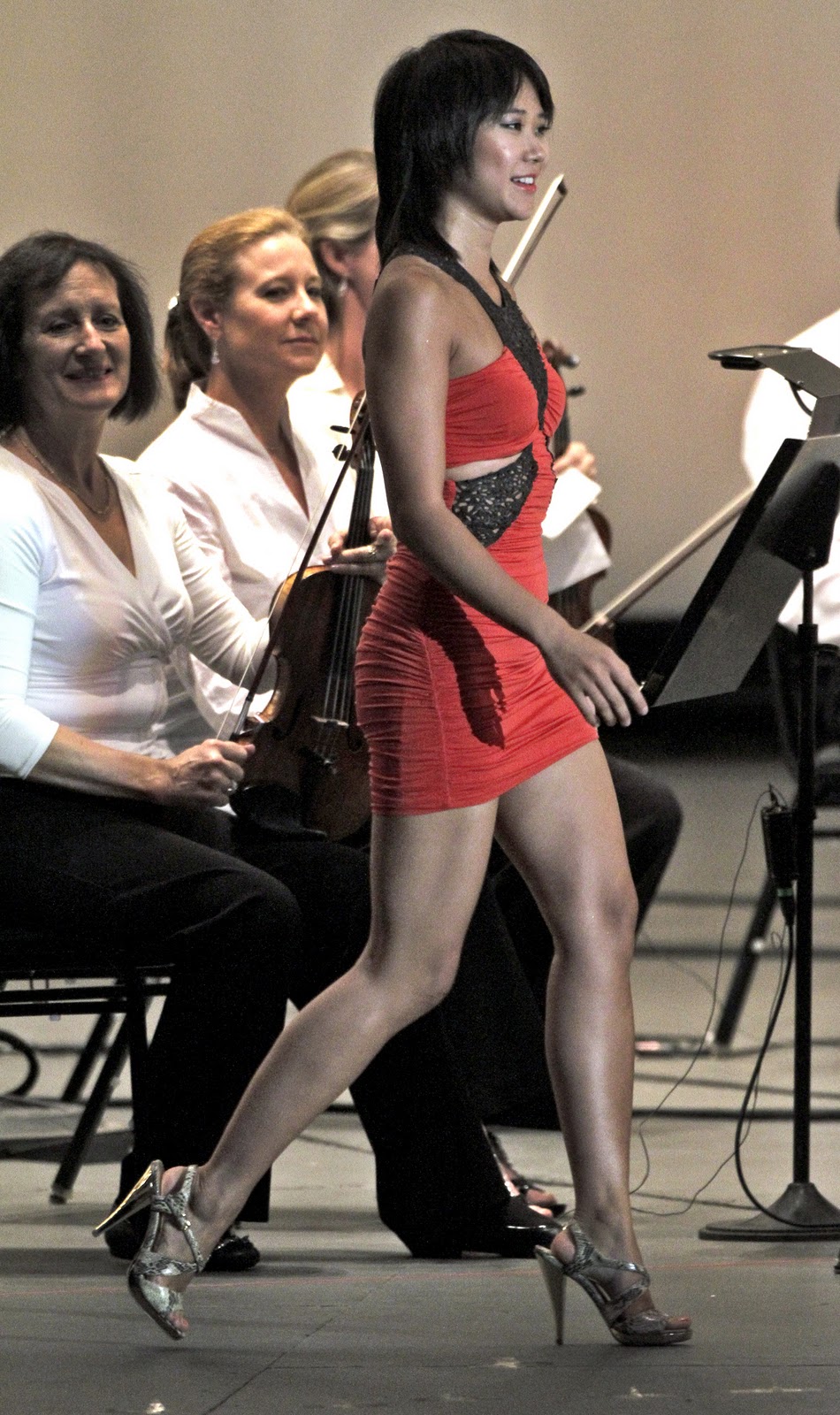
We are inundated, as we always are, by young virtuoso classical musicians. The only difference today is that the young women are wearing micro-minis and the young men are showing off their abs--which makes them typical rising young stars in today's image-obsessed world. Just in case you were wondering, an Australian magazine has kindly assembled The Top Twelve Classical Music Pinups.

But I want to get off that topic, covered in my previous post, and talk about virtuosity and musicality. As an almost-virtuoso myself I have to beware of the dangers of criticizing players for being more virtuoso than I am! So I will try to keep that in check. In truth, I'm not jealous of Pepe Romero and Manuel Barrueco, both sublimely virtuoso players with whom I have studied. Well, just a tad! But they are very different kinds of players from one another and I am a different kind of player myself. Pepe is the kind of player that delights in technical challenges. He really can play anything and I have watched him trying out unfamiliar guitars and his technique just seems effortless. He has an extraordinary and warm tone and terrific velocity. Manuel is a precision player without peer. He has an edged, crystalline tone with clarity and exactitude. I had to laugh watching an interview with our latest guitar virtuoso, Milos, when he made the claim that he is the first to play Granados' Oriental on solo guitar. Manuel recorded it twenty-some years ago--better. I have technical limitations that probably come from starting late on the instrument (anything later than ten years old is a problem!) and from not finding a good teacher until I was into my twenties. But I have certain strengths as well. I have an intuitive grasp of the spectrum of tone-colors and dynamics and a gift for counterpoint.

Virtuosity is partly the physical command of the instrument: you can play fast scales and arpeggios and do it with good tone and in tune. It includes the ability to control dynamics both loud and soft. Musicality is knowing where and why to play loud and soft, what tempo is right, what notes to emphasize and what not. In other words, virtuosity is the ability, musicality the reason. Or in computer terms, virtuosity is like the hardware, musicality the software.

But there is another level that goes beyond both of these. To exemplify it, let me recall a concert I heard by American pianist Stephen Prutsman last season. He had a brilliant idea for a program that interleaved preludes and fugues from the Well-Tempered Clavier with other music from Rameau to Debussy and, in the second half, with non-classical music from jazz to gospel. I had a gas writing program notes for it. But I mention this concert because of one piece. The concert was mostly played with a certain wayward charm and some racing tempos. But when Mr. Prutsman got to La Llorona, a simple Mexican traditional piece about a woman who lost her children, something else appeared. More than anything else in the program, this piece came alive. It was very moving in that way only music can be. During this piece I seem to recall that physically the pianist became more still. In other pieces he moved around a lot. But we, all of us, became captured by the musical beauty of this piece. It is different every time you play, of course. A concert artist can always play with a certain level of virtuosity, though it can be more or less. The same goes for musicality: we have a professional level of ability. But sometimes we are visited by the Muse and the music comes alive in a different way. Perhaps for only one piece in the program, perhaps not at all. Let me hasten to say that this was far from being the most profound piece on the program. But it inspired the player that night and so moved the audience.

What troubles me about the music scene--and I'm not sure it is any different now than it has ever been--is that in an obsession with virtuosity (honestly, fast scales are the most boring of all musical ideas) and with image (I love beautiful women in sexy dresses just like everyone else, but it does tend to distract) we somehow forget that the real reason we listen to music is for the transcendence, for the ecstasy, Greek ἔκστασις (ekstasis) meaning to stand outside yourself.

The ending? Well, yes, Bach did not finish this, the last piece in The Art of Fugue.

Friday, August 12, 2011

Classical Music With a Pop Sensibility

How much has a pop music sensibility invaded the classical music world? Have a look at this article with accompanying photo of pianist Yuja Wang. If you didn't know she was a pianist what would you have guessed? Escapee from a reality TV show? Pole-dancer?


This has been going on for quite a while. Remember Vanessa-Mae?
Her first big album was released in 1995 combining classical and pop music, but she was really a pop musician who played violin, though she started out as a classical musician. More and more these days, though, a pop music sensibility seems to be invading all of classical music. Here is another article. By "pop music sensibility" I suppose I am talking mostly about sexuality. We are always, it seems, looking for the next young thing, but isn't it the case these days that the next young thing, especially if she is female, just always seems to be extremely good-looking? Here is another young pianist:


This is slightly troubling because while the playing is a bit dull, the artist is extremely attractive. I've always had the idea that the performer should not overshadow the piece. But this is hardly a fundamental principle--just a feeling. I do know that how she looks sticks in my mind, but how she plays, in this and other music, does not.

Now what is the probability that all the young stars of today also happen to be very attractive? Surely there must be some stupendous young musicians out there who are rather plain? And if there are, then they seem to be being eliminated somewhere along the line? Is it in school, university or conservatory? At Julliard or Peabody? Or does it happen at the competition level? Faced with two brilliant players do the judges tend to choose the more attractive one because they know their chances of a career are better? Based on my experience with competitions I strongly suspect that the most interesting musician will always place second or third just out of the sheer obtuseness of the judges. So a very beautiful competitor with facility will often win the competition over an interesting musician. That seems to be what Buniatishvili has: facility. Oh, and Yuja Wang, too:

They both sound rather alike to me. Smooth (though not with an entirely even touch), facile and predictable. Good fingers without much actually happening under the surface. In order to confirm this impression--for it is nothing more--I looked for some Beethoven by these artists without much luck, at least on YouTube. But I did find them together doing this:
Now that reminds me of the lesbian scene with Natalie Portman and Mila Kunis from Black Swan. Yes, very, uh, enjoyable. But not a primarily musical experience. Both of these artists seem also to avoid Bach the way vampires avoid holy water. Possibly for similar reasons. It is not very easy for me to decide much about a performer's depth of musical understanding if all they play is music with itself very little depth. But perhaps that's the point.

Oh, I understand the motivation. You have to do whatever you need to, to get noticed in the very competitive musical world of today. It's the same in pop music. But I think that at some point someone ought to point out that a sexy dress and a moving performance are actually different things.

Here is a performance from a famously hip and eccentric pianist from not that long ago:
Sure, I know he played a couple of wrong notes, but it is a musically strong performance of a powerful piece of music (with an interesting and unexpected ornament at the end). Could Friedrich Gulda manage to become known if he appeared today? Or Martha Argerich?

Wednesday, August 10, 2011

Music Criticism

For some reason my previous post on music criticism entitled "The Practice That Dare Not Speak Its Name" has been one of the most popular on the blog. But no-one has left any comments yet so I'm not sure of the reasons. But that would seem enough reason to talk a bit more about music criticism.

As I mentioned before music criticism is at a low ebb. One reason I did not mention is that it may have lost its reputation due to the ham-handed efforts of its defenders--something that classical music itself may be in danger of according to Richard Taruskin as I discuss in this post. Taruskin is an indefatigable musicologist and to my knowledge the most formidable music critic of the day. Most of those labeled 'music critics' are really journalists who talk about concerts and promote events. Actual music criticism is the furthest thing from their minds. Taruskin is the exception. In one lengthy piece in the New York Times he takes apart a popular recent opera by a favorite American composer, John Adams. Here is the article. The composer responded in this piece. You should read both pieces in their entirety. The important quote from John Adams is this:
Taruskin has two modes of writing: his formal musicological work and his 'pop' pieces for the New York Times. In the latter he has made a speciality of character assasination. This makes good copy. It's sort of like watching those tacky 'true crime' shows on television: there must always be a body count at the end, whether the target is Prokofiev, Shostakovich scholars, or anyone else he decides to humiliate. The operative mode for reading his pieces is schadenfreude. Like any true passive-aggressive, he delights in besmirching not only a person's artistic credibility but also in calling into doubt one's whole moral character. I don't think anyone has taken Taruskin's attack on me seriously. I don't think Taruskin himself takes it seriously. It was a rant, a 'riff', an ugly personal attack and an appeal to the worst kind of neo-conservatism in this country. Its musical 'analysis' of my opera wouldn't have stood the test of any of his own PhD candidates. And his logic was astonishing. Those who read the article to the end were treated with the absurd conclusion that while the Taliban might be wrong in banning music, the Boston Symphony was to be commended by cancelling Klinghoffer. One was censorship, the other admirable 'self-control'.
 My conclusion after reading both is that Taruskin makes a detailed and fair argument and the fact that it discusses moral issues does not detract from it in any way. There are obvious moral questions involved. John Adams' riposte however, where he accuses Taruskin of character assassination, is actually a pretty good example of character assassination as he accuses Taruskin of "besmirching [one's] artistic credibility [and] moral character" and of launching "an ugly personal attack". He also called the analysis lacking and the logic astonishing. Now what I notice here is that in Taruskin's discussion of Adams' opera he cites many specific details such as specific scenes in the European vs the American version as well as details of instrumentation and harmony, all to support the points he makes. This is, in my book, good criticism. Adams, in his riposte, counters none of these specifics but just calls Taruskin a passive-aggressive character assassin. It is pretty easy to see who has the credibility.

So there is an example of music criticism. I'll return to this subject in the future.

Tuesday, August 9, 2011

The Case of Chopin

I avoided getting to know the music of Chopin for a long time, largely because, as a guitarist, I never played any of his music. The Spanish guitarist Francisco Tarrega did a great transcription of one of the nocturnes in the late 19th century and an American guitarist recently did the mammoth job of transcribing all of the mazurkas for guitar, a couple of which I have played in concert. Some composer's stars rise and fall, but Chopin's music has been loved ever since it was first heard and on the occasion of his two hundredth anniversary last year, there were many piano recitals featuring Chopin. For some background, have a look at the Wikipedia article.

I finally got acquainted with his music a couple of years ago when I was asked to give a pre-concert talk on Chopin before a piano recital. I gave myself a graduate seminar in Chopin to prepare. I got a complete recording of his piano music--Chopin wrote almost exclusively for piano--and did a lot of listening. I also got several volumes of the scores and read a couple of books on him, one an excellent collection of essays by musicologists. After all this I realized that I had been missing one of the great composers of the 19th century. Chopin was one of the architects of Romantic music and was a huge influence on later composers.


A very few composers in music history create entirely new forms or genres or so utterly transform existing ones that it has the same effect. Chopin is one of these. He completely transformed the scherzo, prelude and nocturne and more or less invented forms like the ballade and impromptu. In his over fifty mazurkas he took a folk tradition and revitalized it. The polonaises are a greatly expanded version of another tradition.

Chopin is a complex figure—he was born on the periphery of European high culture so was less bound by its forms than composers like Bach or Beethoven who spent their entire lives in the heart of the great European traditions. Chopin absorbed these traditions and made them his own but did so very freely. 

A virtuoso pianist, during his short life Chopin only played some thirty public concerts, nearly all of them with other artists. He preferred the ‘salon’, which refers to the interesting social phenomenon, characteristic of Paris, of intimate gatherings of like-minded people to discuss, banter, socialize and experience things of shared interest which would certainly include poetry and music. Chopin was the great master of the salon. Counted as one of the great romantic composers, Chopin himself had little regard for his contemporaries, reserving his admiration for the great classic masters Bach, Handel and Mozart.

Chopin grew up with Bach’s monumental collection of preludes and fugues in all the keys, the Well-Tempered Clavier—as have all classical musicians for the last 250 years! What Bach did was to go beyond all his models both in quality and in the variety of different styles he used. Similarly, Chopin, while owing much to his models, also went far beyond. The main influences on Chopin besides Bach are the melodies of Italian opera, the music of Poland he heard in his youth and the 'brilliant' piano style popular in the early 19th century. We find Bachian counterpoint lurking everywhere in Chopin's music along with operatic melodic decoration, Polish rhythms and brilliant figuration. But he united these things into an absolutely distinctive musical style.

Chopin was a great harmonist: he left behind the Classical clarity and tension between dominant and tonic, substituting instead more ambiguous relations for the sake of color and atmosphere. Here is a magical example:

But in the Berceuse in D flat major, he takes a different approach, contrasting the 'painful simplicity' (in the words of Charles Rosen) of the accompaniment with the freedom of the right hand:


This is my favorite--quite untypical--mazurka:


Let's close with one of Chopin's larger works, the 4th Ballade in F minor. It combines all the elements I have been talking about: the shifting harmonies (it starts by deceiving the listener about what key it is in), imitative counterpoint, brilliant passages, soaring melodies and even a hint of polonaise texture. The opening creates a dreamlike, floating atmosphere through a harmonic ambiguity that previous composers would have avoided. Themes return almost without being noticed and are varied mysteriously—this is a rare blend of complexity hidden within simplicity. The 4th Ballade is one of the greatest piano works of the 19th century.


Monday, August 8, 2011

Talking to the Audience

This is a postscript to the last post on the Miro Quartet concert. As has become customary, it seems, one of the members, the violist, gave lengthy introductions to two of the three pieces on the program. Lengthy meaning perhaps three or four minutes. As the writer of the program notes, there wasn't much for me, but perhaps it was helpful to those people who hadn't had time to read the notes. But he did get one of his facts wrong: it wasn't the cathedral in Toledo that commissioned Haydn's music, it was Cadiz.

When I was a young recitalist, it was considered a bit gauche to chat with the audience. It tended to erode the mystery of the music. But as time went on, that became passe and the cool thing to do was to speak directly to the audience. I do it all the time myself. Alas, sometimes the talking is a bad idea. In the case of a concert by a fine quartet whose every piece was preceded by remarks from their leader, a Russian with an impossibly thick accent, we could barely make out what he was saying, which was clumsy and pointless in any case.

I think it may be time to re-think all this talking. The reason I write program notes, which I do for over thirty concerts a year, is so the players don't have to try and think of what to say. It leaves them free to concentrate on the music. Properly researched and written program notes should also be much better than off-the-cuff remarks. Let's just get to the music, shall we? I often find myself squirming in my seat as some performer drones on, making unnecessary and often mistaken comments on the piece he is about to play.

And while we are at it, if we are not going to wear formal concert garb any more, can we at least refrain from do-rags? No, the Miro Quartet were not sporting this item of apparel, but it's been done...

Miro Quartet in Concert

Living where I do, I don't see a lot of concerts, but Saturday night I went to see the Miro Quartet play in our chamber music festival. I wrote the program notes for all eleven of the premier series concerts and several people came up to say very nice things about them. The Miro Quartet, based in Austin, TX, gave four programs including everything from Haydn to Brahms to Philip Glass to a tango by Carlos Gardel. Saturday was the darkest of the four with three pieces all, in one way or the other, meditations on death. They began with Puccini's single movement Crisantemi, an elegy on the death of the Duke of Savoy. The rest of the first half was the 14th String Quartet by Shostakovich, his next to last. Much late Shostakovich seems to be a meditation on mortality and this is no different. In places it is music of a searing intensity, relieved by passages of Shostakovich's trademark sardonic grotesquerie. As I said to my composition student afterward, what always fascinates me about Shostakovich is his ability to write music that is certainly tonal, while at the same time avoiding all the easily discernible devices of the past: the audible sequences, familiar progressions and so on. I'm sure the Russian modes have something to do with it, but we will be analyzing Shostakovich for the next hundred years.

The second half of the concert was the Seven Last Words of Christ, commissioned by a canon of the Cathedral of Cadiz, by Haydn. A very unusual work, it consists of an overture and seven slow movements followed by a Presto earthquake for finale. It is fascinating to hear how Haydn manages to retain our interest despite the limitations. I often think that severe restrictions like this, or like those Bach imposes on himself in the Art of Fugue actually are a creative inspiration for composers. While mere self-indulgence in the name of creative freedom often leads to some rather bad music. I think that's what went wrong in the 19th century.

Let's listen to some of this music. First, Puccini:


Here are the three movements of the Shostakovich:


Finally, the Haydn:

Well, the first movement anyway. It takes a lot of digging to get all the movements and put them in the correct order, so I'll leave that up to you, gentle reader!

What do you think of this as a program? I'll confess that the reason I picked this program to attend over a number of others was twofold: there was a Shostakovich quartet and I will always go to hear that, and secondly, there was not a long 19th century quartet on the program. I just don't enjoy the lengthy meanderings of the Romantics in string quartets. They did very well with songs and orchestral music, but I find their efforts in chamber music, yes, even Schubert and Brahms, to be flabby and interminable. But none of that on this program, instead, Haydn. Very impressive piece, formerly more popular than it is now.

I would love to hear your thoughts on the program, so feel free. Oh, the quartet played very well. I thought some of the pizzicati were a little out of tune, but they played with both grace and passion and you can't ask for much more.