Thursday, December 6, 2018

Recording in Toronto

I am in Toronto for the next few days recording two pieces with violin. While I am here I will take a few photos and share some experiences with you. In the planning for a good part of a year, over the next few days we will hopefully get good performances of two recent pieces of mine recorded. We used to say "in the can" or "on tape" or maybe "on vinyl" none of which longer apply. "On hard drive" just seems odd.

Anyway, I got in late last night on an Aeromexico flight which, apart from leaving a half-hour late, was excellent. I have been worried about my guitar ever since I booked the flight a few months ago. As I have mentioned before, my instrument was built by Robert Holroyd in Vancouver in 1983 and it has been my sole instrument ever since, undergoing a couple of repairs and restorations over the years. It is a superb guitar and irreplaceable since Bob passed away decades ago. I will not let it travel in cargo. My travel agent assured me that the policy on Aeromexico was that musical instruments can travel as carryon luggage as long as the case is less than 1.15 meters in length (which I guess lets out cellists). My case is 1.07 meters, so I should be good. But I was extremely apprehensive because of many bad experiences over the years where I was often lied to and sometimes forced to check my guitar. When I showed up for checkin in Mexico City yesterday there was no problem. I held up my guitar case saying, "this is my carryon" and they simply said," that's a guitar?" and waved me on. It came to me that all the bad experiences I had back when I was touring, were with Canadian airlines, who seemed to actually hate guitars.

Seated next to me on the flight was a gentleman who commented on my case and asked me if I was a classical guitarist. He turned out to be a Mexican guitarist who just started teaching at the University of Toronto and he gave me a copy of a recent album he recorded that I will review when I can get to it. So that was a nice coincidence.

I got in very late last night--it was snowing lightly and around 0 degrees (32 Fahrenheit), but the hotel folks were very nice. That is the first thing I notice, Canadians are polite to a fault! Now, yes, I do realize that I am in fact Canadian, born and raised, but I have not actually lived in English Canada for the last twenty-eight years so I do feel a distance from English Canadian culture. The first eight of those years were in Quebec, which is quite different, and the last twenty in Mexico, which is really different. It is fascinating to view one's own culture from the outside, as it were, which is what I am doing. I have never spent much time in Ontario (apart from a summer back in the 80s) and I have not been in Toronto since around 2000. One of my first goals will be to see if I can find some Montreal smoked meat!

I am writing this on a new laptop, an Acer 15.6 inch Chromebook that I purchased from Amazon for $213. Yes, not a misprint. There was a charge for shipping and import duties to Mexico, but not that much really. Why so cheap? Chromebooks are much cheaper because they do not include hefty fees for the Windows operating system. They take some getting used to because they do not run any of the usual programs, but for web browsing they are perfect and you can use Google docs instead of the usual Office programs. I find that, for most purposes, they are ideal. They boot up in a few seconds and shut down instantly. This is the third one I have owned and I love them when I travel. My Macbook Pro is a bit too heavy. Plus, 15.6 is a lot of screen on a laptop, which I appreciate. I can't do any composing on it as it will not run Finale. I should look and see if there is any music software available.

I managed to completely forget all of my charging cables so I will have to ration my computer time. It says that the average battery life is twelve hours (!) so that gives me two hours a day as I charged it up before I left. Fingers crossed! My iPhone is going to die a lot sooner, so I am going to leave it turned off most of the time. Why did I forget the cables, which I usually remember? I think it was because I was mostly focused on packing everything I needed for the recording. I haven't traveled with my guitar for twenty years so there was a lot to remember:

  • guitar
  • extra sets of strings (2)
  • sandpaper (2 kinds) for the nails
  • polishing board for the nails and nail file
  • clipper for the strings if I have to put a new one on
  • metronome/tuner
  • scores for both pieces
  • music stand
  • foot rest
Often the most challenging part of being a musician is simply the logistics of getting there with everything you need.

I am staying in a Marriot just a couple of blocks from the CBC building where we are going to be recording and while a modest, older hotel is quite suitable. The room is great--it has a kitchenette with a fridge, stovetop, dishwasher and kitchenware so I can actually cook here. I wonder if I can find a decent bagel? I am told I have to visit the Kensington Market, which I vaguely remember from years ago. I won't be here very long and every day involves either rehearsing, recording or editing, but maybe I can fit that in.

And now, time for breakfast!

Monday, December 3, 2018

Best Albums of the Year?

We live in a time when criticism, music criticism in particular, is abhorred. Ok, let's go with that. If you don't have criticism, which has to be some sort of bigotry: sexist, colonialist, oppressive, exclusionist, etc, then you have wide open doors and windows, let the sunshine in! In practical terms this means that, as we find from Ted Gioia, you just give a long, long list of everything under the sun: The 100 Best Recordings of 2018. Not only that, but there is a long list of also-rans. Just reading the list makes me tired. So is this any kind of service to the listener? Maybe, let's listen to a few samples. Number two on the list is Marisa Anderson: Cloud Corner, described as "Serene Folk Guitar Instrumentals from Portland"


Uh, ok. Fairly harmless, but I have heard pretty much exactly this dozens of times before. So nothing special. I only skipped the first one because it was described as "Contemporary Soul/R&B Influenced by Billie Holiday, Etta James, Nina Simone" and I have heard lots of that before. The third one is Mark Applebaum: Speed Dating, described as "Experimental Spoken Word Music / Contemporary Classical Music" Blogger won't embed, so follow the link for "3 Unlikely Corporate Sponsorships: No. 1, Nestlé"


This is a polyphonic version of Kurt Schwitters Ursonate mixed up with Tom Waits "Step Right Up" in a special version for kindergarten. Number four is Typh Barrow: Raw, described as the Belgian Amy Winehouse.


Pretty typical soul/blues to my ear, but with a nicely gravelly voice. Number five looks really promising: Thomas Bartlett and Nico Muhly: Peter Pears: Balinese Ceremonial Music, described as "Gamelan Transcriptions and Contemporary Songs Inspired by Them" Oh dear, imagine my disappointment when what I hear is gamelan reduced to kind of bland new age music with dreary breathy semi-spoken vocals. I would describe this as road trip music for overstimulated folks who really need to calm down.


And besides isn't this the worst kind of cultural appropriation?

I could go on, but all this seems to prove is that 90% of everything really is crap. If Ted Gioia had actually done the proper job of a music critic and tried to pick the ten good ones out of the hundred, now that would have been a public service. And we could have some good arguments about it. But as it is, in this post-critical wasteland, he makes no critical judgements so you have struggle through the whole bloody list to find the few gems that might lie within. How marvelous.

UPDATE: Just to be fair, this is Ted Gioia's reason for presenting the list as it is:
I am listing my top 100 and honorable
mention albums for 2018 in alphabetical
order, rather than ranking them. This
marks a change from pre-2017 lists. I
am doing this because each of these
albums deserves recognition and the
sequential ranking tended to focus
too much attention on just a few
recordings.
Each of these albums deserves equal recognition? Why is that exactly? How delightfully egalitarian.

Everything Has Already Been Done

Here is a video by producer Rick Beato with guest Rhett Shull asking "Has every song been written?"


I think that this is really a genre question: the more tightly restricted a genre becomes, the more pieces written in that genre come to resemble one another. This could be Viennese minuets, San Francisco psychedelia or current pop songs. The first example in the video is of exactly the same chord progression used by Marvin Gaye and Ed Sheeran over which different melodies and lyrics are heard. What we have now is a kind of industrial songwriting process vaguely similar to the process of making sausages or hot dogs. The process is similar and the end result is similar. This is actually a plus because in the pop environment the listeners tend to like stuff similar to other stuff they like, so the more homogenous the product, the more likely it will be accepted. On the other hand, the danger is always present that too much homogeneity will cause boredom and rejection. You want to give the listeners exactly what they expect, with a little spice of difference.

But then you get critics, like these guys, or me, saying "hey, you're just regurgitating what has already been done." Hilariously, there was a critic back in the 16th century, if I recall correctly, who was claiming that all the contrapuntal ideas and combinations had already been tried. Two hundred years before Bach! And then Shostakovich, in the 1950s, proved all over again that even in the genre of keyboard fugues, you could still come up with lots of new ideas. (Domenico Scarlatti managed to write 555 sonatas for harpsichord between 2 and 6 minutes in length without ever repeating himself.)

Creativity is a very remarkable thing because someone can come along, and with one tiny change, or a whole bunch of them, or one or more big changes, they can transform a whole genre, create a new mood or perspective and thereby renew a whole area of music. DuFay did it in the 15th century, Monteverdi did it in the 16th century, Bach did it in the 17th century, Haydn did it in the 18th century, Chopin did it in the 19th century, Stravinsky did it in the 20th century and so on.

And at the same time, every one of these composers used a whole lot of traditional material, they just transformed it without throwing it away.

For an envoi, here is the ballade by Guillaume DuFay, "Se la face ay pale."


Sunday, December 2, 2018

One Year in the Studio, part 1

I just read a little essay by Simon Leys on the book, published in 1840, by Richard Henry Dana, jr., Two Years Before the Mast about the time he spent as a common sailor on a two year voyage from Boston to California. For some reason, this sparked the idea of doing a little series of posts on a transformative experience in my life. I have mentioned this before a few times, but my career as a musician really took flight when I went to Spain in 1974 and spent the better part of a year studying with the maestro José Tomás in Alicante on the Mediterranean coast. This experience ended up shaping my life in so many ways that I want to go into it in more detail.

By way of context, I should mention that I was born in thinly-populated and isolated northern Canada and, were it not for a move to Vancouver Island in 1965 when my mother took a new job there, I likely would never have had much exposure to classical music. Who knows where I would have ended up: fertilizer salesman would be my guess! But the move did ensue and it involved entering a whole new world. Even the landscape was utterly different from this:

Click to enlarge
And this:

Click to enlarge
(Yes, even identifying which car is yours can be a challenge.)

To this:

Click to enlarge
Yes, there really are trees that big. It was also my first encounter with the ocean:

Click to enlarge
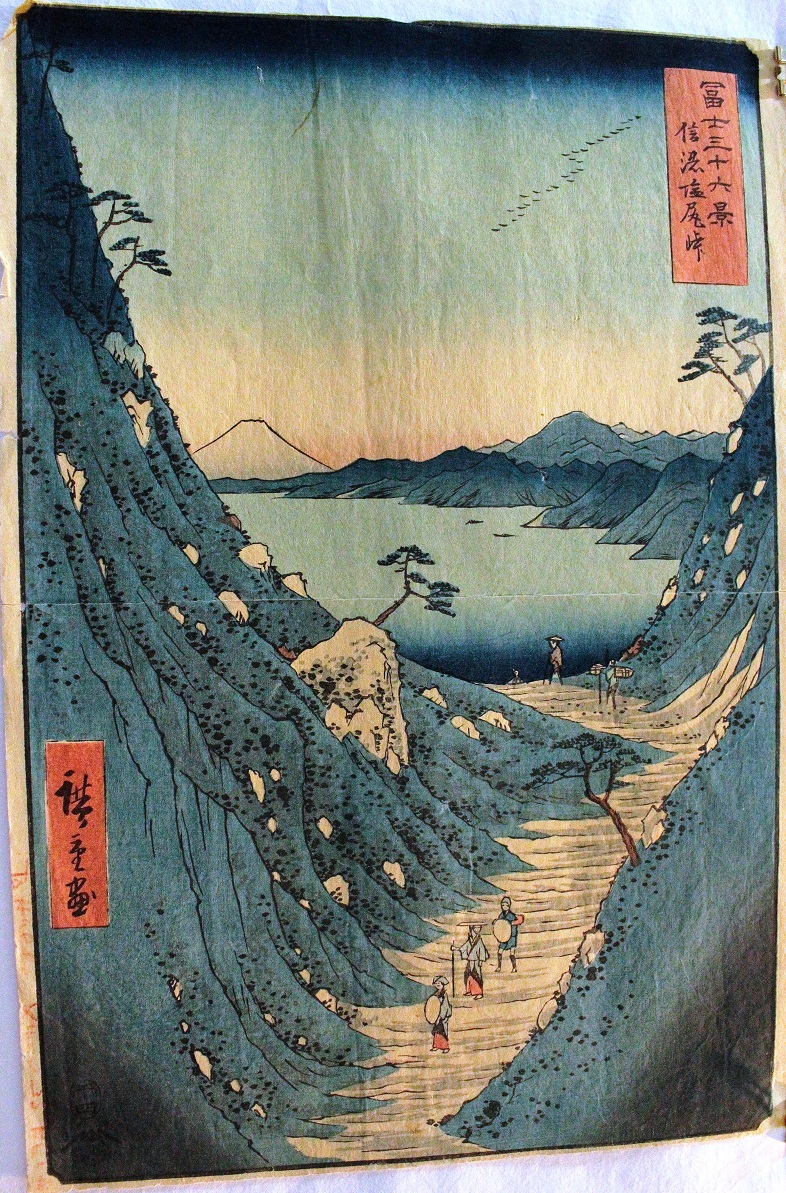
The physical environment was both less harsh and more dramatic. I also started to encounter an Asian aesthetic. For one thing, all the cafes and corner stores were owned by Chinese people and there were some interesting books in the library. I was particularly attracted to the Japanese woodcuts known as ukiyo-e.


After all, if you look out west from the coast of British Columbia, the next body of land is probably Japan.

So that was one big transition. We are all a mixture of nature and nurture. How much of which characteristics are due to each is a matter of continuing controversy. But it is likely the case that while your basic qualities come from your inherited genes, how or whether these qualities are developed is influenced to a large degree by your environment. No-one raised in a cellar is likely to grow up to be a landscape watercolorist.

This likely gives us a theory as to why there are, in certain places and times an upsurging of creative energy such as in 5th and 4th century BC Athens or northern Italy in the 15th and 16th centuries or England in the 16th and 18th centuries and so on. There were enough resources available and a critical mass of creative talent attracted by them to elevate a lot of lesser talents to significant achievements as well.

Next time I will talk about my encounters with music and what they led to.

I have an interesting envoi. The only musician of any renown who came from the small town in northern BC that I lived in is Roy Forbes who performs as BIM. Here is a tune in the Canadian folk-music/country tradition. If I had stayed in the north, this would likely have been the only musical path available to me.


Friday, November 30, 2018

Friday Miscellanea

Here is your Friday whimsy (though not, perhaps, for the artists pictured): The Worst Album Covers Ever Created. My favorites:


* * *

And on a completely different note, I am reading Paul Johnson's Art: A New History every morning and enjoying it hugely. I am in the Middle Ages now. He says that the cathedrals and churches of Europe are likely the greatest body of art ever created in the history of civilization. The illustrations are a bit meagre, so I find myself going to Wikipedia and looking up examples there. I have to admit that, prominent though they are, I have never had much interest in either cathedrals or architecture, but he is probably correct. Here are a couple of examples:

St. Andrews Cross arches from Wells Cathedral, Somerset, mid-14th century
Interior of the cathedral of Sevilla, 15th century
And there are hundreds of others. It took a significant part of the GDP of various nations and hundreds of years of creative effort to build these astonishing structures. Of course, every time I look at these images I start to imagine the music that would have been (and is) performed therein.

* * *

The blog On An Overgrown Path has a biting little post citing an example of musical hypocrisy: What happened to the native Tibetan people, Mr. Barenboim?
Norman Lebrecht reports that at his recent Sydney concert with the Staatskapelle Berlin Daniel Barenboim dedicated the performance to the memory of ‘native’ Australians. The conductor then went on to say "Any country in the world needs to account for its past before being able to be accepted into a society of nations". 
Immediately prior to the Sydney concert Barenboim had given three performances with the Staatskapelle Berlin in Beijing.
Of course, Mr. Barenboim made no mention there of the destruction of Tibetan culture and religion under the rule of China. So, any country in the world except China?

* * *

A musicologist uncovers song arrangements from a most unlikely place: Auschwitz.
Patricia Hall went to the Auschwitz-Birkenau Museum in 2016 hoping to learn more about the music performed by prisoners in World War II death camps.
The University of Michigan music theory professor heard there were manuscripts, but she was "completely thrown" by what she found in the card catalogs: Unexpectedly upbeat and popular songs titles that translated to "The Most Beautiful Time of Life" and "Sing a Song When You're Sad," among others. More detective work during subsequent trips to the Polish museum over the next two years led her to several handwritten manuscripts arranged and performed by the prisoners
I knew personally a musician who was sent to Auschwitz and survived: violinist Paul Kling.

* * *

I mentioned a while back that they are preparing for the return of Glenn Gould to the concert stage in the form of a hologram. Based on the Maria Callas hologram concert, you may want to skip it.
Heavily glossed with reverb, the amplified orchestra-with-no-name chugged joylessly through repertoire that the real Callas had recorded with the Philharmonia and the Orchestra del Teatro alla Scala di Milano under conductors such as Serafin, Prêtre and Giulini. Equalised at the mixing desk to a degree that stripped this distinctive voice of its tannic, acidic extremes and smudged the meticulous artistry of the phrasing, Norma’s Casta diva, Lady Macbeth’s Vieni, t’affretta and even Ophelia’s Á vos jeux, mes amis acquired a dull, tranquillised haze, as did we.
The trouble with holograms is that they cannot respond to a live audience….
Well, not the only trouble!

* * *

In our continuing series on odd or unusual musical instruments I offer the lithophones!
“The rocks were first selected for their acoustical properties,” said Martorano,”and then they had to be made into a certain shape. What the material is matters, what the ends are shaped like matters. Then how they are held and what they are played with matters.” Martorano demonstrated the different tones achieved by hitting the lithophones with wood, antler and bone. The lithophones produce sounds ranging from the sound of tapping on a crystal glass, to a wooden marimba, to a xylophone.
“Out of the 22 artifacts we studied, we got a minimum of 57 notes out of them. That’s at least two different notes from each stone,” Martorano said, adding that “56 percent of the notes made by the stones are the notes played on the black keys of the piano--the pentatonics. Those are the most commonly used scales in music in civilized societies around the world.”
* * *

Alex Ross has a new piece at The New Yorker celebrating the Los Angeles Philharmonic:
“Season of the Century” is the slogan that the Los Angeles Philharmonic is using to tout its centennial season. The phrase is emblazoned on a sign outside Disney Hall and on street banners across the city. The double meaning is apparent: not only is this season intended to celebrate the orchestra’s past hundred years; it aims to make history itself. Ordinarily, such marketing effusions don’t withstand scrutiny, but the L.A. Phil’s 2018-19 season invites superlatives. The ensemble has commissioned pieces from more than fifty composers, ranging from such venerable figures as Philip Glass and Steve Reich to young radicals on the fringes. It is launching a slew of theatrical events and collaborations with pop and jazz artists. It is honoring African-American traditions and exploring the experimental legacy of the Fluxus movement. Gustavo Dudamel, the orchestra’s music director, is leading new works by John Adams and Thomas Adès. Esa-Pekka Salonen, the orchestra’s previous director, is presenting a nine-day Stravinsky festival. Meredith Monk’s opera “atlas,” from 1991, will receive a long-awaited revival. And so on. No classical institution in the world rivals the L.A. Phil in breadth of vision.
Now if only I knew what the phrase "breadth of vision" was meant to convey other than "lots of different stuff"?

* * *

 It's always always always about creating a straw man in order to establish equity in outcome: In the key of F: Harriet Harman on why musical creativity is not a male preserve.
Creativity is a miracle and a blessing that needs to be nurtured and celebrated wherever it springs from. And a diversity of creators only enhances and deepens the creative landscape. So, as chair of Trinity Laban Conservatoire of Music & Dance, I was delighted to hear about its Venus Blazing programme which, in the centenary year of women getting the vote, is setting itself the challenge of discovering and celebrating women composers of the past, and opening a path for women composers of the future.
The programme, which began last month, is a year-long initiative with a twofold promise. Across the more than 60 concerts and opera performances given by the Conservatoire’s major performing groups this academic year, at least half of the programme will be music written by female composers. We will thus have the chance to hear renaissance madrigals, 1970s jazz, 19th-century symphonies and 20th-century string quartets and operas, all of which have been neglected largely because the person who created them was a woman.
These articles always follow the same dreary form of argument:
  • open with an innocuous cliché
  • assert the importance of diversity
  • mention which oppressed group will be favored
  • state the means of righting an historic bias
  • end by restating the principle that if a particular group has had less historic prominence it is solely due to bigotry
  • and you're done!
You should notice that the assumptions are never argued for but always assumed--if you are a virtuous person you will just have to accept them. Notice also how the very opening contains a lovely contradiction: creativity must be nurtured wherever it springs from, so we are going to create a quota system to make sure that half of the creativity we nurture springs from women.

* * *

 For our envoi, let's have some music that might have been performed in those two cathedrals pictured above. First the Kyrie Cuthberte from around 1280:


This is Adorámoste Señor by Francisco de la Torre (fl. 1483 - 1504):


He was a singer in the cathedral in Sevilla from 1464 to 1467.

Friday, November 23, 2018

Friday Miscellanea

Let's start with some whimsy:


* * *

Every now and then when I am talking about aesthetics I scrounge around for an example of bad music. I am typically unsuccessful because searching for "bad music" on YouTube usually doesn't get what I am looking for. You get tunes by Lady Gaga and Michael Jackson, for example. But I just ran across a good example of bad music, pop ballad sub-category. This is "I Like Dreamin'" by Kenny Nolan and for sheer regurgitated style, maudlin sentiment and gratuitous arrangement, it rates some sort of award:


You have to listen to songs by Tom Waits, Bob Dylan and Leonard Cohen just to clean out your ears after.

* * *

Here is a cool clip on the contrabassoon:


* * *

Fellow music blogger Wenatchee the Hatchet has a lengthy and interesting post on the last Beethoven piano sonata, op. 111 (that we just heard in a recital this week):
Thousands of words have already been written about Beethoven's last piano sonata and I hardly feel like I need to write too many more, although I probably could.  Some composers are drawn to the giant variation-finale and it's a wonderful movement, too.  But I admit that as a guitarist who started by aspiring to play Pinkfloyd and Bob Dylan songs I'm a sucker for the mercurial first movement.
What makes the sonata movement so fascinating to me decades after I first heard it and read through the score listening to Brendel's recording back in college was how Beethoven seemed to have such a puny development section.  Supposedly sonata forms are supposed to have a development section that shows how much a composer can do with thematic materials.  Beethoven, so to speak, was the composer who began to "biggie size" developments and codas in sonata forms.
Keep reading as he makes a lot of interesting observations.

* * *

The New Yorker embarks on an entirely predictable crusade: The Myth of Whiteness in Classical Sculpture. The subhead tells it all:
Greek and Roman statues were often painted, but assumptions about race and aesthetics have suppressed this truth. Now scholars are making a color correction.
Yes, and bronze statues often had painted marble eyes (usually missing), something that has been noticed forever, does that mean that race and aesthetics have suppressed this truth?

The Artemision Bronze, notice the missing eyeballs
 Just for the record, scholars have long known that Greek statuary was often painted from traces on a few surviving examples, plus innumerable mentions in literature. The Greeks also did monumental statues of gods and goddesses such as the statue of Athena, Athena Parthenos, made for the Parthenon in Athens that were quite colorful from the various precious materials used. Wikipedia describes it as follows:
The statue was 26 cubits (around 11.5 m (37 ft 9 in)) tall and stood on a pedestal measuring 4 by 8 metres.[10] The sculpture was assembled on a wooden core, covered with shaped bronze plates covered in turn with removable gold plates, save for the ivory surfaces of the goddess's face and arms; the gold weighed 44 talents, the equivalent of about 1,100 kilograms (2,400 lb); the Athena Parthenos embodied a sizeable part of the treasury of Athens.[11]
According to Ian Jenkins in The Parthenon and Its Sculpturees "Athena was portrayed as a warrior resting after successful combat. A figure of winged victory alighted on the palm of her outstretched right hand, while her left hand supported a round shield. A spear rested against her left shoulder. The goddess was draped in the simplest form of tunic, the peplos, her shoulders and chest hung with the aegis, the snake fringed, fish-scaled poncho that had been the gift of her father Zeus and had protective powers"
Myth of whiteness? You know, this might be slightly more plausible if progressive social justice warriors were not engaged in an all-out assault on "whiteness" demonstrating quite clearly that they are the biggest racists around.

 * * *

2018 being the centenary of the death of Claude Debussy, there are a lot of concerts and publications in his honor. The New York Review of Books has a review of Debussy: A Painter in Sound by Stephen Walsh.
Perhaps most impressively, Walsh has managed the rare tightrope act of describing and analyzing widely beloved music in ways that will neither seem simplistic to connoisseurs nor confuse a general audience.
Walsh also makes the astute decision to focus on Debussy’s music, rather than on his social life, precisely to the degree that Debussy himself neglected personal obligations in favor of the inner world of his work. Walsh announces in his introduction that he has set out “to treat Debussy’s music as the crucial expression of his intellectual life”; he has an understandable horror of his book amounting to “a slightly annoying series of incidents.”
Thank goodness for that.

* * *

You may have noticed that I have a fascination for odd musical instruments and this one is the oddest of all: Back from the brink: Jean Tinguely’s beloved music machine.
A year after it was silenced, Jean Tinguely’s beloved clanging, banging, creaking, groaning music machine Méta-Harmonie II is ready to go back into action at the Museum Tinguely in Basel following a laborious year-long restoration of many of its parts.
Conceived as a kinetic sound sculpture and built by the artist with his associates in 1979, the work is one of four large-scale Méta-Harmonie machines created by Tinguely and has resided at the museum on permanent loan from the Emanuel Hoffman Foundation since 1996. Made of scrap metal and musical instruments held together by hundreds of screws, bolts, belts and springs, the work also consists of playful objects like a plastic Disney figurine and a child’s shoe.
* * *

And while we are on the subject, an old friend of mine dropped by this week to show off his 9-string guitar which he designed himself:

Click to enlarge
 In the middle are the standard six strings tuned EADGBE. Above this is a high A string and below this are two extra bass strings, the lowest of which is a low F#. The idea is to enable the playing of more complex contrapuntal music.

* * *

And on a sad note, the last classical record store in Vancouver is shutting its doors: "For the sake of a couple of bucks, they deserted us": Vancouver's last classical record store to close.
For decades, Sikora's Classical Records has been the go-to place for classical music lovers in Vancouver — but now, after 40 years, the beloved downtown business is closing its doors.
The store houses a remarkable number of titles — roughly 15,000 albums and thousands of CDs. To get a sense of just how expansive their collection is, they have 16 bins of Bach CDs alone, and 13 of Beethoven. They also have an impressive jazz collection.
The shop wasn't only a place to buy records; it was also a focal point for the classical community, and in addition to the many regulars, Sikora's drew classical-loving travelers from around the world, as well as artists from Ben Heppner to Marc-André Hamelin to Elton John.
But in today's music landscape, online monoliths such as Spotify and Amazon rule, and now even the small independent retailers who have managed to stay afloat through two decades of change are vanishing.
I remember visiting Sikora's on a number of occasions when I lived in the area. It was close to an excellent music store, Ward's Music, where I spent hours browsing through scores. I wonder if it has survived?

* * *

Tomás de Sancta Maria was a 16th century organist and theorist and I mention him because my friend with the unusual guitar has been studying him for quite a while. Tomás wrote an authoritative text on how to improvise and ornament fantasias (which I used freely to ornament some fantasias by Luys Milan) and my friend has been transcribing examples from the treatise. He is playing one of his own glosses in the photo. Here is a fantasia played on the organ of Salamanca Cathedral, parts of which date to the 16th century:


Thursday, November 22, 2018

Art: A New History by Paul Johnson

I'm a great reader but in recent years I have noticed that too much of my reading is casual browsing of the Internet. I browse several newspapers every morning then a dozen blogs. Along with email and text messages, that takes a lot of time. I read on my Kindle as well, but that is usually light fiction (though I have been re-reading Basic Economics by Thomas Sowell recently). So when Paul Johnson came to mind recently I decided to commit to re-reading his excellent Art: A New History which I will be doing an hour each morning. It is a large, splendid book though lacking, for budgetary reasons a lot of scholarly apparatus like footnotes and bibliography. But it does have an index. It is very readable and written from what I think is a reasonable point of view--that is, it is not all about identity politics, political correctness and who oppressed whom. It is, instead, a well-researched survey of art in human history attempting to see each civilization and culture from the inside on its own terms while not shying away from aesthetic evaluation. Re-reading it now (I first read it over a decade ago as it was published in 2003) I delight in immersing myself in the art of distant times and cultures. When we ignore history, as we seem to be doing now, we grossly impoverish ourselves. Here is one of the excellent illustrations: the pharoah Mycerenus, his goddess-mentor and wife.


Ancient Egyptian artists were not very individual as they followed, for thousands of years, a very strict set of aesthetic conventions, but they were masterful stone carvers.

I see that the book seems to be out of print, but you can purchase a used hardcover copy very cheaply at Amazon.